Rosetta operations
Editor's note: This page is no longer being updated, but will be preserved as a record. Click here for the latest information on Rosetta.
Rosetta is an ESA cornerstone mission to chase, go into orbit around, and land on a comet. It is studying the Jupiter-family comet 67P/Churyumov-Gerasimenko with a combination of remote sensing and in situ measurements. The spacecraft arrived at the comet on 6 August 2014 following a 10-year journey through the Solar System. Between August and November 2014, the spacecraft orbited the comet and gathered data to characterise the environment and the comet nucleus.
On 12 November 2014, Rosetta's lander Philae was deployed to the surface. Philae carries a suite of instruments for imaging and sampling the comet nucleus. The Rosetta orbiter will track the comet through perihelion (August 2015), examining its behaviour before, during and after closet approach. The mission ended in a controlled landing on the comet's surface on 30 September 2016.
The Rosetta mission was approved in November 1993 as the Planetary Cornerstone Mission in ESA's long-term space science programme. The mission goal was initially set for a rendezvous with Comet 46 P/Wirtanen. After postponement of the initial launch, a new target was set: Comet 67 P/Churyumov-Gerasimenko. On its 10-year journey to the comet, the spacecraft also passed by two asteroids.
Rosetta's main objective is to rendezvous with and enter orbit around Comet 67P/Churyumov-Gerasimenko, performing observations of the comet's nucleus and coma. During the period that Rosetta orbits the comet, 67P/Churyumov-Gerasimenko will reach the closest point to the Sun in its orbit, on 13 August 2015. On 12 November 2014, at 17:32 GMT, Rosetta's Philae lander made the first-ever landing on a comet.
| ROLE | Comet exploration/landing |
| LAUNCH DATE | 2 Mar 2004 |
| LAUNCHER/LOCATION | Ariane 5/Kourou, French Guiana |
| LAUNCH MASS | 3000 kg |
| ORBIT | Highly complex; 3 Earth & 1 Mars gravity assists en route; arrived at comet 67P/C-G on 6 Aug 2014 |
| COMET LANDING | DLR-operated Philae lander made first-ever comet landing 12 Nov 2014 |
| NOMINAL MISSION | 30 September 2016 |
| + Rosetta now tracking 67P/C-G as it orbits the Sun – its lander Philae made the first-ever landing on a comet + | |
The Rosetta Mission Operations Centre (MOC) is located at ESOC, Darmstadt, Germany.
The Flight Control Team
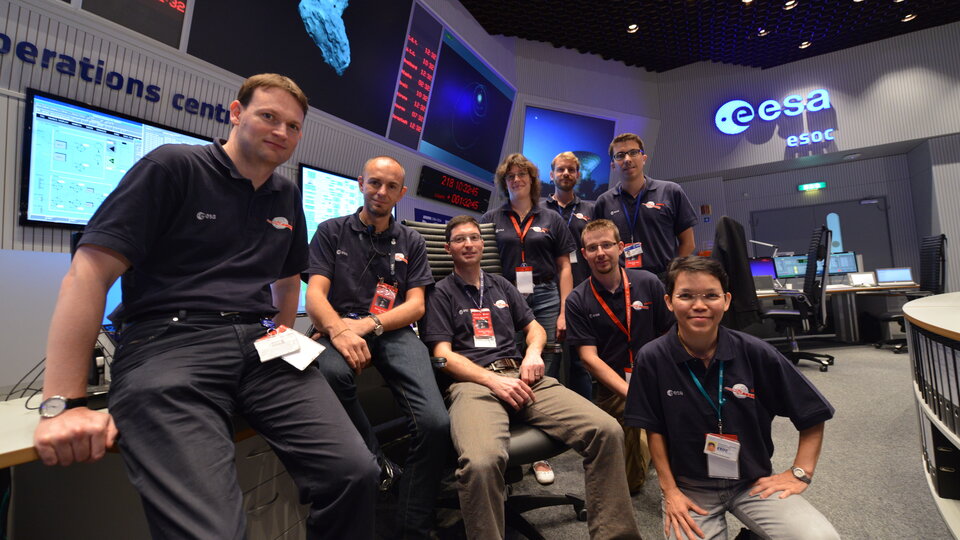
The Flight Control Team (FCT) at ESOC operates from the same Dedicated Control Room (DCR) as Mars Express. Spacecraft Operations Manager (SOM) Sylvain Lodiot, from France, oversees a team of spacecraft operations engineers working full-time on Rosetta. The team is further augmented by analysts and SPACONs (spacecraft controllers), who support all ESA interplanetary missions via integrated ground software and daily operations.
Other ESOC teams provide additional support in the areas of flight dynamics, ground facilities and software support.
Mission operations overview
During its 10-year journey to Comet 67P/Churyumov-Gerasimenko, Rosetta will circle the Sun almost four times. It will also cross the asteroid belt twice and gain velocity from gravitational 'kicks' provided by close swing-bys of Mars (2007) and Earth (2005, 2007 and 2009).
The launch and early orbit phase (LEOP)
The planned launch date for Rosetta was 07:36:49 GMT on 26 February 2004. However, an initial delay due to adverse weather, and a subsequent delay due to a technical issue with the launch vehicle, pushed the launch date back by five days, to 2 March 2004.


Access the video
After burn-out of the lower stage, the spacecraft and upper stage remained in Earth parking orbit (4000 x 200 km) for about two hours. Ariane's upper stage then ignited to boost Rosetta into its interplanetary trajectory, before separating from the spacecraft.
Earth swing-bys
Rosetta first travelled away from its home planet, before returning a year after launch, in March 2005. Rosetta then headed to Mars and returned to Earth in November 2007 for its second swing-by of our planet. In November 2009 Rosetta will fly past the Earth for the third and last time to receive the final boost required to reach its final target.
Rosetta alternates periods of active and passive phases during the cruise to Earth. The distance at closest approach is between 300 and 5300 km. Operations are mainly focused on orbit determination for the fundamental swing-by manoeuvres; however payload check-out, calibrations and scientific observations are also performed. If required, orbit correction manoeuvres take place before and after each swing-by.
Mars swing-by
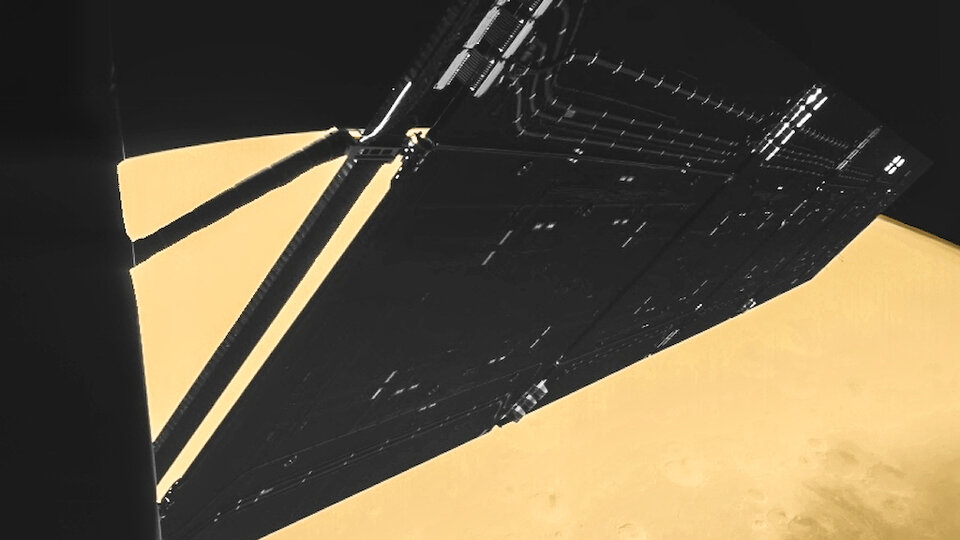
Rosetta flew past Mars in February 2007 at a distance of about 250 km, phasing its trajectory for the next Earth swing-by and, as a spin-off, obtaining some science observations. During the swing-by, Rosetta had to survive an eclipse for which, due to the mission target change, the spacecraft was not specifically designed to handle.
This operation required a significant effort by the FCT, but was entirely successful; during the swing-by itself, a communications black-out was also caused by an occultation as the spacecraft passed behind Mars with respect to the Earth.
Asteroid fly-bys
During the cruise phase, Rosetta alternates between phases of passive and active operation, depending on mission needs. As a secondary scientific objective, Rosetta has observed asteroid Steins in 2008 from a distance of 800 km. In July 2010 only 3160 km will separate Rosetta from asteroid Lutetia when it will fly past. Science data recorded onboard will be transmitted to Earth afterwards.
Deep-space hibernation
Following a planned deep-space manoeuvre using the engine to achieve a change in speed of approximately 800 m/s, the spacecraft went into hibernation between 8 June 2011 and 20 January 2014, due to the very limited power that was available – which did not allow safe spacecraft operations. Almost all electrical systems were switched off, except for the thermal subsystem, on-board computer, radio receivers, command decoders and power supply.

Access the video
During this period, Rosetta recorded its maximum distance from the Sun, approximately 780 000 000 km, and Earth, approximately 880 000 000 km.
Wake up
On 20 January 2014, still approximately 9 million km from the comet, Rosetta’s pre-programmed internal alarm clock woke up the spacecraft. After warming up its key navigation instruments, coming out of a stabilising spin, and aiming its main radio antenna at Earth, Rosetta sent a signal to let mission operators know it had survived the most distant part of its journey.
The signal was received by both NASA’s Goldstone and Canberra ground stations at 18:18 GMT/ 19:18 CET, during the first window of opportunity the spacecraft had to communicate with Earth. Signal receipt was immediately confirmed in ESA’s space operations centre in Darmstadt via the @esaoperations Twitter channel and the successful wake-up was announced via the until-then quiescent @ESA_Rosetta twitter account, which tweeted: “Hello, World!”
Comet approach
During May-August 2014, Rosetta conducted a series of ten orbit correction manoeuvres to phase its orbit with that of the comet and bring it closer to the point of arrival. One of these thruster burns, conducted on 21 May 2014, was one of the longest-ever burns carried out by an ESA spacecraft.
Arrival
On 6 August 2014, when Rosetta was just 100 km from the comet’s surface, it conducted an orbit manoeuvre that kicked the spacecraft onto the first leg of a pair of triangular-shaped trajectories passing in front of the comet, first at a distance of 100 km and then at 50 km. In the following weeks, Rosetta is attempting to achieve a close, near-circular orbit at 30 km and, depending on the activity of the comet, perhaps come even closer.
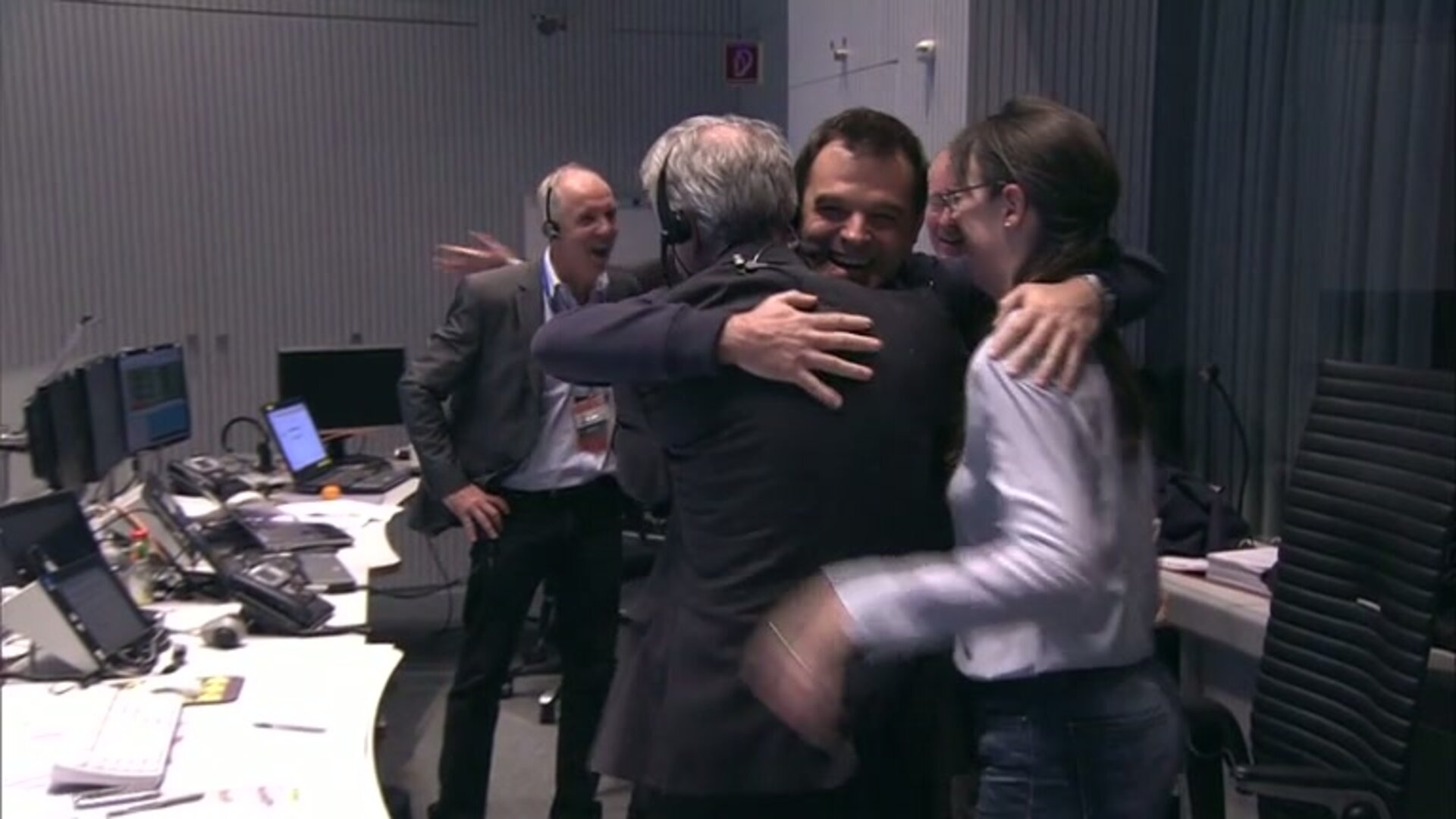
Access the video
Landing sites
On 25 August, using detailed information collected by Rosetta during its first two weeks at Comet 67P/Churyumov-Gerasimenko, five locations were identified as candidate sites to set down the Philae lander in November 2014. A final prime landing site, named Agilkia (plus a backup), was announced in early November.
Landing on 67P/C-G
Philae touchdown on the comet was confirmed at ESOC at 16:03 GMT/17:03 CET on 12 November. Analysis of data from Philae later revealed that the lander did not just touch down once, but three times, as the craft's harpoons did not fire, allowing it to rebound into space again. It continued travelling for 1 hour 50 minutes; during that time, it travelled about 1 km at a speed of 38 cm/s. It then made a smaller second hop, travelling at about 3 cm/s, landing in its final resting place seven minutes later.
Mission end
Squeezing out unique scientific observations until the very end, Rosetta’s thrilling mission will culminate with a descent on 30 September 2016 towards a region of active pits on the comet’s ‘head’. The region, known as Ma’at, lies on the smaller of the two lobes of Comet 67P/Churyumov–Gerasimenko. It is home to several active pits more than 100 m in diameter and 50–60 m in depth – where a number of the comet’s dust jets originate.

Since launch, the Rosetta mission has been controlled from the Rosetta Mission Operations Centre (MOC) at ESOC, Darmstadt, using ESA's 35m-diameter deep-space ground station at New Norcia.
During critical mission phases (launch, planet swing-bys, etc.) it is supported for tracking, telemetry and command by other ESA ground stations at Kourou, Malargüe and Cebreros, and by the NASA Deep Space Network (DSN) stations at Madrid, Spain, and Goldstone, USA.
Ground segment
The Rosetta ground segment is designed to meet both the scientific objectives and the challenges imposed by a deep-space mission. These challenges include long turnaround times for signals (up to 100 minutes), low bit rates for data (8 bps), low power availability (it is the first spacecraft ever to fly with solar power generators beyond 3.1 AU from the Sun) and very precise navigation during planetary swing-bys (Rosetta made use of gravity-assist manoeuvres with Mars and Earth to achieve its final orbit around the Sun).
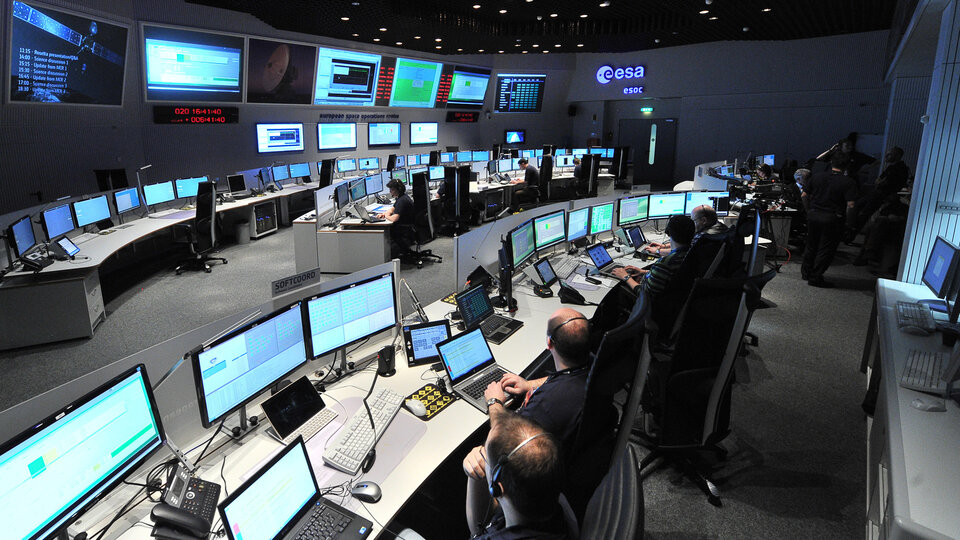
ESOC teams must cope with the long mission duration and the related problems in scheduling expertise and experienced FCT personnel, while minimising overall cost. The central element of the Rosetta ground segment, the Mission Control System, is based on SCOS-2000.
The Rosetta Science Operations Centre (RSOC) located at ESAC, near Madrid, produces detailed scientific mission planning requests, which are submitted to the MOC in the form of operation requests. The RSOC makes pre-processed scientific data and the scientific data archive available to the scientific community.
A Rosetta Lander Ground Segment (RLGS) controls the Philae lander. This is coordinated through the Lander Control Centre at the German Aerospace Center (DLR) establishment in Cologne, Germany, and the lander scientific control centre of CNES, France's space agency, in Toulouse.
The platform
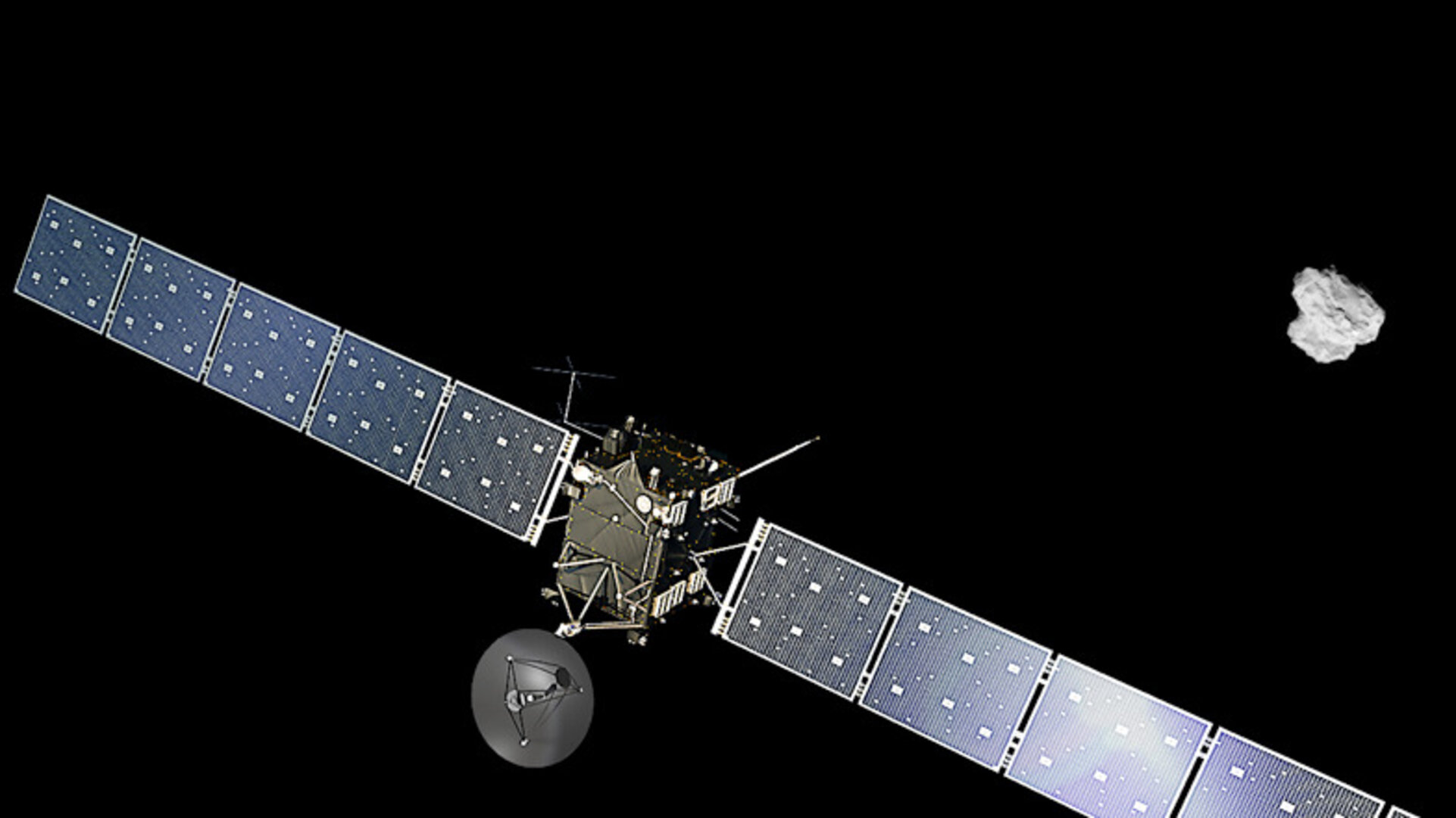
Rosetta is a large aluminium box, 2.8 x 2.1 x 2.0 metres in size. The scientific instruments are mounted on the 'top' of the box (the Payload Support Module) while the subsystems are on the 'base' (Bus Support Module).
On one side of the orbiter is a 2.2m-diameter communications dish antenna – the steerable high-gain antenna; the lander is attached to the opposite face. Two enormous solar panels extend from the other sides. These 'wings', each 32 square metres in area, have a total span of about 32m tip-to-tip. Each comprises five panels, and both may be rotated through +/-180° to track the Sun in every attitude assumed by the spacecraft.
The Payload
In order to investigate the comet nucleus and the gas and dust ejected from the nucleus as the comet approaches the Sun, Rosetta carries a suite of eleven instruments on-board the orbiter; the lander, Philae, is equipped with a further ten instruments to perform surface measurements.
The orbiter instruments combine remote sensing techniques, such as cameras and radio science measurements, with direct sensing systems such as dust and particle analysers. The instruments are provided by collaborative efforts between scientific institutes in ESA member states and the USA. Principal investigators in several European countries and America lead the nationally funded science teams.
Access details on Rosetta instruments and science results via http://sci.esa.int/rosetta.