• → European Space Agency

      • Space for Europe
      • Space News
      • Space in Images
      • Space in Videos
    • About Us

      • Welcome to ESA
      • DG's News and Views
      • For Member State Delegations
      • Business with ESA
      • ESA Exhibitions
      • ESA Publications
      • Careers at ESA
    • Our Activities

      • Space News
      • Observing the Earth
      • Human Spaceflight
      • Launchers
      • Navigation
      • Space Science
      • Space Engineering
      • Operations
      • Technology
      • Telecommunications & Integrated Applications
    • For Public

    • For Media

    • For Educators

    • For Kids

    • ESA

    • Space Science

    • Our Universe
    • About Space Science
    • ESA's 'Cosmic Vision'
    • Science missions
    • Mission navigator
    • Target groups
    • For Media
    • For Scientists
    • For Kids
    • Multimedia
    • Science images
    • Science videos
    • Animations
    • Downloads
    • Sounds from space
    • Resources
    • Reference section
    • Services
    • FAQs
    • Glossary
    • Help
    • Portal terms of use
    • Comments
    • Follow us
    • RSS feeds
    • ESA Sci on Twitter
    • ESA Space Science Images on Flickr
    • ESA 3D on Flickr

    ESA > Our Activities > Space Science

    Loading...
    A day in the life of Venus Express
    Access the video

    A day in the life of Venus Express

    21 January 2013

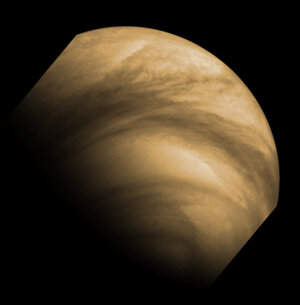
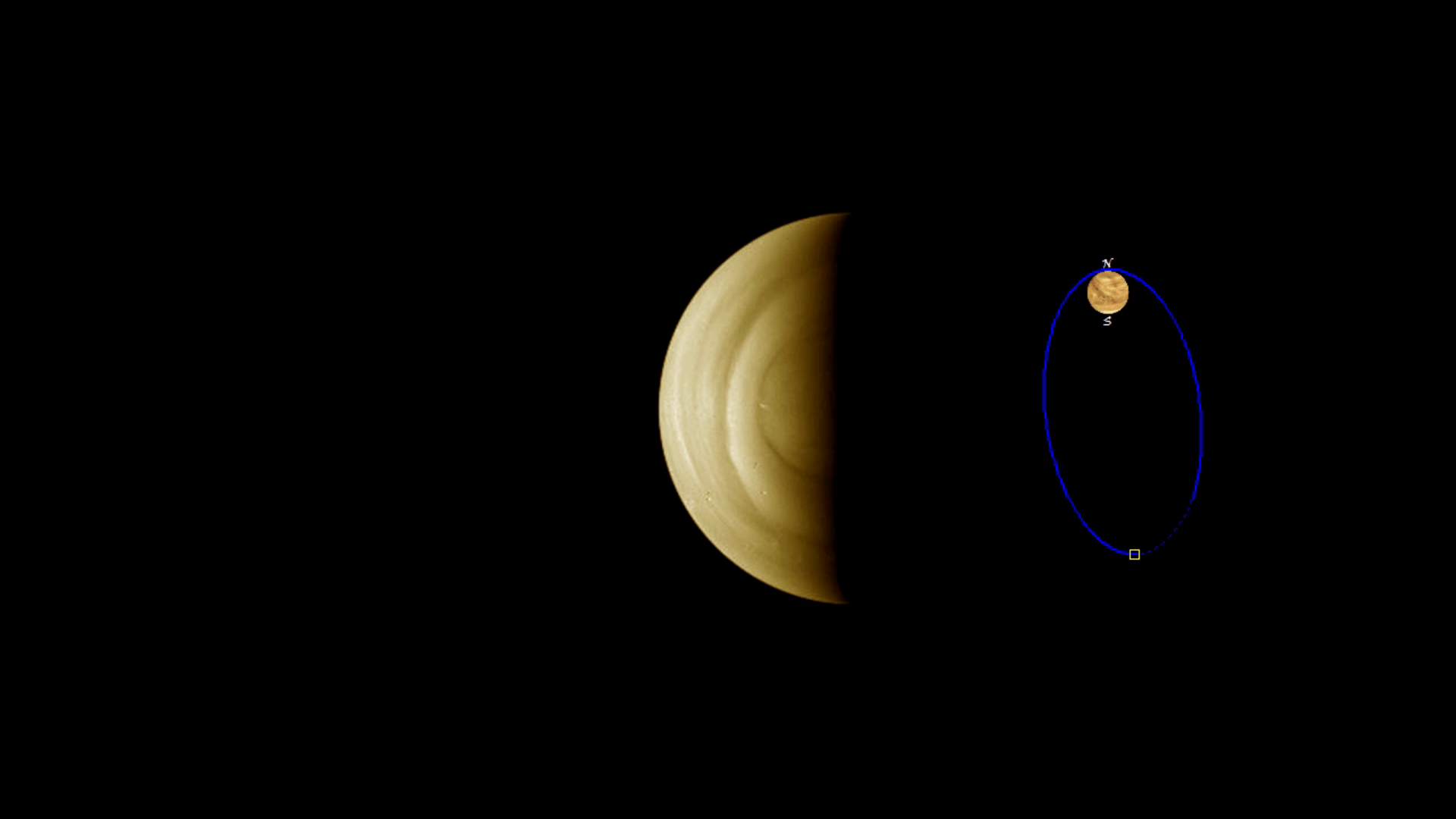
    Bright and dark cloud bands wind around the poles of Venus in this beautiful sequence tracked by ESA’s Venus Express as it makes a rollercoaster orbit around the planet.

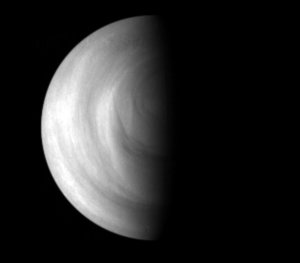
    We join the spacecraft from a staggering 66 000 km above the south pole, staring down into the swirling south polar vortex. From this bird’s-eye view, half of the planet is in darkness, the ‘terminator’ marking the dividing line between the day and night sides of the planet.

    Intricate features on smaller and smaller scales are revealed as Venus Express dives to just 250 km above the north pole and clouds flood the field of view, before regaining a global perspective as it climbs away from the north pole.

    The movie is based on images snapped by the Venus Monitoring Camera over a period of 18 hours during one of the spacecraft’s 24-hour orbits around the planet on 7–8 January last year. It was compiled using public data from the Venus Express data archive.

    The camera observes the planet in ultraviolet wavelengths, revealing intriguing patterns in the cloud tops, which ride around the planet about 70 km above the surface.

    The observed pattern of bright and dark markings is caused by variations in an unknown absorbing chemical at the Venus cloud tops.

    The clouds are driven by extremely strong winds, sweeping around the planet once every four days. By comparison, the planet takes 243 days to complete one rotation about its own axis.

    Venus Express has been orbiting the planet since 2006. It carries seven scientific instruments investigating the surface, atmosphere and ionosphere of Venus.

    Rate this

    Views

    Share

    • Currently 4.5 out of 5 Stars.
    • 1
    • 2
    • 3
    • 4
    • 5
    Rating: 4.45/5 (46 votes cast)

    Thank you for rating!

    You have already rated this page, you can only rate it once!

    Your rating has been changed, thanks for rating!

    7783
    Tweet

    Related articles

    Have Venusian volcanoes been caught in the act?03 December 2012

    Have Venusian volcanoes been caught in the act?03 December 2012 Six years of observations by ESA’s Venus Express have shown large changes in the sulphur dioxide content of the planet’s atmosphere, and one intriguing possible explanation is volcanic eruptions.

    Venus cloud tops

    Chasing clouds on Venus08 October 2012

    Venus cloud tops

    Chasing clouds on Venus08 October 2012

    Venus Express and the transit of Venus11 June 2012

    Venus Express and the transit of Venus11 June 2012 While astronomers around the world looked to the skies last week to witness Venus move across the face of the Sun, ESA’s Venus Express took measurements of the transiting planet from its unique viewpoint.

    Ultraviolet view of Venus South Pole

    A curious cold layer in the atmosphere of Venus01 October 2012

    Ultraviolet view of Venus South Pole

    A curious cold layer in the atmosphere of Venus01 October 2012 Venus Express has spied a surprisingly cold region high in the planet’s atmosphere that may be frigid enough for carbon dioxide to freeze out as ice or snow.

    Transit of Venus wows astronomers worldwide06 June 2012

    Transit of Venus wows astronomers worldwide06 June 2012 Astronomers around the world looked to the sky last night and this morning to observe Venus as it passed across the face of the Sun for the last time this century. ESA’s Sun-watching space missions also tuned in for the solar spectacular.

    Animation of Venus

    Could Venus be shifting gear?10 February 2012

    Animation of Venus

    Could Venus be shifting gear?10 February 2012 ESA’s Venus Express spacecraft has discovered that our cloud-covered neighbour spins a little slower than previously measured. Peering through the dense atmosphere in the infrared, the orbiter found surface features were not quite where they should be.

    • Space Science Image of the Week Archive
    • Space Live
      Space Live
      Space science image gallery
    • Looking at Venus
    • Venus Express Press Kit
    • Venus Express brochure (pdf)
    • In depth
    • Venus Express in-depth
    • ESA’s planetary science archive

    Connect with us

    • RSS
    • Youtube
    • Twitter
    • Flickr
    • G+
    • Facebook
    • Livestream
    • Subscribe
    • App Store
    • ESA Science Twitter

    Follow ESA science

    • LATEST ARTICLES
    • · Rare merger reveals secrets of gal…
    • · Watching for hazards: ESA opens as…
    • · ESA astronaut Timothy Peake set fo…
    • · Space drives e-mobility
    • · Proba-V opens its eyes
    • FAQ

    • Jobs at ESA

    • Site Map

    • Contacts

    • Terms and conditions