• → European Space Agency

      • Space for Europe
      • Space News
      • Space in Images
      • Space in Videos
    • About Us

      • Welcome to ESA
      • DG's News and Views
      • For Member State Delegations
      • Business with ESA
      • ESA Exhibitions
      • ESA Publications
      • Careers at ESA
    • Our Activities

      • Space News
      • Observing the Earth
      • Human Spaceflight
      • Launchers
      • Navigation
      • Space Science
      • Space Engineering
      • Operations
      • Technology
      • Telecommunications & Integrated Applications
    • For Public

    • For Media

    • For Educators

    • For Kids

    • ESA

    • Space Science

    • Our Universe
    • About Space Science
    • ESA's 'Cosmic Vision'
    • Science missions
    • Mission navigator
    • Target groups
    • For Media
    • For Scientists
    • For Kids
    • Multimedia
    • Science images
    • Science videos
    • Animations
    • Downloads
    • Sounds from space
    • Resources
    • Reference section
    • Services
    • FAQs
    • Glossary
    • Help
    • Portal terms of use
    • Comments
    • Follow us
    • RSS feeds
    • ESA Sci on Twitter
    • ESA Space Science Images on Flickr
    • ESA 3D on Flickr

    ESA > Our Activities > Space Science

    Steins revisited

    Asteroid Steins’ hidden gems

    18 February 2013

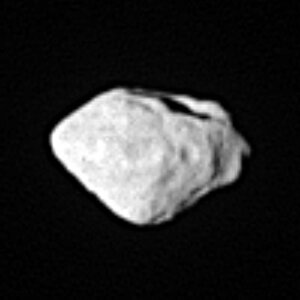
    ESA’s Rosetta spacecraft snapped images of asteroid Steins as it flew by the diamond-shaped asteroid on 5 September 2008, revealing a tiny world with a big history of collisions.

    The images were taken by Rosetta’s Wide Angle Camera as the spacecraft flew within 800 km of the 5 km-wide asteroid, and later processed by amateur astronomer Ted Stryk to produce the image presented here.

    By emphasising the shadows, the processing reveals high-contrast features, such as bright crater rims against their dark, shadowed interiors. However, this technique can also create some artifacts, such as the illusion of boulders protruding from the surface, that are not present in the raw data.

    One striking feature is the gaping hole at the south pole (top in this image) of Steins – its largest impact crater at about 2 km wide and nearly 300 m deep. This crater is named ‘Diamond’ following the gem nomenclature chosen after the asteroid’s overall shape earned it the nickname ‘diamond in the sky’.

    The circular crater in the centre of the asteroid as seen in this viewing angle is called Topaz and is about 650 m wide and 80 m deep.

    A chain of several craters can be seen stretching from the asteroid’s north pole (bottom in this image) right up to Diamond crater.

    So far, around 40 craters have been found, but the imposing Diamond crater likely influenced the appearance of the entire asteroid because the debris thrown out from this dramatic collision would have scattered over the surface, imprinting over other, older craters.

    Rosetta has since passed by asteroid Lutetia in July 2010 and is now in deep-space hibernation. It will wake up on 20 January 2014 and rendezvous with comet 67P/Churyumov–Gerasimenko in May 2014. A few months later, its Philae probe will separate to make the first controlled landing on a comet.

    Comets are considered to be the primitive building blocks of the Solar System, and Rosetta will help scientists to learn more about their role in the evolution of our local cosmic neighbourhood.

    Rate this

    Views

    Share

    • Currently 4.5 out of 5 Stars.
    • 1
    • 2
    • 3
    • 4
    • 5
    Rating: 4.71/5 (28 votes cast)

    Thank you for rating!

    You have already rated this page, you can only rate it once!

    Your rating has been changed, thanks for rating!

    4530
    Tweet

    Related articles

    A fleeting flyby of a battered world25 June 2012

    A fleeting flyby of a battered world25 June 2012

    Steins getting closer

    Steins: A diamond in the sky06 September 2008

    Steins getting closer

    Steins: A diamond in the sky06 September 2008 The first images from Rosetta’s OSIRIS imaging system and VIRTIS infrared spectrometer were derived from raw data this morning and have delivered spectacular results.

    Rosetta spacecraft

    Encounter of a different kind: Rosetta observes asteroid at close quarters06 September 2008

    Rosetta spacecraft

    Encounter of a different kind: Rosetta observes asteroid at close quarters06 September 2008 ESA PR 37-2008. ESA's comet chaser, Rosetta, last night flew by a small body in the main asteroid belt, asteroid Steins, collecting a wealth of information about this rare type of minor Solar System body.

    • Space Science Image of the Week Archive
    • Space Live
      Space Live
      Space science image gallery
    • ESA's comet chaser: Rosetta
    • ESA's ATV blog direct from ATV mission control
      ESA's ATV blog direct from ATV mission control
      Rosetta Blog
    • More about
    • Rosetta
    • Related links
    • This image on Ted Stryk’s blog
    • In depth
    • New science paper on Steins’ craters
    • Rosetta data archive
    • Rosetta in depth

    Connect with us

    • RSS
    • Youtube
    • Twitter
    • Flickr
    • G+
    • Facebook
    • Livestream
    • Subscribe
    • App Store
    • ESA Science Twitter

    Follow ESA science

    • LATEST ARTICLES
    • · ESA astronaut Timothy Peake set fo…
    • · Space drives e-mobility
    • · Proba-V opens its eyes
    • · First new Galileo satellite arrive…
    • · Next destination: space
    • FAQ

    • Jobs at ESA

    • Site Map

    • Contacts

    • Terms and conditions