• → European Space Agency

      • Space for Europe
      • Space News
      • Space in Images
      • Space in Videos
    • About Us

      • Welcome to ESA
      • DG's News and Views
      • For Member State Delegations
      • Business with ESA
      • ESA Exhibitions
      • ESA Publications
      • Careers at ESA
    • Our Activities

      • Space News
      • Observing the Earth
      • Human Spaceflight
      • Launchers
      • Navigation
      • Space Science
      • Space Engineering
      • Operations
      • Technology
      • Telecommunications & Integrated Applications
    • For Public

    • For Media

    • For Educators

    • For Kids

    • ESA

    • Rosetta

    • ESA Science

    • About Rosetta

      • Europe's comet chaser
      • Why 'Rosetta'?
    • About the spacecraft

      • The Rosetta orbiter
      • Orbiter: Instruments
      • The Rosetta lander
      • Lander: Instruments
    • About the journey

      • The long trek
      • Debris of the Solar System: Asteroids
      • Asteroid (2867) Steins: a portrait
      • Life and survival in deep space
      • Long-distance communication
      • The Rosetta ground segment
    • About the arrival

      • Comets - an introduction
      • Comet 67P/Churyumov- Gerasimenko
      • Comet rendezvous
      • Giotto - ESA's first comet mission
    • Meet the team
    • Mission Manager
    • Project Scientist
    • Multimedia
    • VideoTalk
    • 3D Flash 'model'
    • Rosetta images
    • Rosetta videos
    • Rosetta Animations
    • Rosetta wallpaper
    • Life of a comet
    • Services
    • Frequently asked questions
    • Comments

    ESA > Our Activities > Space Science > Rosetta

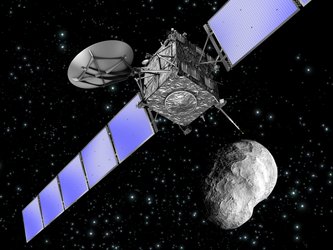
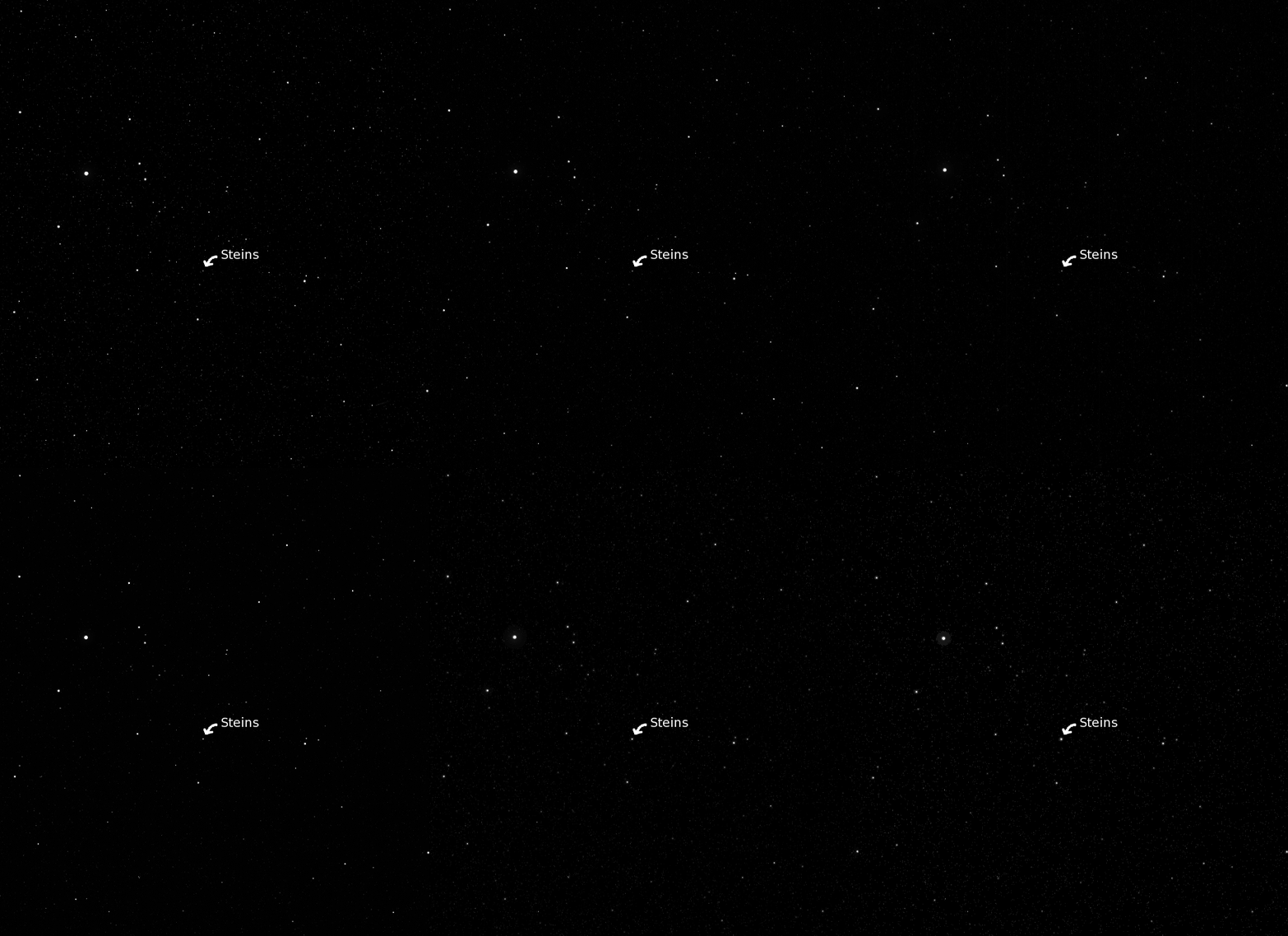
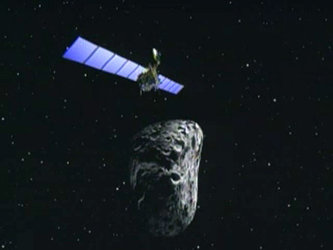
    Steins getting closer
    Steins getting closer (actual animation)

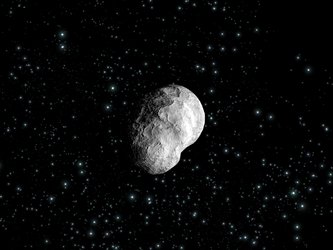
    Steins: A diamond in the sky

    6 September 2008

    The first images from Rosetta’s OSIRIS imaging system and VIRTIS infrared spectrometer were derived from raw data this morning and have delivered spectacular results.

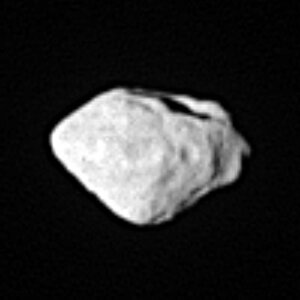
    "Steins looks like a diamond in the sky," said Uwe Keller, Principal Investigator for the OSIRIS imaging system from the Max Planck Institut Fuer Sonnensystemforschung, Lindau.

    Visible in the image are several small craters on the asteroid, and two huge ones, one of which is 2 km in diameter, indicating that the asteroid must be very old.

    The images are 50 to 60 pixels in diameter, enough to characterise the shape and other characteristics of the body of the asteroid.
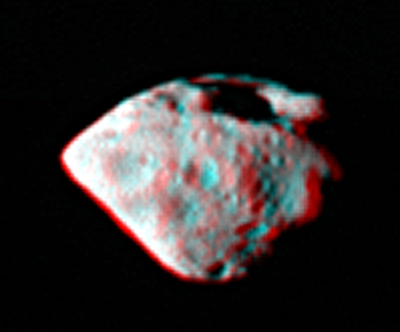
    Steins in 3-D

    Rita Schulz, Rosetta Project Scientist, said, "In the images is a chain of impact craters, which must have formed from recurring impact as the asteroid rotated. The impact may have been caused by a meteoroid stream, or fragments from a shattered small body."

    The chain is composed of about 7 craters. To determine the age of the asteroid, a count of the craters on the asteroid’s surface has been started (the more the number of craters, the older the asteroid). So far, 23 craters have been spotted.

    From the images, scientists will try and understand why the asteroid is unusually bright, and how fine grains of the surface regolith are. This will tell them more about how the asteroid formed.
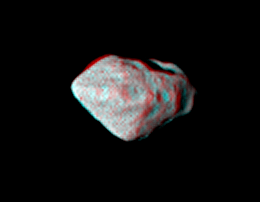

    Steins in 3-D

    Gerhard Schwehm, Mission Manager for Rosetta said, "It looks like a typical asteroid, but it is really fascinating how much we can learn from just the images. This is our first science highlight; we certainly have a lot of promising science ahead of us. I’m already looking forward to encountering our next diamond in the sky, the much bigger Lutetia."

    The OSIRIS imaging system's Wide Angle Camera (WAC) worked perfectly through the fly-by.

    The OSIRIS team expects that the images that they will retrieve from the Narrow Angle Camera (NAC) will be of comparable resolution. This will add to the detailed colour information and hence to knowledge of the surface composition.

    Asteroid Steins: A diamond in space

    Science team members noted that the Narrow Angle Camera (NAC) appears to have switched to safe mode a few minutes before closest approach, but switched back on after a few hours. The software is programmed to switch to safe mode when certain parameter thresholds are crossed to protect the camera. The team will concentrate investigating the reasons for this anomaly once the science data has been analysed.

    After analysis of the Rosetta data, Steins will be one of the best-characterised asteroids so far.
    Rate this

    Views

    Share

    • Currently 5 out of 5 Stars.
    • 1
    • 2
    • 3
    • 4
    • 5
    Rating: 5/5 (2 votes cast)

    Thank you for rating!

    You have already rated this page, you can only rate it once!

    Your rating has been changed, thanks for rating!

    1951
    Tweet
    • ESA's ATV blog direct from ATV mission control
      ESA's ATV blog direct from ATV mission control
      Rosetta Blog
    • ESA's comet chaser: Rosetta
    • Spacecraft Operations
      Spacecraft Operations
      Operations
    • A virtual tour of ESOC, ESA's Space Operations Centre
      A virtual tour of ESOC, ESA's Space Operations Centre
      ESOC
    • Download presentation files (PDF)
    • G. Schwehm - Rosetta: The Mission
    • R. Schulz - Rosetta & Asteroids
    • A. Accomazzo - Stretching Rosetta's Limits
    • U. Keller - Asteroid (2867) Steins
    • G. Winters - Space Situational Awareness
      • Encounter of a different kind: Rosetta observes asteroid at close quarters
      • Related articles
        • Steins: A diamond in the sky
          • Rosetta Steins fly-by confirmed
            • (2867) Steins getting closer
              • Rosetta: Cool science at a rare target
                • Rosetta Blog now live
                  • Rosetta Steins fly-by timeline
                    • Rosetta spacecraft meets asteroid Steins
                    • For the media
                    • Media Press Kit
                    • Rosetta factsheet (pdf)
                    • In depth
                    • Rosetta in depth
                    • Related links
                    • Astrium
                    • DLR Rosetta special

    Connect with us

    • RSS
    • Youtube
    • Twitter
    • Flickr
    • G+
    • Facebook
    • Livestream
    • Subscribe
    • App Store
    • LATEST ARTICLES
    • · Rare merger reveals secrets of gal…
    • · Watching for hazards: ESA opens as…
    • · ESA astronaut Timothy Peake set fo…
    • · Space drives e-mobility
    • · Proba-V opens its eyes
    • FAQ

    • Jobs at ESA

    • Site Map

    • Contacts

    • Terms and conditions