• → European Space Agency

      • Space for Europe
      • Space News
      • Space in Images
      • Space in Videos
    • About Us

      • Welcome to ESA
      • DG's News and Views
      • For Member State Delegations
      • Business with ESA
      • ESA Exhibitions
      • ESA Publications
      • Careers at ESA
    • Our Activities

      • Space News
      • Observing the Earth
      • Human Spaceflight
      • Launchers
      • Navigation
      • Space Science
      • Space Engineering
      • Operations
      • Technology
      • Telecommunications & Integrated Applications
    • For Public

    • For Media

    • For Educators

    • For Kids

    • ESA

    • Space Science

    • Our Universe
    • About Space Science
    • ESA's 'Cosmic Vision'
    • Science missions
    • Mission navigator
    • Target groups
    • For Media
    • For Scientists
    • For Kids
    • Multimedia
    • Science images
    • Science videos
    • Animations
    • Downloads
    • Sounds from space
    • Resources
    • Reference section
    • Services
    • FAQs
    • Glossary
    • Help
    • Portal terms of use
    • Comments
    • Follow us
    • RSS feeds
    • ESA Sci on Twitter
    • ESA Space Science Images on Flickr
    • ESA 3D on Flickr

    ESA > Our Activities > Space Science

    COROT sees first light!

    COROT’s first light
    24 January 2007

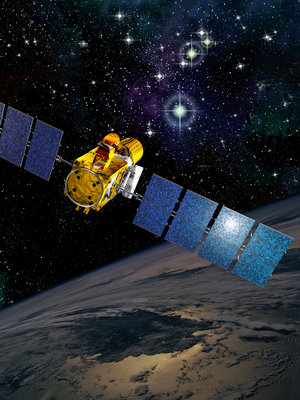
    In the night between 17 and 18 January 2007, the protective cover of the COROT telescope has been successfully opened, and COROT has seen for the first time light coming from stars.

    Surveying vast stellar fields to learn about star interiors and to search for extra-solar planets is the goal of this unique mission, whose scientific observations will officially start at the beginning of February this year.

    The first light detected by COROT comes from the constellation of the Unicorn near Orion, the great 'hunter' whose imposing silhouette stands out in the winter nights. This nice image, taken during the in-orbit calibration exercise, shows that the quality of this preliminary data is basically as good as the computer simulations. "This is an excellent piece of news," commented Malcolm Fridlund, ESA Project Scientist for COROT.

    COROT's orbit
    COROT's orbit

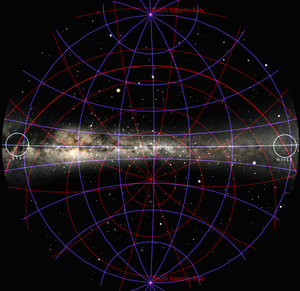
    On 18 January, the telescope was carefully aligned with the region to be observed, facing away from the centre of our Galaxy. This setting that will be maintained until April, when the Sun's rays will start to interfere with the observations.

    COROT will then rotate by 180 degrees and will start observing the opposite region towards the centre of the Milky Way. In the meantime the COROT scientists are preparing for the science phase to start in February, continuing a thorough examination of the data and the information collected so far.


    Note to editors

    COROT's launch
    COROT is launched

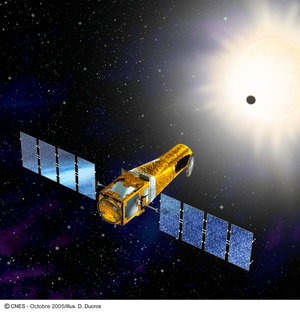
    COROT was set in space by a Soyuz rocket after a text-book launch from the Baikonur cosmodrome in Kazakhstan on 27 December 2006. Settled in its almost-circular polar orbit ranging between 895 and 906 kilometres altitude over the Earth's surface, the spacecraft was powered on 2 January 2007, and has begun its calibration exercise, still on going.

    Major steps of this testing phase have been the test of the COROT four thrusters's nozzles, necessary to precisely orient the spacecraft in space, and the calibration of the light sensors. The sensor calibration process, which paradoxally must take place in total darkness, is designed to check the detector arrays pixel by pixel. For a given amount of light, a pixel doesn't generate exactly the same amount of current as its neighbours, so these individual responses must be taken into account when applying corrections to the scientific data to come.

    COROT is a CNES project with ESA participation. The other major partners in this mission are Austria, Belgium, Brazil, Germany and Spain.

    For more information

    Malcolm Fridlund, ESA COROT Project Scientist
    Email: malcolm.fridlund @ esa.int

    Rate this

    Views

    Share

    • Currently 0 out of 5 Stars.
    • 1
    • 2
    • 3
    • 4
    • 5
    Rating: 0/5 (0 votes cast)

    Thank you for rating!

    You have already rated this page, you can only rate it once!

    Your rating has been changed, thanks for rating!

    50
    Tweet
    • COROT will dig into stellar interiors
      COROT will dig into stellar interiors
      Searching for exoplanets
    • Related ESApod
    • COROT (vodcast)
    • COROT (podcast)
    • More about...
    • COROT overview
      • COROT factsheet
      • Related articles
        • COROT sees first light!
          • COROT on its way
            • Europe looks forward to COROT launch
              • The European dimension of COROT: An interview with Fabio Favata
                • COROT launch postponed
                  • COROT fuels up
                    • COROT started its launch campaign in Baikonur
                      • COROT and the new chapter of planetary searches
                        • Europe goes searching for rocky planets
                          • How many planets are outside our Solar System?
                            • How to find an extrasolar planet
                            • ESA ESTEC expertise and facilities assist COROT project
                              • Planet discoverer: An interview with Didier Queloz
                              • Related links
                              • COROT at CNES
                              • Extrasolar Planets Encyclopedia
                              • Starsem

    Connect with us

    • RSS
    • Youtube
    • Twitter
    • Flickr
    • G+
    • Facebook
    • Livestream
    • Subscribe
    • App Store
    • ESA Science Twitter

    Follow ESA science

    • LATEST ARTICLES
    • · Rare merger reveals secrets of gal…
    • · Watching for hazards: ESA opens as…
    • · ESA astronaut Timothy Peake set fo…
    • · Space drives e-mobility
    • · Proba-V opens its eyes
    • FAQ

    • Jobs at ESA

    • Site Map

    • Contacts

    • Terms and conditions