• → European Space Agency

      • Space for Europe
      • Space News
      • Space in Images
      • Space in Videos
    • About Us

      • Welcome to ESA
      • DG's News and Views
      • For Member State Delegations
      • Business with ESA
      • ESA Exhibitions
      • ESA Publications
      • Careers at ESA
    • Our Activities

      • Space News
      • Observing the Earth
      • Human Spaceflight
      • Launchers
      • Navigation
      • Space Science
      • Space Engineering
      • Operations
      • Technology
      • Telecommunications & Integrated Applications
    • For Public

    • For Media

    • For Educators

    • For Kids

    • ESA

    • ESA Science

    • Cassini-Huygens

    • Unique insights into a ringed world

      • Striking sights of a ringed world...
      • Solving the puzzles of Saturn and Titan
    • About Cassini-Huygens

      • Cassini-Huygens mission facts
      • The mission
      • Cassini spacecraft
      • Cassini instruments
      • Huygens spacecraft
      • Huygens instruments
      • The launcher
    • About Saturn

      • Facts about Saturn
      • Saturn's rings
      • Saturn's moons
      • Saturn's atmosphere
      • Saturn's magnetosphere
    • About Titan

      • Facts about Titan
      • Titan's atmosphere
      • Titan's surface
      • Life on Titan?
    • Meet the team

      • International collaboration
      • Huygens Mission Team
      • Cassini Project Team
      • ASI Programme Manager
      • Huygens investigators
      • Cassini orbiter investigators (1)
      • Cassini orbiter investigators (2)
    • Multimedia
    • VideoTalk
    • Cassini-Huygens images
    • Cassini-Huygens videos
    • Titan virtual tour
    • Hygens probe descent - multilingual CD-rom
    • Download wallpapers
    • Download screensavers
    • 3D Flash 'model'
    • SOI animation
    • Waiting for Titan - the human side of Huygens
    • Services
    • Comments

    ESA > Our Activities > Space Science > Cassini-Huygens

    Fire and ice on Enceladus

    Fire and ice on Enceladus

    24 August 2005

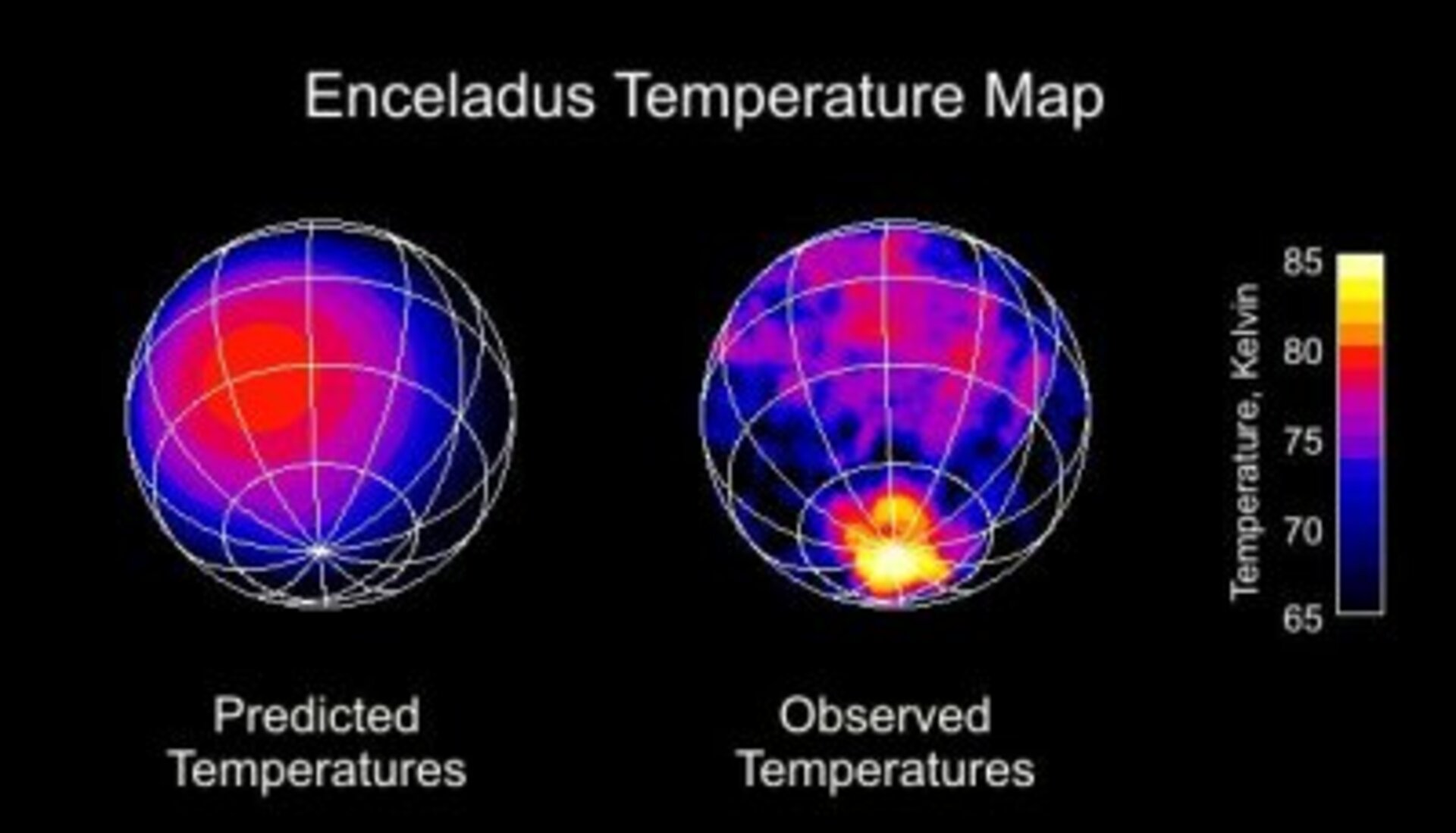
    The NASA/ESA/ASI Cassini spacecraft has spotted a dramatic warm spot centred on the south pole of Saturn's moon Enceladus, that is probably a sign of internal heat leaking out of the icy moon.

    This image surprised Cassini scientists in the Composite Infrared Spectrometer (CIS) team when they got their first look at the infrared radiation, or heat, from Enceladus.

    They saw a dramatic warm spot centred on the pole in data collected during the spacecraft's third fly-by of this intriguing moon on 14 July 2005.

    Based on data from previous fly-bys, which did not show the south pole well, team members expected that this pole would be very cold, as shown in the left panel.

    Enceladus is one of the coldest places in the Saturn system because its extremely bright surface reflects 80 percent of the sunlight that hits it, so only 20 percent is available to heat the surface. As on Earth, the poles should be even colder than the equator because the Sun shines at such an oblique angle there.

    The right panel shows a global temperature image made from measurements of heat radiation from Enceladus at wavelengths between 9 and 16.5 micrometres. Equatorial temperatures are much as expected, topping out at about 80 Kelvin, but the south pole is occupied by a well-defined warm region reaching 85 Kelvin - 15 Kelvin warmer than expected.

    The CIS data also suggest that small areas of the pole are at even higher temperatures, well over 110 Kelvin. Evaporation of this relatively warm ice probably generates the cloud of water vapour detected above the south pole by several other Cassini instruments.

    These temperatures are very difficult to explain if sunlight is the only energy source heating the surface, though exotic sunlight-trapping mechanisms have not yet been completely ruled out. It seems likely that portions of the pole are warmed by heat escaping from inside the moon.

    This would make Enceladus only the third solid body in the Solar System, after Earth and Jupiter's volcanic moon Io, where hot spots powered by internal heat have been detected.

    For more information:

    Carolina Martinez, NASA Jet Propulsion Laboratory, Pasadena, California, USA
    Tel: 001 818 354 9382
    Rate this

    Views

    Share

    • Currently 0 out of 5 Stars.
    • 1
    • 2
    • 3
    • 4
    • 5
    Rating: 0/5 (0 votes cast)

    Thank you for rating!

    You have already rated this page, you can only rate it once!

    Your rating has been changed, thanks for rating!

    4
    Tweet
    • At Saturn and Titan
    • More about...
    • More on Saturn's moons
    • Related articles
      • Unusual geology seen during Enceladus fly-by
        • Huygens 3D animation of Titan's surface
          • Cassini finds atmosphere on Enceladus
            • Icy surface of Enceladus
              • Sounds of Enceladus
                • Hydrocarbon lake on Titan?
                  • Cassini's Hyperion fly-by
                  • Related links
                  • NASA JPL Cassini-Huygens site
                  • Italian Space Agency (ASI)
                  • Space Science Institute
                  • CIS team

    Connect with us

    • RSS
    • Youtube
    • Twitter
    • Flickr
    • G+
    • Facebook
    • Livestream
    • Subscribe
    • App Store
    • LATEST ARTICLES
    • · ESA astronaut Timothy Peake set fo…
    • · Space drives e-mobility
    • · Proba-V opens its eyes
    • · First new Galileo satellite arrive…
    • · Next destination: space
    • FAQ

    • Jobs at ESA

    • Site Map

    • Contacts

    • Terms and conditions