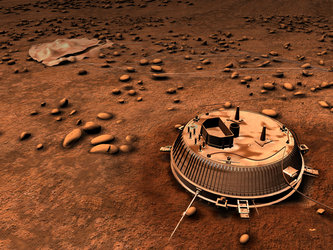
Tracking Huygens during its descent
ESA scientists have teamed up with the Joint Institute for Very Long Baseline Interferometry in Europe (JIVE) for an experiment which is expected to bring unique information from the Huygens probe during its descent through Titan’s atmosphere.
They intend to use a technique called Very Long Baseline Interferometry (VLBI) to pick-up the probe’s faint radio signal here on Earth and use it for reconstruction of the trajectory of descent of the probe in the atmosphere of Titan.
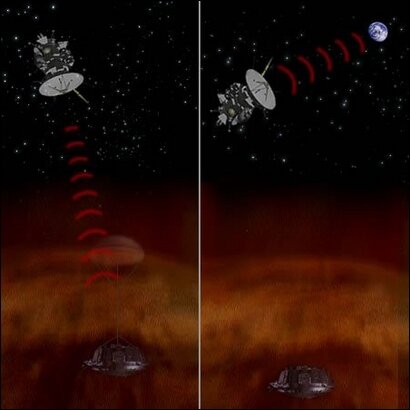
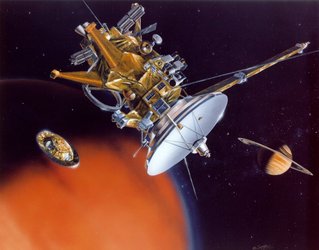
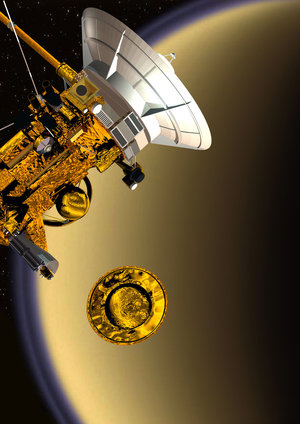
As the Huygens probe parachutes down to the surface of Titan, it beams its radio signal to the Cassini orbiter flying overhead. Cassini will be pointing its high-gain antenna towards Titan to receive the Huygens data and to measure the ‘Doppler shift’ of the received signal.
The latter will be used for measurements of the radial velocity of the probe along the line connecting Cassini and Huygens.
A few hours later, Cassini must turn its high-gain antenna away from Titan and relay the Huygens data back to Earth. However, the very faint Huygens signal itself will also reach Earth, but only 80 minutes after the descent, this delay being due to the distance.
Working with partners and organisations in the USA, Australia, China and Japan, the team is preparing to use the VLBI technique to pick up the probe’s faint radio signal here on Earth.
The project is jointly co-ordinated by ESA and JIVE, located in Dwingeloo, The Netherlands. It also involves the Netherlands Foundation for Research in Astronomy, University of Bonn (Germany), Helsinki University of Technology (Espoo, Finland), NASA Jet Propulsion Laboratory (Pasadena, USA), National Radio Astronomy Observatory (NRAO, Green Bank and Socorro, USA), Australia Telescope National Facility (Epping, Australia), University of Tasmania (Hobart, Australia), National Astronomical Observatories of China and Shanghai Astronomical Observatory (Shanghai and Urumqi, China) and the National Institute for Communication Technologies (Kashima, Japan).
Because this technique uses an array of radio telescopes located thousands of kilometres apart, they must be carefully co-ordinated. The signals received at each telescope are recorded and sent for processing at a special correlation facility. In the case of Huygens VLBI tracking, data from about twenty radio telescopes located in Asia, Australia and the United States will be processed at the European VLBI Network Data Processor at JIVE.
VLBI tracking of Huygens during its parachute descent in the atmosphere of Titan will allow observers to reach an unprecedented accuracy of about one kilometre in determination of the probe’s position - at the distance between Earth and Titan of 1200 million kilometres! Such the angular resolution would allow sport fans to watch a trajectory of a table-tennis ball if the game was played on the Moon!
The Huygens tracking experiment pushes the applications of VLBI technologies to their extremes. This is why a number of ‘local’ and ‘global’ tests and dry runs were to be conducted in the run up to the Huygens atmosphere entry scheduled for 14 January 2005. In particular, on 27 August and 17 November 2004, the Huygens VLBI tracking team conducted test observations using the carrier signal from the Cassini-Huygens spacecraft as a training ‘beacon’.

Telescopes in China (Shanghai and Urumqi), the Netherlands (Westerbork), USA (Robert C. Byrd/Green Bank Telescope and several VLBA stations), five radio telescopes in Australia (Ceduna, Hobart, Mopra, Parkes and the Australia Telescope Compact Array) and Japan (Kashima) were involved in these tests.
The tests marked the highest VLBI achievements to date. For example, this was the first time that disk-only recording was used with the highest data rate of 1 Gbit/s, using the largest steerable radio telescope on the planet, the NRAO’s 110-metre Green Bank radio telescope.
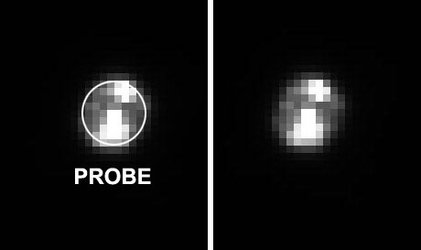
The data obtained in the test are being analysed using special software tools developed for the Huygens VLBI tracking experiment. The tests resulted in successful detection of the Cassini-Huygens narrow-band carrier signal. At the time of writing, fine-tuning of the data processing algorithms continues in order to achieve best possible performance in the real event of 14 January 2005.
The Huygens VLBI tracking experiment shows an example of the synergy between experimental techniques developed in fundamental astrophysics and based on radio physics, quantum electronics and digital signal processing, with planetary science and exploration of the Solar System by deep space probes. This synergy is the first step in future novel applications of VLBI for planetary missions in the coming decades.