• → European Space Agency

      • Space for Europe
      • Space News
      • Space in Images
      • Space in Videos
    • About Us

      • Welcome to ESA
      • DG's News and Views
      • For Member State Delegations
      • Business with ESA
      • ESA Exhibitions
      • ESA Publications
      • Careers at ESA
    • Our Activities

      • Space News
      • Observing the Earth
      • Human Spaceflight
      • Launchers
      • Navigation
      • Space Science
      • Space Engineering
      • Operations
      • Technology
      • Telecommunications & Integrated Applications
    • For Public

    • For Media

    • For Educators

    • For Kids

    • ESA

    • Space Science

    • Our Universe
    • About Space Science
    • ESA's 'Cosmic Vision'
    • Science missions
    • Mission navigator
    • Target groups
    • For Media
    • For Scientists
    • For Kids
    • Multimedia
    • Science images
    • Science videos
    • Animations
    • Downloads
    • Sounds from space
    • Resources
    • Reference section
    • Services
    • FAQs
    • Glossary
    • Help
    • Portal terms of use
    • Comments
    • ESA Press Releases
    • Follow us
    • RSS feeds
    • ESA Sci on Twitter
    • ESA Space Science Images on Flickr
    • ESA 3D on Flickr

    ESA > Our Activities > Space Science

    Venus cloud tops

    Chasing clouds on Venus

    8 October 2012

    Clouds regularly punctuate Earth’s blue sky, but on Venus the clouds never part, for the planet is wrapped entirely in a 20 km-thick veil of carbon dioxide and sulphuric dioxide haze.

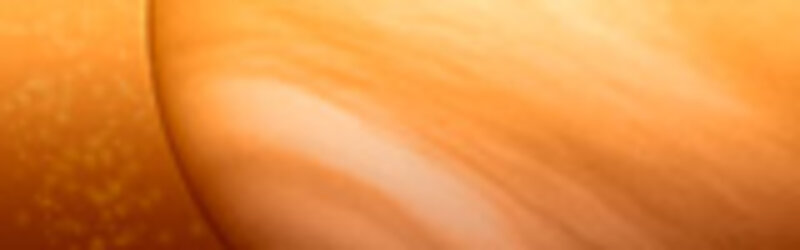
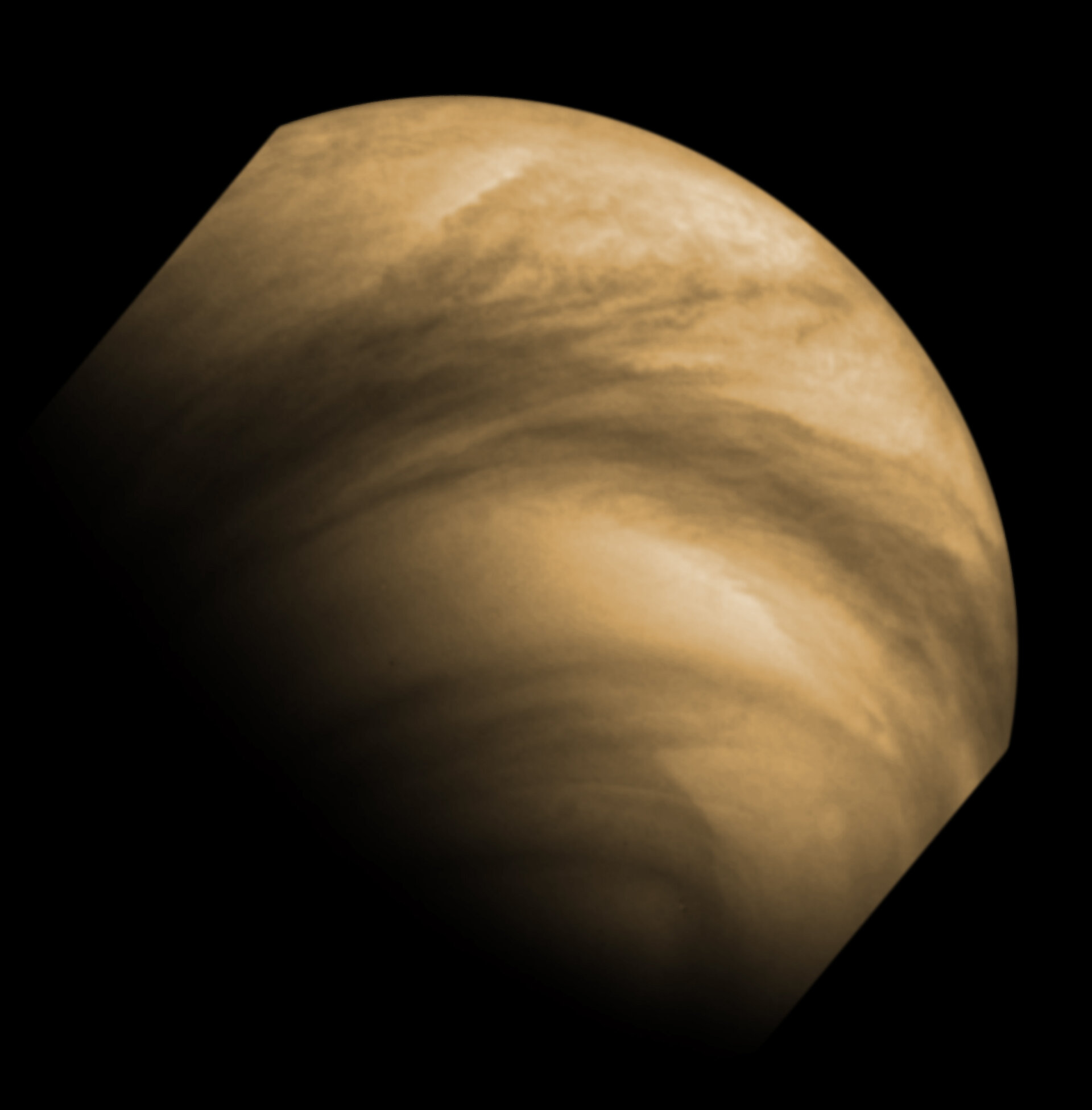
    This view shows the cloud tops of Venus as seen in ultraviolet light by the Venus Express spacecraft on 8 December 2011, from a distance of about 30 000 km.

    Much of the image is occupied by the planet’s southern hemisphere, with the south pole at the bottom of the frame and the equator close to the top. The visible top cloud layer seen in the image is about 70 km above the planet’s surface.

    The observed pattern of bright and dark markings is caused by variations in an unknown absorbing chemical at the Venus cloud tops. It is abundant in the low latitudes (upper part of the image) that make this region look dark in UV.

    In the brighter high latitudes (lower part of the image), the UV absorber is either in deficit or masked by a thick haze of a reflecting aerosol.

    The shapes of the cloud top features show evidence of vigorous circulation and dynamics in the planet’s atmosphere.

    At low latitudes, mottled cloud formations associated with turbulent activities are seen, while smooth, laminar flows are visible in middle to high latitudes.

    The wind speed is derived from tracking cloud features as they whip around the planet faster than 100 metres per second. This ‘super-rotating’ atmosphere completes one circuit every four Earth days, in comparison to the planet’s surface, which takes 224 days to complete one revolution about its axis.

    Rate this

    Views

    Share

    • Currently 1 out of 5 Stars.
    • 1
    • 2
    • 3
    • 4
    • 5
    Rating: 1/5 (2 votes cast)

    Thank you for rating!

    You have already rated this page, you can only rate it once!

    Your rating has been changed, thanks for rating!

    49
    facebook
    twitter
    reddit
    google plus
    digg
    tumbler
    digg
    blogger
    myspace
    • Archive
      • Image of the week archive
      • Space Live
        Space Live
        Space science image gallery
      • Looking at Venus
      • Transit of Venus blog
      • For the media
      • Venus Express Press Kit
      • Venus Express brochure (pdf)
      • Related articles
        • A curious cold layer in the atmosphere of Venus
          • Transit of Venus wows astronomers worldwide
            • Could Venus be shifting gear?
              • ESA finds that Venus has an ozone layer too
                • Venus holds warning for Earth
                • In depth
                • Venus Express in-depth
                • Follow us
                • ESA Space Science Image of the Week on Flickr
                • ESA 3D on Flickr
                • ESA Sci on Twitter

    Connect with us

    • RSS
    • Youtube
    • Twitter
    • Flickr
    • Google Buzz
    • Subscribe
    • App Store
    • ESA Science Twitter

    Follow ESA science

    • LATEST ARTICLES
    • · CryoSat hits land
    • · Ariane 5 completes seven launches …
    • · Measuring skull pressure without t…
    • · Malargüe station inauguration
    • · The solar wind is swirly
    • FAQ

    • Jobs at ESA

    • Site Map

    • Contacts

    • Terms and conditions