Cluster quartet take a trip down Earth’s tail
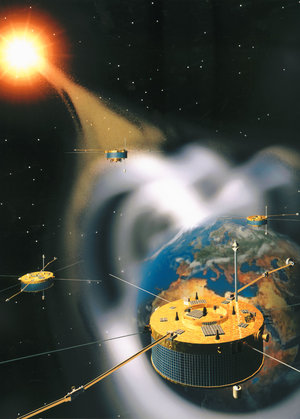
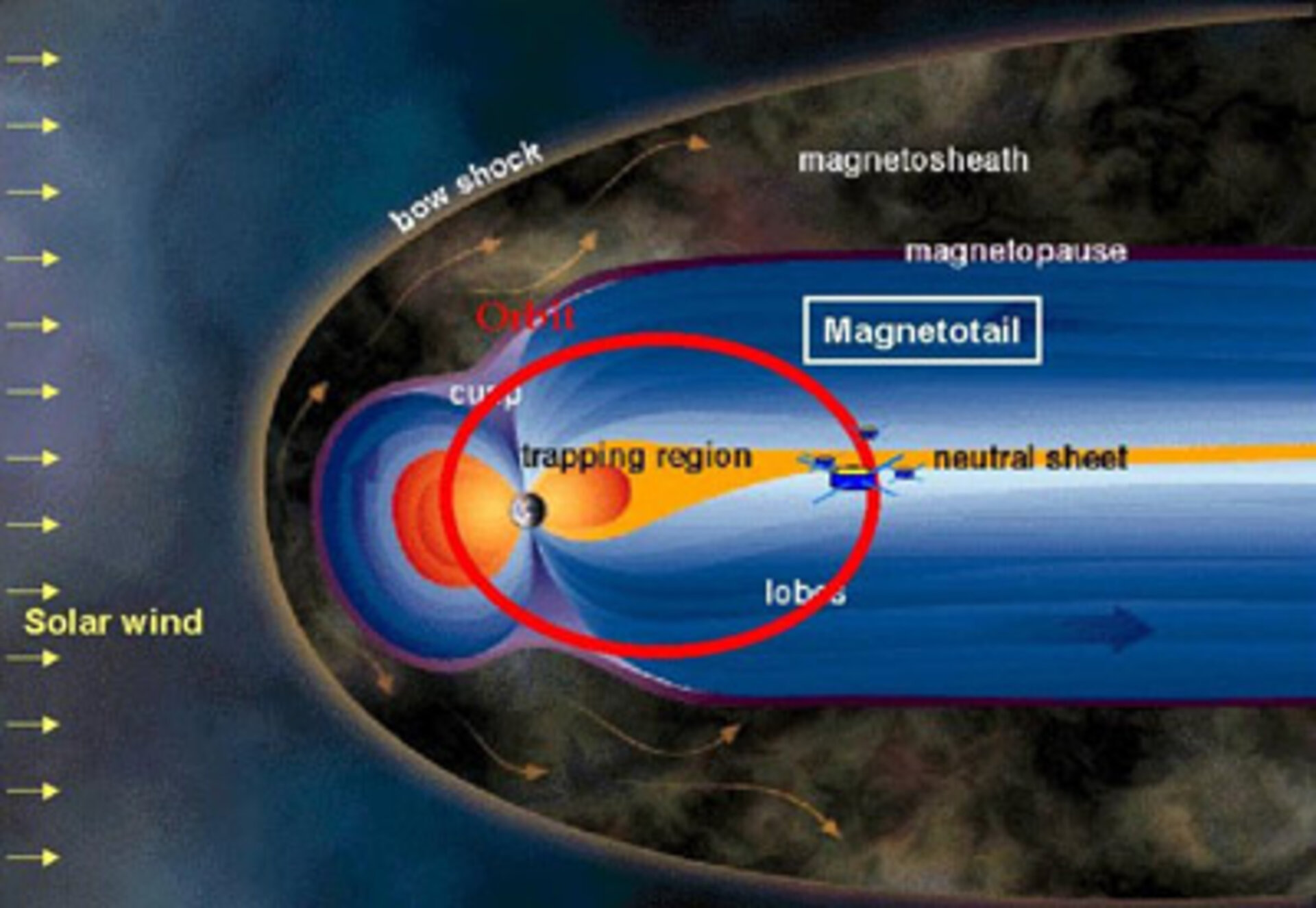
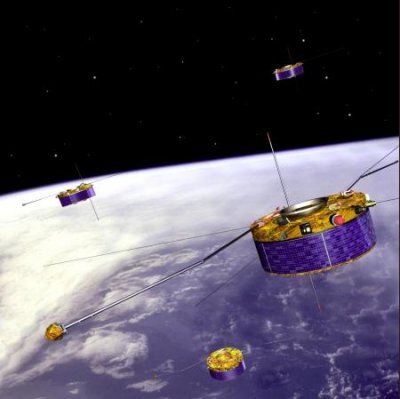
Everyone is familiar with animals' tails, but less well known is the fact that most planets have tails too – huge, magnetic tails filled with electrified gas rather than fur, flesh and muscle. Since the end of August, ESA's four Cluster spacecraft have been flying along the middle of the Earth's magnetotail, carrying out the most in-depth exploration of this region ever undertaken.
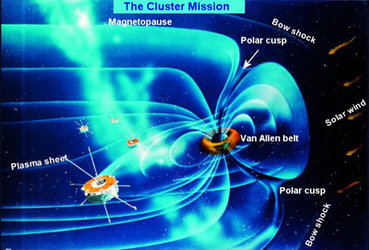
The tail that Cluster is traversing is part of the invisible bubble in space that is created by Earth's magnetic field. If the vast reaches of space between the planets were completely empty, then the magnetic bubble would be shaped something like a round ball. But Earth is continually bombarded by a supersonic blast of electrically charged particles - electrons and protons - from the Sun. This so-called solar wind sweeps around the magnetic bubble, shaping it so that it resembles a giant windsock.
Trapped inside the tail is a complex mixture of particles that have escaped from Earth's upper atmosphere and from the Sun. Scientists know that these particles can pick up energy and be accelerated towards the planet's poles, where they create the auroras - Northern and Southern Lights.
"Exactly what causes these substorms is still uncertain," said Cluster project scientist, Philippe Escoubet. "Cluster will give us unique sets of data from 42 instruments that will help us to unravel what is happening in the magnetotail." "This is extremely important," he added, "because substorms can cause power blackouts and communication breakdowns on Earth, as well as beautiful auroras."
Although our Earth's tail has been explored by numerous spacecraft over the past few decades, many mysteries remain. This is mainly because the magnetotail is so large - it stretches at least two million kilometres into space on the night side of the Earth. Single spacecraft cannot hope to discover the secrets of this vast region.
However, by travelling up to 120 000 km along the magnetotail once every 56 hours, the Cluster quartet should be able to pin down the physical processes taking place at its heart. As they fly in a tetrahedral formation, about 2000 km apart, the spacecraft will obtain the first detailed, three-dimensional view of this magnetic powerhouse.
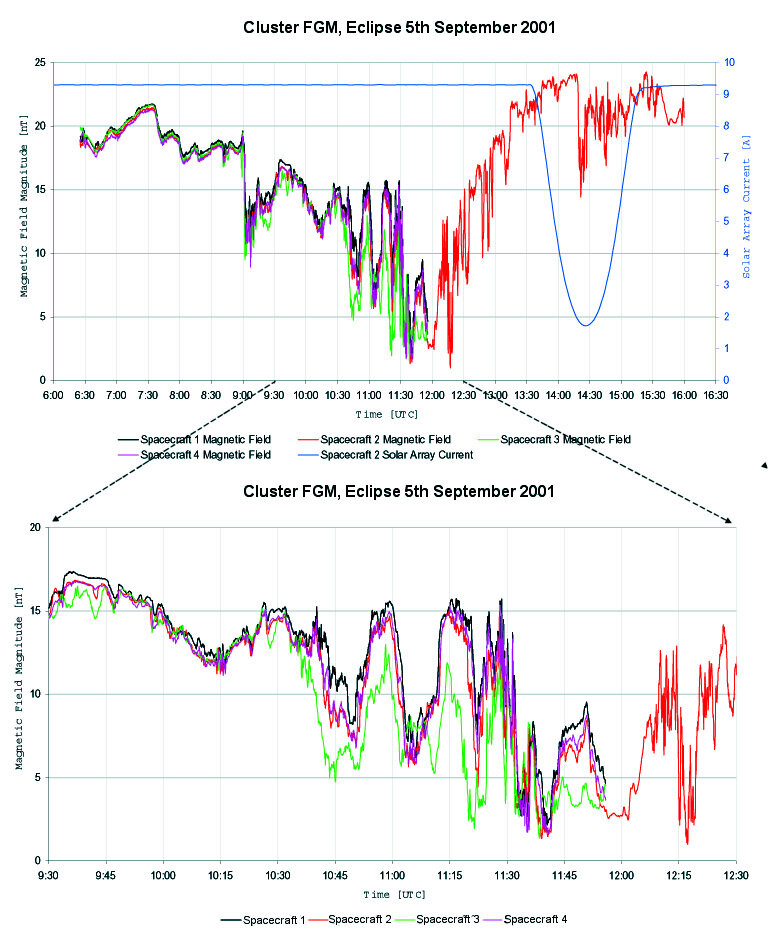
Meanwhile, Cluster's passage through the mid-tail region on the Earth's night side caused a small headache for the spacecraft operations team - a series of three eclipses, the longest of which lasted for around four hours, between 30 August and 5 September. With no sunlight falling on their solar cells while they were in the planet's shadow, ground controllers decided to conserve battery power by shutting down all of the instruments except one of the FGM magnetometers.
This was the first time that magnetic field data had been obtained during an eclipse since Cluster became operational. The measurements show that the magnetic field dropped erratically in the plasma sheet - the central region of the tail. There were also some small variations during the eclipse.
"The smaller disturbances during the eclipse were almost certainly parts of the tail plasma sheet and not due to lack of sunlight at the time," said Professor André Balogh of Imperial College London, principal investigator for the FGM instruments.
"I'm pleased to say that all of the instruments are now back online and the spacecraft are in fine shape," commented Dr. Escoubet after the completion of Cluster's final eclipse.
The spacecraft will stay in the tail until the end of October, after which they will turn their attention once more to other regions of near-Earth space. However, if all goes according to plan, Cluster should once more plunge into the elongated magnetotail for a second prolonged period of exploration towards the end of 2002.