Space weather
The solar wind of particles streaming from the Sun can become gusty and even build up into storms. Driven by solar magnetic activity, the solar wind and solar storms lead to what is known as space weather.
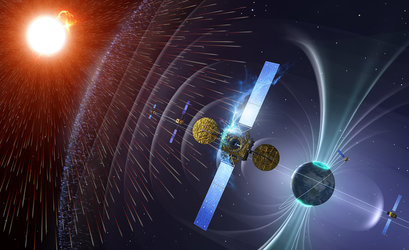
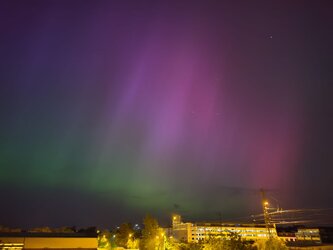
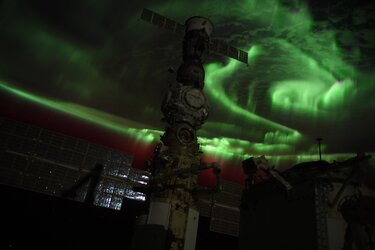
Solar storms can spark colourful auroras in the night sky and, more seriously, prove dangerous to modern technology. They can endanger astronauts and satellites, and disrupt communications, computers, power supplies and navigation systems on Earth. This makes space weather a matter necessitating constant vigilance, with spacecraft watching for events on the Sun that may cause trouble on Earth in the coming minutes and days.
During a solar storm, the Sun can follow the following sequence of events, although not all the elements are apparent every time.
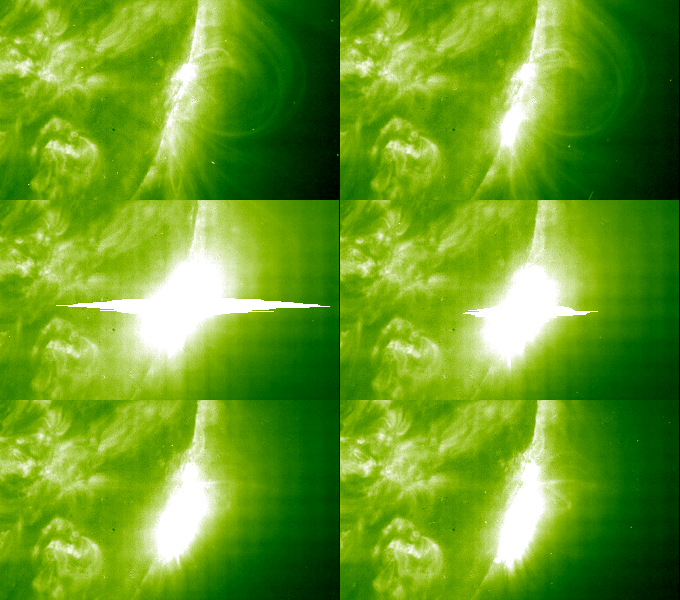
When a solar flare erupts, the magnetic explosion can release as much energy as a billion atomic bombs. A torrent of X-rays and ultraviolet rays leave the Sun at the speed of light. If they are heading towards Earth, they arrive here eight minutes later before being absorbed in the ionosphere, potentially disrupting short-wave radio transmissions and causing errors in navigation systems.
Following on about an hour or two behind are high-speed solar protons and other energetic particles. These can harm astronauts, damage spacecraft and, if they reach the ground, cause errors in computers.
A flare is often accompanied by a large eruption of gas from the Sun’s outer atmosphere, known as a 'coronal mass ejection' (CME). A CME creates gusts and shock waves in the solar wind, which, if heading towards Earth, can take anything from 18 hours to a few days to reach us.

When a CME arrives, it buffets Earth's magnetic field, causing a geomagnetic storm. This makes compass needles wander and can provoke damaging surges of electrical current in long metallic structures such as power lines and pipelines. It also allows more particles from space to enter the upper atmosphere, where they collide with atoms and molecules, creating auroras.
The various effects of solar storms heat Earth’s upper atmosphere, making it swell and increasing its drag on low-altitude satellites. If a satellite does not compensate by using its thrusters, it can be dragged out of orbit. This effect also has a positive side, as it helps to drag space debris down into the atmosphere, where it burns up.
Telecommunications and weather satellites in geostationary orbits suffer in a different way. If a gust in the solar wind squeezes the magnetosphere severely enough, the satellites can find themselves outside the shield and more exposed to damaging particles.
However, in one respect the solar storms themselves shield Earth. They reduce the intensity of cosmic rays, the energetic emissions reaching Earth from outside our Solar System. Major storms can cause a big drop in the cosmic-ray count for a day or two. Over longer periods the average cosmic-ray count falls as solar activity increases during the 11-year solar cycle.

Access the video
Sun science and space safety
ESA is working hard to improve our understanding of space weather and reduce its harmful impacts. For decades, the agency has been leading and collaborating on space science missions gathering data on the Sun and Sun–Earth interactions. Space weather is also a key component of ESA's Space Situational Awareness programme, part of the agency's efforts to improve space safety.
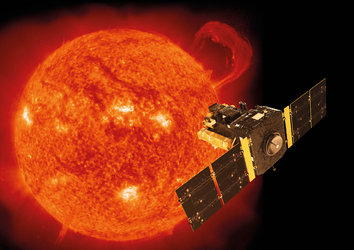
Current and completed missions related to solar activity and space weather include: Proba-3 (2024–now), Solar Orbiter (2020–now), Swarm (2013–now), Proba-2 (2009–now), SOHO (1995–now), Cluster (2000–2024), Ulysses (1990–2009) and Double Star (2003–2007).
Soon to be launched are:
- Smile (2026), a collaborative mission with the Chinese Academy of Sciences to study how solar wind and other activity interacts with Earth's magnetic field
- NanoMagSat (2027/2028), a set of three small satellites to monitor Earth's magnetic field
- Vigil (2031), designed to provide continuous, near real-time data on potentially hazardous solar activity before it rolls into Earth's view