Swing mission overview
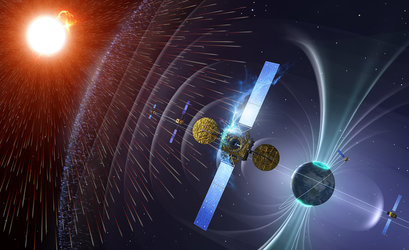
ESA’s first space weather nanosatellite mission, Swing, will demonstrate the capability of very small satellites to provide important, near-real time space weather data in a reliable and cost-effective manner for use in operational applications.
Mission objectives

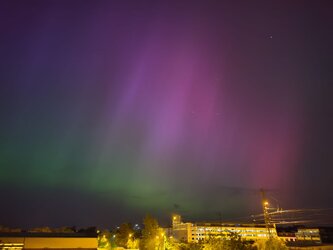
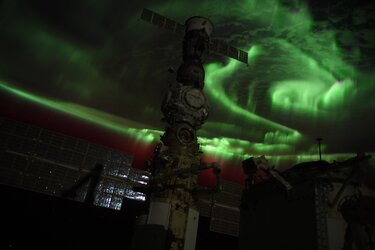
ESA’s Space Weather Ionosphere Nanosat Generation (Swing) will monitor the ionosphere, a layer of the atmosphere which affects communications and navigation services, and provide data for operational space weather applications.
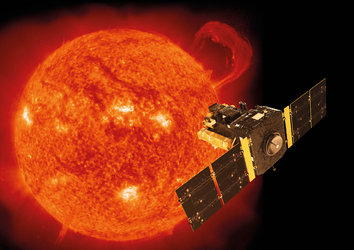
Swing’s data on electron density, charged particle radiation and solar X-ray flux will improve our understanding of the effects of space weather and be used to produce accurate nowcasts of the state of the ionosphere and provide actionable information to European satellite operators.


Access the video
“Individually, nanosatellites provide an innovative opportunity to implement cost-effective, targeted space missions. As a constellation, they have the potential to form an effective part of the European space weather monitoring system. With Swing, we will demonstrate the suitability of nanosatellites as part of a space weather system and also as a way to bring European industry into the domain of space weather monitoring.”
-- Juha-Pekka Luntama, Head of the ESA Space Weather Office.
"Understanding the behaviour of the ionosphere is crucial to build reliable navigation and communication services. Its electrically charged particles can have a critical effect on high-precision GNSS services by causing positioning or timing errors. Swing’s data will help to further understand the effects of space weather and provide accurate nowcasts of the state of the ionosphere.”
-- Melanie Heil, Space Segment Coordinator in the Space Weather Office and Swing Project Manager.
“Space weather poses a significant risk to our infrastructure on Earth and in space. Developing space weather sensors that can provide actionable information to the operators of critical European infrastructure is one of the main objectives of ESA's Space Safety Programme.”
-- Holger Krag, ESA Space Safety Programme Manager.
Spacecraft and instruments

Development of the Swing spacecraft is led by prime contractor Hemeria (France), who will also oversee the procurement of the satellite’s instruments, development, integration, test, launch campaign, in-space commissioning and routine operations. The spacecraft will be assembled at Hemeria's facilities in Toulouse, France.
The spacecraft will be based on Hemeria’s HP-IOT nanosatellite platform. The payload will consist of the following four instruments:
- DREAM - Radiation monitor - CNES, Steel Electronique (France)
- XFM-NS - X-ray monitor - Isaware (Finland)
- m-NLP – Langmuir Probe - EIDEL (Norway)
- Aquila – GNSS radio occultation instrument - Syntony (France)
The spacecraft’s data will be used by space weather models to provide accurate ionospheric weather nowcasts and forecasts to the user community. Data from the Swing mission will also be valuable for scientific research on the upper atmosphere.
Orbit and operations

Swing will adopt a Sun-synchronous orbit, a special type of polar orbit that allows the satellite to pass over the same spot on Earth’s surface at the same local time each day. At an altitude of between 500 and 600 km, the nanosat will perform consistent in-situ measurement of the ionosphere and record how it changes over time.
The Swing Mission Operations Centre and the delivery of the processed space weather data to ESA are sub-contracted to Planetek (Italy).
Launch
Swing is planned for launch in 2027. Routine data provision is expected to begin in early 2028 via the ESA Space Weather Portal.