• → European Space Agency

      • Space for Europe
      • Space News
      • Space in Images
      • Space in Videos
    • About Us

      • Welcome to ESA
      • DG's news and views
      • For Member State Delegations
      • Business with ESA
      • Law at ESA
      • ESA Exhibitions
      • ESA Publications
      • Careers at ESA
      • ESAshop
    • Our Activities

      • Space News
      • Observing the Earth
      • Human Spaceflight
      • Space Transportation
      • Navigation
      • Space Science
      • Space Engineering & Technology
      • Operations
      • Telecommunications & Integrated Applications
      • Preparing for the Future
    • Careers at ESA

    • For Media

      • Media
      • ESA TV
      • Videos for professionals
      • Photos
    • For Educators

    • For Kids

    • ESA

    • Space Science

    • Our Universe
    • About Space Science
    • ESA's 'Cosmic Vision'
    • Science missions
    • Mission navigator
    • Target groups
    • For Media
    • For Scientists
    • For Kids
    • Multimedia
    • Science images
    • Science videos
    • Science poster
    • Animations
    • Downloads
    • Sounds from space
    • Resources
    • Reference section
    • Services
    • FAQs
    • Glossary
    • Comments
    • Follow us
    • ESA Sci on Twitter
    • ESA Space Science Images on Flickr
    • ESA 3D on Flickr
    • Terms and conditions

    ESA > Our Activities > Space Science

    Loading...
    Revealing the cosmic microwave background with Planck
    Access the video

    Cosmic detectives

    2 April 2013

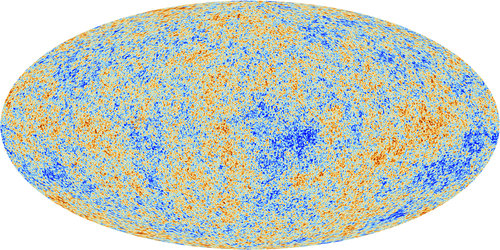
    Cosmologists recently unveiled the best image yet of the cosmic microwave background – the ‘afterglow’ of the Big Bang – by ESA’s Planck space telescope.

    The background is the oldest light in our Universe, imprinted on the sky when it was just 380 000 years old. It shows tiny temperature fluctuations that correspond to regions of slightly different densities at very early times, representing the seeds of all future structure: the stars and galaxies of today.

    This animation illustrates the painstaking detective work performed by cosmologists to extract the cosmic microwave background from 15.5 months of data collected by Planck.

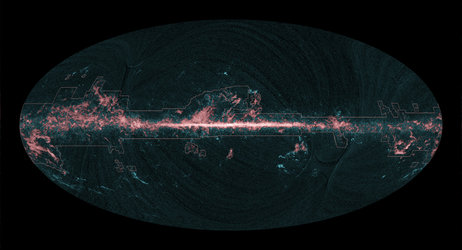
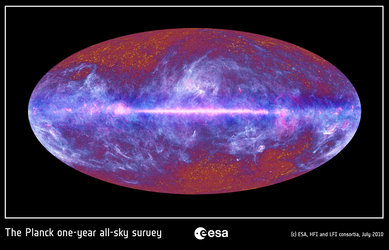
    The first image in the sequence shows the sources of emission detected on the whole sky at the microwave and submillimetre wavelengths probed by Planck, which range from 11.1 mm to 0.3 mm, corresponding to frequencies between 27 GHz and 1 THz.

    The different sources include discrete emission from individual galactic and extragalactic sources, and diffuse radio and thermal emission from interstellar material in the Milky Way.

    The cosmologists had to remove all possible contamination due to emission by foreground sources before they could fully explore the cosmic microwave background, which is unveiled in the final slide of the animation.

    Using the new map, cosmologists can find clues to the formation and evolution of our Universe since the Big Bang 13.8 billion years ago, and trace the history of star and galaxy formation to the present day.

    This week, cosmologists are meeting at a dedicated Planck symposium hosted by ESA’s space research and technology centre, ESTEC, in the Netherlands, to discuss the results and implications of the new cosmology results.

    On Wednesday 3 April a ‘public’ session will be streamed live via the web. The session opens at 16:15 GMT (18:15 CEST) and will finish at around 17:30 GMT (19:30 CEST).

    Two short presentations will highlight Planck’s contribution to cosmology, and the importance of the map released on 21 March.

    Visitors watching the live feed are invited to contribute to the Q&A session by asking questions via Twitter to @esascience using the hashtag #AskPlanck or by emailing them to scicom[@]esa.int.
    Rate this

    Views

    Share

    • Currently 5 out of 5 Stars.
    • 1
    • 2
    • 3
    • 4
    • 5
    Rating: 5/5 (3 votes cast)

    Thank you for rating!

    You have already rated this page, you can only rate it once!

    Your rating has been changed, thanks for rating!

    4083
    Tweet

    Related articles

    Planck reveals an almost perfect Universe21 March 2013

    Planck reveals an almost perfect Universe21 March 2013 Acquired by ESA’s Planck space telescope, the most detailed map ever created of the cosmic microwave background – the relic radiation from the Big Bang – was released today revealing the existence of features that challenge the foundations of our curr...

    Coming soon: Planck unveils the cosmic microwave background18 March 2013

    Coming soon: Planck unveils the cosmic microwave background18 March 2013 This Thursday, scientists will unveil the best image yet of the cosmic microwave background – the ‘afterglow’ of the Big Bang – by ESA’s Planck space telescope.

    All-sky image of molecular gas seen by Planck and previous surve

    Planck steps closer to the cosmic blueprint13 February 2012

    All-sky image of molecular gas seen by Planck and previous surve

    Planck steps closer to the cosmic blueprint13 February 2012 ESA’s Planck mission has revealed that our Galaxy contains previously undiscovered islands of cold gas and a mysterious haze of microwaves. These results give scientists new treasure to mine and take them closer to revealing the blueprint of cosmic st...

    Planck’s new view of the cosmic theatre11 January 2011

    Planck’s new view of the cosmic theatre11 January 2011 ESA PR-3 2011 The first scientific results from ESA’s Planck mission were released at a press briefing today in Paris. The findings focus on the coldest objects in the Universe, from within our Galaxy to the distant reaches of space.

    Planck unveils the Universe – now and then05 July 2010

    Planck unveils the Universe – now and then05 July 2010 ESA PR-15 2010 ESA’s Planck mission has delivered its first all-sky image. It not only provides new insight into the way stars and galaxies form but also tells us how the Universe itself came to life after the Big Bang.

    • ESA Space Science Portal
    • Space Live
      Space Live
      Space science image gallery
    • Planck: looking back at the dawn of time
    • Planck Toolkit
    • Planck toolkit introduction
    • Planck and the CMB
    • CMB and inflation
    • CMB and the distribution of matter
    • Tools to study the distribution of matter
    • History of cosmic structure formation
    • Effect of cosmic structure on CMB
    • In depth
    • Planck in depth
    • Planck Science Team
    • Related links
    • 47th ESLAB Symposium
    • Planck symposium live streaming
    • App Store
    • Subscribe
    • mobile version
    • ESA Science Twitter

    @ESAscience

    • LATEST ARTICLES
    • · Exploration makes perfect
    • · A job and a half for first Eurosta…
    • · ɸ and citizens
    • · Microlaunchers: new ways to access…
    • · Electric blue thrusters propelling…
    • FAQ

    • Site Map

    • Contacts

    • Terms and conditions