Darwin overview
Objective
Darwin was a phase-A study performed by ESA. It studied a constellation of spacecraft to find Earth-like planets - the most likely places where life as we know it could develop. Darwin proposed to survey 1000 of the closest stars looking for small, rocky planets.
Mission
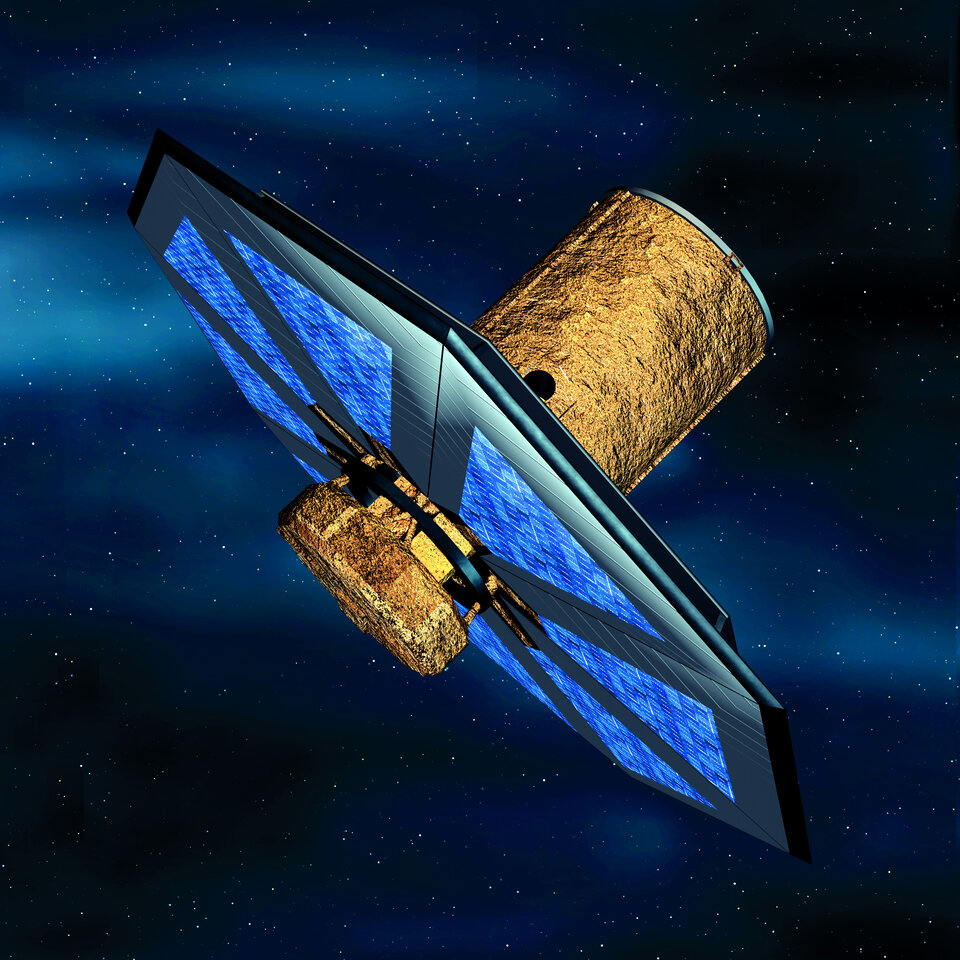
Darwin was proposed as a constellation of four or five free-flying spacecraft designed to search for Earth-like planets around other stars and analyse their atmospheres for chemical signatures of life.
The constellation was proposed to carry out high-resolution imaging using aperture synthesis in order to provide pictures of celestial objects in unprecedented detail.
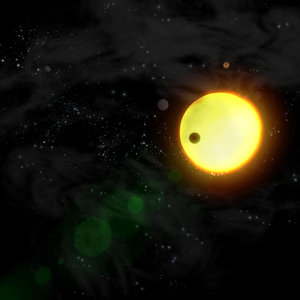
Looking for planets that orbit stars outside the Solar System, or extrasolar planets, is very hard. Even for nearby stars, it is like trying to see the feeble light from a candle next to a lighthouse 1000 km away.
At optical wavelengths a star outshines an Earth-like planet by a thousand million to one. Partly to overcome this difficulty, Darwin proposed to conduct observations in the mid-infrared. At these wavelengths the star-planet contrast drops to a million to one, making detection a little easier.
What's special?
Darwin’s observations would have been carried out in the infrared since life on Earth leaves some of its marks at these wavelengths.
On Earth, biological activity produces gases that mingle with our atmosphere. For example, plants give out oxygen and animals expel carbon dioxide and methane. These gases and other substances, such as water, leave their fingerprints by absorbing certain wavelengths of infrared light. Darwin would have split the light from an extrasolar planet into its constituent colours, using an instrument called a spectrometer.
This would show the drop in light caused by specific gases being in the atmosphere, allowing them to be identified. If they turned out to be the same as those produced by life on Earth, rather than by non-biological processes, Darwin would have found evidence for life on another world.
Earth’s atmosphere blocks the mid-infrared wavelengths that Darwin would be designed to observe. At room temperature, the telescopes would themselves emit infrared radiation, swamping their own observations. It would be like using a normal telescope to perform optical astronomy with a wall of floodlights pointing into it.
Outside Earth’s atmosphere, in outer space, temperatures are very low. Darwin’s telescope was to be designed to work at just 40K (–233°C) while the actual detector was to be reduced in temperature further to just 8K (–265°C). This would stop the telescope from giving out its own infrared signal, allowing it to search for faint light from distant planets.
Spacecraft
Three (or four) spacecraft of the Darwin constellation would have carried 3-4 m telescopes or light collectors, based on the Herschel design. These would have redirected light to the central hub spacecraft.
To meet its objective to find and investigate Earth-like planets, Darwin would have used a technique called 'nulling interferometry'. The light reaching some of the telescopes would have been delayed slightly before being combined again. This would have caused light from the central star to be 'cancelled out' in the resultant data.
Light from planets, however, is already delayed between one telescope and the other since the planet is to one side of where the telescopes are pointed. By delaying the light a second time, the light from the planet would be combined constructively, showing the planet. If not for this 'nulling', the starlight would overwhelm the planet's feeble glow.
In its 'imaging' mode, Darwin would have worked like a single large telescope, with a diameter of up to several 100 m, providing images of many types of celestial objects in detail.
For Darwin to work, the telescopes and the hub must have stayed in formation with millimetre precision. ESA was planning to achieve this aim using a variation of the highly successful Global Positioning System (GPS) that provides so much of the satellite-based navigation on Earth.
But this was not enough, as the light collected by the telescopes was supposed to be recombined at very high precision. A deviation of more than just 100 thousandths of a millimetre could have ruined the observation.
Although this sounds like an impossible feat of accuracy, ESA together with European industry had started some of the pre-developments for the necessary metrology and optical equipment that would allow such precision. The full demonstration of the final feasibility of the approach would have required more detailed studies.
The spacecraft was probably to be equipped with tiny ion engines that need just five kilograms of fuel to last the entire five-year mission. The ion engines expel small particles at very high velocity such that the spacecraft moves slightly in the opposite direction.
Journey
For launch, the mission would have required two launches with Soyuz-Fregat rockets.
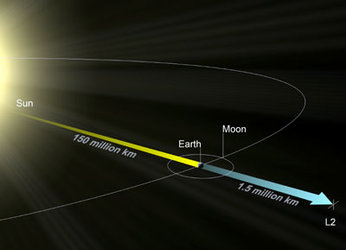
Instead of an orbit around Earth, Darwin would have been placed far away, beyond the Moon. At a distance of 1.5 million kilometres from Earth, in the opposite direction from the Sun, Darwin would have operated from the second Lagrange Point (L2).
History
The idea for this mission was proposed in 1993. Darwin's goals were to detect Earth-like planets circling nearby stars and to set constraints on the possibility of the existence of life as we know it on these planets.
The goals were then expanded to include the capability to provide high-resolution images, at least 10 to 100 times more detailed than the James Webb Space Telescope (JWST), a joint NASA/ESA mission due for launch around 2014.
ESA had been working on possible designs since the mid-1990s. Scientists and engineers redesigned the Darwin flotilla, finding ingenious ways to reduce the demanding technological requirements of the various spacecraft. ESA followed on with a study to investigate a way to achieve the same scientific results using just four free-flying telescopes instead of eight.
Partnerships
During the Darwin study, NASA was also considering missions similar to Darwin. Given the ambitious nature of both projects, NASA and ESA considered a collaboration on the final mission.