• → European Space Agency

      • Space for Europe
      • Space News
      • Space in Images
      • Space in Videos
    • About Us

      • Welcome to ESA
      • DG's News and Views
      • For Member State Delegations
      • Business with ESA
      • ESA Exhibitions
      • ESA Publications
      • Careers at ESA
    • Our Activities

      • Space News
      • Observing the Earth
      • Human Spaceflight
      • Launchers
      • Navigation
      • Space Science
      • Space Engineering
      • Operations
      • Technology
      • Telecommunications & Integrated Applications
    • For Public

    • For Media

      • Media
      • ESA TV
      • Videos for professionals
      • Photos
    • For Educators

    • For Kids

    • ESA

    • Space Science

    • Our Universe
    • About Space Science
    • ESA's 'Cosmic Vision'
    • Science missions
    • Mission navigator
    • Target groups
    • For Media
    • For Scientists
    • For Kids
    • Multimedia
    • Science images
    • Science videos
    • Animations
    • Downloads
    • Sounds from space
    • Resources
    • Reference section
    • Services
    • FAQs
    • Glossary
    • Help
    • Portal terms of use
    • Comments
    • Follow us
    • RSS feeds
    • ESA Sci on Twitter
    • ESA Space Science Images on Flickr
    • ESA 3D on Flickr

    ESA > Our Activities > Space Science

    Will Huygens land or splashdown?
    Will Huygens land or splashdown on Titan?

    ESA’s ‘shipping forecast’ - from Titan!

    ESA could be releasing its own marine weather report next January - but not for any Earthly ocean. Thanks to the NASA/ESA Cassini-Huygens mission, the first data about an extraterrestrial ocean may finally be received, ending 25 years of scientific speculation.

    There is a growing body of evidence that at least part of Titan’s surface is covered with liquid methane and a related chemical, ethane. On Earth, methane is a gas but at the colder temperatures of Titan, around –180 °C, it could exist as a liquid or be frozen solid into ice. If it is a liquid, it could exist as lakes in craters or even as vast oceans.

    Recent radar observations suggest that up to seventy-five percent of the surface may be covered in liquid. In that case, it is highly likely that after its descent through Titan’s atmosphere, the Huygens probe will not so much land as ‘splashdown’.
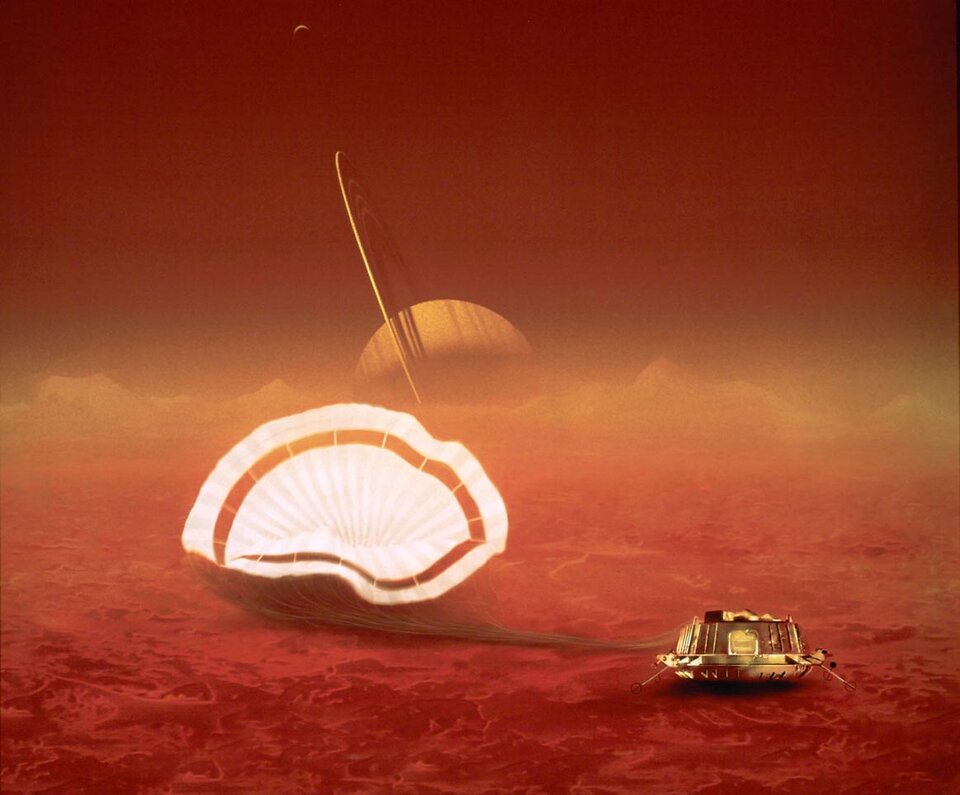
    Cassini /Huygens
    Landing on an ocean would be better than on a solid surface

    To understand what to expect if this happens, the Principal Investigator of the Huygens Surface Science Package, John Zarnecki of the UK’s Open University, has teamed up with Nadeem Ghafoor, Surrey Satellite Technology, and colleagues from the Southampton Oceanography Centre.

    Together, the team used a computer model to predict the behaviour of the ocean on Titan. They looked at the waves they might encounter.

    On Earth, wind drives the waves. By placing Titan’s characteristics into their computer program, the team discovered that Titan’s waves will be slow-motion giants, reaching some seven times the height of a typical wave on Earth. Their height is mostly generated because Titan’s gravitational strength is only one seventh that of Earth.


    Titan's waves would look seven times bigger but move three times more slowly than those on Earth, giving surfers a wild ride!

    If Huygens does land on an ocean, the Surface Science Package will attempt to measure its composition, and depth using sonar. It will also record the frequency and height of any waves that pass.

    Extreme sports fans might find surfing on these waves a wild ride, according to Nadeem Ghafoor, because the waves would look seven times bigger but move three times more slowly than those on Earth.

    Of course, the sea would be 180 degrees below zero and it would not smell very good either. The surroundings would be a murky orange-brown because of the permanently overcast conditions and there might be the occasional iceberg to dodge near the shore!

    In short, Titan could be like nothing like we have seen before and Cassini-Huygens is due to reveal all on 14 January 2005.

    Rate this

    Views

    Share

    • Currently 0 out of 5 Stars.
    • 1
    • 2
    • 3
    • 4
    • 5
    Rating: 0/5 (0 votes cast)

    Thank you for rating!

    You have already rated this page, you can only rate it once!

    Your rating has been changed, thanks for rating!

    37
    Tweet
    • More about...
      • Cassini-Huygens overview
      • Related articles
        • No rest on the way to the most mysterious of Saturn's moons
          • Splashing down on Titan's oceans
            • Challenges of landing on alien worlds
              • ESA to search for life, but not as we know it
              • Related links
              • Where is Cassini-Huygens now?

    Connect with us

    • RSS
    • Youtube
    • Twitter
    • Flickr
    • G+
    • Facebook
    • Livestream
    • Subscribe
    • App Store
    • ESA Science Twitter

    Follow ESA science

    • LATEST ARTICLES
    • · Rare merger reveals secrets of gal…
    • · Watching for hazards: ESA opens as…
    • · ESA astronaut Timothy Peake set fo…
    • · Space drives e-mobility
    • · Proba-V opens its eyes
    • FAQ

    • Jobs at ESA

    • Site Map

    • Contacts

    • Terms and conditions