Euclid overview
Name
Euclid. Euclid is named after the Greek mathematician Euclid of Alexandria, who lived around 300 BC and founded the subject of geometry. As the density of matter and energy is linked to the geometry of the Universe, the mission was named in his honour.
Launch
1 July 2023
Mission objectives
Euclid is designed to explore the evolution of the dark Universe. It is creating a 3D-map of the Universe (with time as the third dimension) by observing billions of galaxies out to 10 billion light-years, across more than a third of the sky.
While dark energy accelerates the expansion of the Universe and dark matter governs the growth of cosmic structures, scientists remain unsure about what dark energy and dark matter actually are.
By observing the Universe evolving over the past 10 billion years, Euclid is revealing how it has expanded and how structure has formed over cosmic history – and from this, astronomers can infer the properties of dark energy, dark matter and gravity, to reveal more about their precise nature.
This addresses two core themes of ESA’s Cosmic Vision programme: What are the fundamental physical laws of the Universe? and How did the Universe originate and what is it made of?
Key questions
Euclid is designed to tackle some of the most important questions in cosmology:
- What is the structure and history of the cosmic web?
- What is the nature of dark matter?
- How has the expansion of the Universe changed over time?
- What is the nature of dark energy?
- Is our understanding of gravity complete?
Spacecraft and instruments
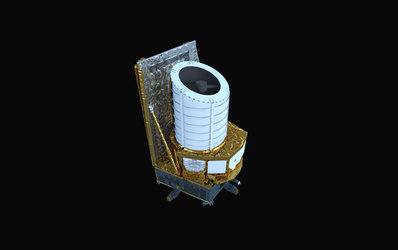
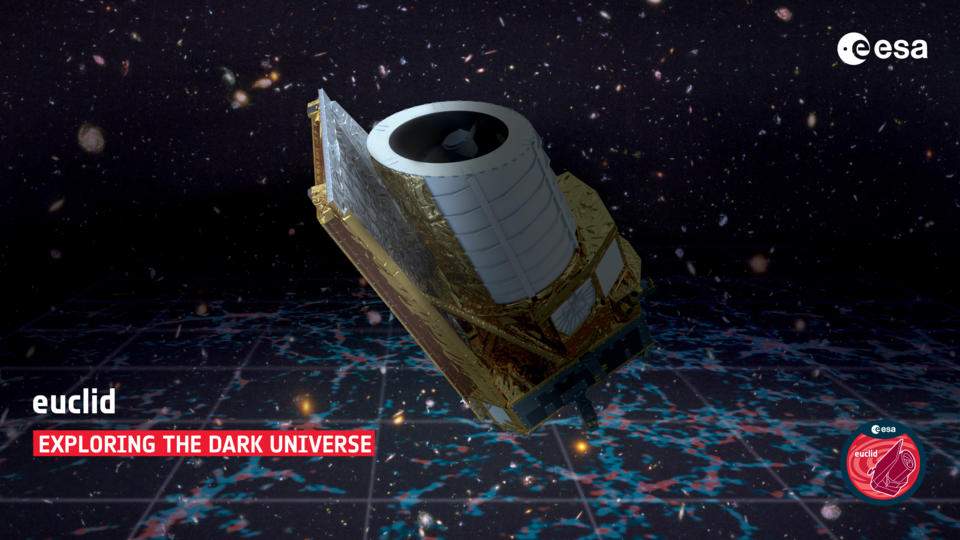
The Euclid spacecraft is approximately 4.7 m tall and 3.7 m in diameter. It consists of two major components: the service module and the payload module.
The payload module comprises a 1.2-m-diameter telescope and two scientific instruments: a visible-wavelength camera (the VISible instrument, VIS) and a near-infrared camera/spectrometer (the Near-Infrared Spectrometer and Photometer, NISP). The service module contains the satellite systems: electric power generation and distribution, attitude control, data processing electronics, propulsion, telecommand and telemetry, and thermal control.
Journey and orbit
Euclid launched on a SpaceX Falcon 9 launch vehicle from Cape Canaveral, Florida, USA. Its is currently observing the Universe from the Sun-Earth Lagrange point 2 (L2), at an average distance of 1.5 million km from Earth. This special location keeps pace with Earth as we orbit the Sun (and also hosts ESA’s Gaia and Webb space telescopes).
Lifetime
Nominal mission lifetime is six years, with the possibility of extension (limited by the amount of cold gas used for propulsion).
History
Euclid emerged from two mission concepts that were proposed in response to the ESA Cosmic Vision 2015-2025 Call for Proposals, issued in March 2007: Dune, the Dark Universe Explorer, and Space, the Spectroscopic All Sky Cosmic Explorer. Both missions proposed complementary techniques to probe dark energy, and after an assessment study phase, they came together as a combined mission: Euclid. In October 2011 Euclid was selected by ESA’s Science Programme Committee for implementation, and it was formally adopted in June 2012.
Collaboration
Euclid is a European mission, built and operated by ESA, with contributions from its Member States and NASA. The Euclid Consortium – consisting of more than 2000 scientists from 300 institutes in 15 European countries, the USA, Canada and Japan – is responsible for providing the scientific instruments and scientific data analysis. ESA selected Thales Alenia Space as prime contractor for the construction of the satellite and its service module, with Airbus Defence and Space chosen to develop the payload module, including the telescope. NASA provided the detectors of the Near-Infrared Spectrometer and Photometer, NISP. Euclid is a medium-class mission in ESA’s Cosmic Vision Programme.
Euclid mission facts
Euclid was launched in July 2023 and started its routine science observations on 14 February 2024. In November 2023 and May 2024, the world got its first glimpses of the quality of Euclid’s images, and in October 2024 the first piece of its great map of the Universe was released.
Euclid is a cosmology survey mission, optimised to determine the properties of dark energy and dark matter on universal scales.
Euclid takes images in optical and near-infrared light; these images will eventually cover more than one-third of the extragalactic sky outside the Milky Way, and depict billions of cosmic targets out to a distance where light has taken up to 10 billion years to reach us.
Euclid’s image quality is at least four times sharper than that achieved by ground-based sky surveys.
In addition, Euclid performs near-infrared spectroscopy of hundreds of millions of galaxies and stars over the same sky. This will allow scientists to investigate the chemical and kinematical properties of many targets in detail.
Euclid will build up a large archive of unique data, unprecedented by volume for a space-based mission, enabling research over all disciplines in astronomy.
Euclid’s mass in orbit is 2 tonnes (including 800 kg of payload module, an 850 kg service module, 40 kg of balancing mass and 210 kg of propellant).