• → European Space Agency

      • Space for Europe
      • Space News
      • Space in Images
      • Space in Videos
    • About Us

      • Welcome to ESA
      • DG's News and Views
      • For Member State Delegations
      • Business with ESA
      • ESA Exhibitions
      • ESA Publications
      • Careers at ESA
    • Our Activities

      • Space News
      • Observing the Earth
      • Human Spaceflight
      • Launchers
      • Navigation
      • Space Science
      • Space Engineering
      • Operations
      • Technology
      • Telecommunications & Integrated Applications
    • For Public

    • For Media

    • For Educators

    • For Kids

    • ESA

    • Space Science

    • Our Universe
    • About Space Science
    • ESA's 'Cosmic Vision'
    • Science missions
    • Mission navigator
    • Target groups
    • For Media
    • For Scientists
    • For Kids
    • Multimedia
    • Science images
    • Science videos
    • Animations
    • Downloads
    • Sounds from space
    • Resources
    • Reference section
    • Services
    • FAQs
    • Glossary
    • Help
    • Portal terms of use
    • Comments
    • ESA Press Releases
    • Follow us
    • RSS feeds
    • ESA Sci on Twitter
    • ESA Space Science Images on Flickr
    • ESA 3D on Flickr

    ESA > Our Activities > Space Science

    Eyeing up the total solar eclipse

    Eyeing up the total solar eclipse

    17 December 2012

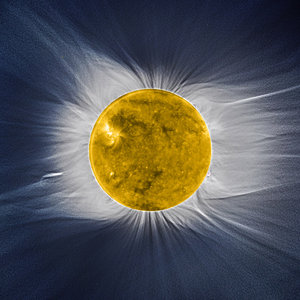
    The Sun appears to be eyeballing us in this unique portrayal of the total solar eclipse last month, which combines ground-based images with views from the Proba-2 and SOHO satellites.

    The colourful ‘pupil’ of this solar eye is created from ESA’s Proba-2 view of the solar disc at the time of the eclipse as observed from Earth.

    The images were taken by the satellite’s SWAP imager, which observes the Sun in ultraviolet light.

    The colours have been manipulated to distinguish between vastly different features, in particular to show the intensities of stormy active regions.

    Dark blue sites represent sunspots, with bunches of magnetic field lines arching out from the surface. Sunspots are the footprints of some large solar flares and coronal mass ejections that are occasionally directed towards Earth.

    The blue ‘iris’ is a composite of hundreds of white-light exposures taken continuously during the two-minute total eclipse as seen from northern Australia on 13 November.

    Observing in visible light extremely close to the solar surface is only possible from the ground during eclipses when the solar disc is temporarily obscured by the Moon, briefly exposing the Sun’s atmosphere, or corona.

    Loops of magnetic field lines and ‘streamers’ can clearly be seen in the white-light images, spilling over into the corresponding wide-field view from the ESA/NASA SOHO satellite as the solar wind blows these features out into space.

    The connection between the ground- and space-based images provides a unique opportunity to correlate difficult-to-see regions of the Sun’s atmosphere, visible only during the fleeting moments of a total solar eclipse, with well-known features on the solar disc and the wider solar environment.

    The image also reminds us that even as our planet’s northern hemisphere heads towards winter solstice this week, the Sun is still very active, with a magnetic environment that changes with every blink of an eye.
    Rate this

    Views

    Share

    • Currently 4.5 out of 5 Stars.
    • 1
    • 2
    • 3
    • 4
    • 5
    Rating: 4.5/5 (6 votes cast)

    Thank you for rating!

    You have already rated this page, you can only rate it once!

    Your rating has been changed, thanks for rating!

    979
    facebook
    twitter
    reddit
    google plus
    digg
    tumbler
    digg
    blogger
    myspace

    Related articles

    Totality

    Proba-2 soaks up three solar eclipses14 November 2012

    Totality

    Proba-2 soaks up three solar eclipses14 November 2012 ESA’s Sun-watching Proba-2 satellite experienced three partial solar eclipses last night while lucky observers watching from northern Australia were treated to a total solar eclipse.

    Get ready for a total solar eclipse!12 November 2012

    Get ready for a total solar eclipse!12 November 2012

    Transit of Venus wows astronomers worldwide06 June 2012

    Transit of Venus wows astronomers worldwide06 June 2012 Astronomers around the world looked to the sky last night and this morning to observe Venus as it passed across the face of the Sun for the last time this century. ESA’s Sun-watching space missions also tuned in for the solar spectacular.

    Proba-2 catches solar eclipse21 May 2012

    Proba-2 catches solar eclipse21 May 2012 Europe missed Sunday’s solar eclipse on the other side of the planet but ESA’s space weather microsatellite Proba-2 passed repeatedly through the Moon’s shadow.

    Proba-2 teams up with solar eclipse watchers12 July 2010

    Proba-2 teams up with solar eclipse watchers12 July 2010 Astronomers gathered among the stone-carved heads of Easter Island on Sunday to witness a total eclipse of the Sun. Meanwhile, 720 km away in space, ESA’s Proba-2 was focused on the same target.

    Proba-2 tracks Sun surging into space30 June 2010

    Proba-2 tracks Sun surging into space30 June 2010 Proba-2 is a small but innovative member of ESA’s spacecraft fleet, crammed with experimental technologies. In its first eight months of life it has already returned more than 90 000 images of the Sun.

    • Space Science Image of the Week Archive
    • Space Live
      Space Live
      Space science image gallery
    • More about...
    • Proba-2
    • SOHO
    • Follow us
    • ESA Space Science Image of the Week on Flickr
    • ESA 3D on Flickr
    • ESA Sci on Twitter

    Connect with us

    • RSS
    • Youtube
    • Twitter
    • Flickr
    • Google Buzz
    • Subscribe
    • App Store
    • ESA Science Twitter

    Follow ESA science

    • LATEST ARTICLES
    • · CryoSat hits land
    • · Ariane 5 completes seven launches …
    • · Measuring skull pressure without t…
    • · Malargüe station inauguration
    • · The solar wind is swirly
    • FAQ

    • Jobs at ESA

    • Site Map

    • Contacts

    • Terms and conditions