• → European Space Agency

      • Space for Europe
      • Space News
      • Space in Images
      • Space in Videos
    • About Us

      • Welcome to ESA
      • DG's News and Views
      • For Member State Delegations
      • Business with ESA
      • ESA Exhibitions
      • ESA Publications
      • Careers at ESA
    • Our Activities

      • Space News
      • Observing the Earth
      • Human Spaceflight
      • Launchers
      • Navigation
      • Space Science
      • Space Engineering
      • Operations
      • Technology
      • Telecommunications & Integrated Applications
    • For Public

    • For Media

    • For Educators

    • For Kids

    • ESA

    • Space Science

    • Our Universe
    • About Space Science
    • ESA's 'Cosmic Vision'
    • Science missions
    • Mission navigator
    • Target groups
    • For Media
    • For Scientists
    • For Kids
    • Multimedia
    • Science images
    • Science videos
    • Animations
    • Downloads
    • Sounds from space
    • Resources
    • Reference section
    • Services
    • FAQs
    • Glossary
    • Help
    • Portal terms of use
    • Comments
    • ESA Press Releases
    • Follow us
    • RSS feeds
    • ESA Sci on Twitter
    • ESA Space Science Images on Flickr
    • ESA 3D on Flickr

    ESA > Our Activities > Space Science

    Gaia antenna in test chamber

    Gaia checks out of antenna testing

    2 July 2012

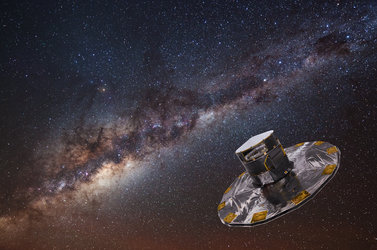
    Entombed by the distinctive foam pyramids typical of test chambers, the main antenna of the Gaia billion-star surveyor has been put through its paces ahead of launch next year.

    The antenna will send Gaia’s precious science data to Earth from its location 1.5 million kilometres away.

    Over five years, Gaia is expected to download 200 TB of data – the equivalent of nearly 45 000 standard DVDs – as it makes precise measurements of the positions of a billion stars.

    The information will be used to create a 3D map of stars in our home Galaxy, revealing information about its composition, formation and evolution.

    Since the spacecraft rotates in space, a complex antenna steered electronically is required to ensure the beam is always directed towards Earth.

    By comparison, a conventional mechanical antenna would create tiny vibrations that would impair the performance of the mapping telescope.

    The photo shows the 1.5m diameter Gaia antenna panel in the test facility at EADS CASA, Madrid. The chamber’s walls are covered with pyramids of non-reflective foam that absorb reflected radio waves to simulate the boundless nature of space.

    The chamber also blocks all external signals, such as aircraft radar and cell phones.

    As the panel has to radiate the heat generated by the satellite and received from the Sun, it is covered with mirrors.

    Gaia will be launched in 2013 from Europe’s Spaceport in French Guiana, and will have an initial lifetime of five years.

    Rate this

    Views

    Share

    • Currently 0 out of 5 Stars.
    • 1
    • 2
    • 3
    • 4
    • 5
    Rating: 0/5 (0 votes cast)

    Thank you for rating!

    You have already rated this page, you can only rate it once!

    Your rating has been changed, thanks for rating!

    24
    facebook
    twitter
    reddit
    google plus
    digg
    tumbler
    digg
    blogger
    myspace
    • Archive
      • Image of the week archive
      • Space Live
        Space Live
        Space science image gallery
      • More about
        • Gaia overview
          • Gaia factsheet
          • Related articles
            • Gaia spreads its wings
              • Gaia to lift off from Europe’s Spaceport on a Soyuz launcher
                • ESA selects prime contractor for Gaia astrometry mission
                  • Most extensive mapping of Milky Way a step closer
                    • Keeping ESA’s ‘lady of space’ cool
                      • The billion-pixel camera
                        • Mapping the Galaxy, and watching our backyard
                        • In depth
                        • Gaia in depth
                        • Follow us
                        • ESA Space Science Image of the Week on Flickr
                        • ESA 3D on Flickr
                        • ESA Sci on Twitter

    Connect with us

    • RSS
    • Youtube
    • Twitter
    • Flickr
    • Google Buzz
    • Subscribe
    • App Store
    • ESA Science Twitter

    Follow ESA science

    • LATEST ARTICLES
    • · CryoSat hits land
    • · Ariane 5 completes seven launches …
    • · Measuring skull pressure without t…
    • · Malargüe station inauguration
    • · The solar wind is swirly
    • FAQ

    • Jobs at ESA

    • Site Map

    • Contacts

    • Terms and conditions