• → European Space Agency

      • Space for Europe
      • Space News
      • Space in Images
      • Space in Videos
    • About Us

      • Welcome to ESA
      • DG's News and Views
      • For Member State Delegations
      • Business with ESA
      • ESA Exhibitions
      • ESA Publications
      • Careers at ESA
    • Our Activities

      • Space News
      • Observing the Earth
      • Human Spaceflight
      • Launchers
      • Navigation
      • Space Science
      • Space Engineering
      • Operations
      • Technology
      • Telecommunications & Integrated Applications
    • For Public

    • For Media

      • Media
      • ESA TV
      • Videos for professionals
      • Photos
    • For Educators

    • For Kids

    • ESA

    • Space Science

    • Our Universe
    • About Space Science
    • ESA's 'Cosmic Vision'
    • Science missions
    • Mission navigator
    • Target groups
    • For Media
    • For Scientists
    • For Kids
    • Multimedia
    • Science images
    • Science videos
    • Animations
    • Downloads
    • Sounds from space
    • Resources
    • Reference section
    • Services
    • FAQs
    • Glossary
    • Help
    • Portal terms of use
    • Comments
    • Follow us
    • RSS feeds
    • ESA Sci on Twitter
    • ESA Space Science Images on Flickr
    • ESA 3D on Flickr

    ESA > Our Activities > Space Science

    Herschel to finish observing soon

    Herschel and Rosette Nebula
    5 March 2013

    ESA’s Herschel space observatory is expected to exhaust its supply of liquid helium coolant in the coming weeks after spending more than three exciting years studying the cool Universe. 

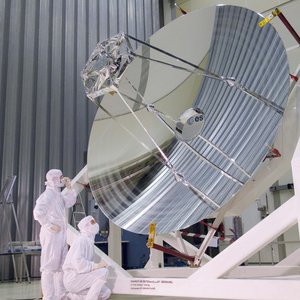
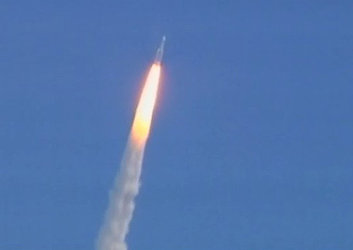
    Herschel was launched on 14 May 2009 and, with a main mirror 3.5 m across, it is the largest, most powerful infrared telescope ever flown in space.

    A pioneering mission, it is the first to cover the entire wavelength range from the far-infrared to submillimetre, making it possible to study previously invisible cool regions of gas and dust in the cosmos, and providing new insights into the origin and evolution of stars and galaxies.

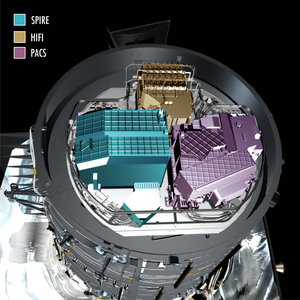
    In order to make such sensitive far-infrared observations, the detectors of the three science instruments – two cameras/imaging spectrometers and a very high-resolution spectrometer – must be cooled to a frigid –271°C, close to absolute zero. They sit on top of a tank filled with superfluid liquid helium, inside a giant thermos flask known as a cryostat.
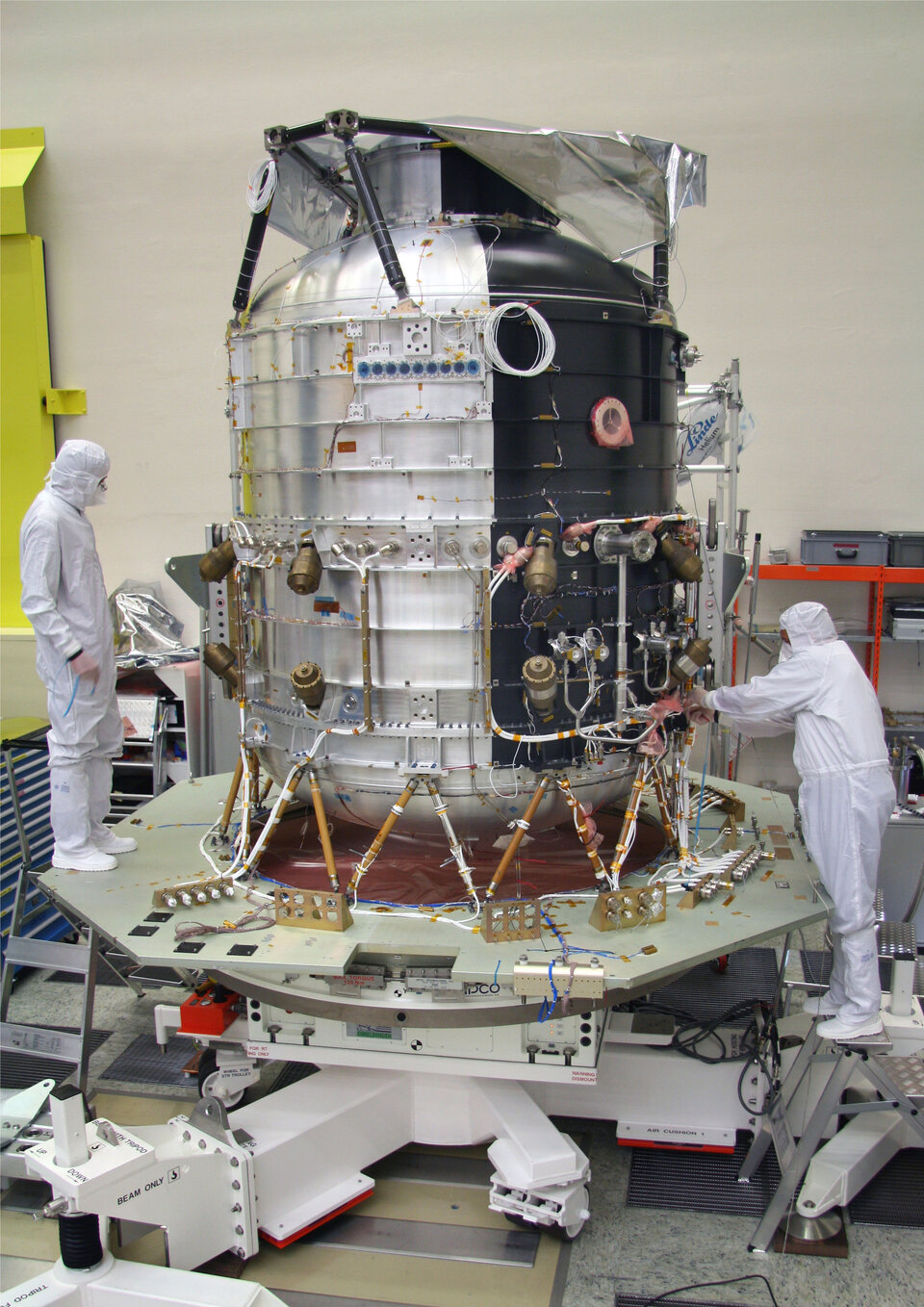
    Herschel’s cryostat vacuum vessel

    The superfluid helium evaporates over time, gradually emptying the tank and determining Herschel’s scientific life. At launch, the cryostat was filled to the brim with over 2300 litres of liquid helium, weighing 335 kg, for 3.5 years of operations in space.

    Indeed, Herschel has made extraordinary discoveries across a wide range of topics, from starburst galaxies in the distant Universe to newly forming planetary systems orbiting nearby young stars.

    However, all good things must come to an end and engineers believe that almost all of the liquid helium has now gone.

    It is not possible to predict the exact day the helium will finally run out, but confirmation will come when Herschel begins its next daily 3-hour communication period with ground stations on Earth.

    “It is no surprise that this will happen, and when it does we will see the temperatures of all the instruments rise by several degrees within just a few hours,” says Micha Schmidt, the Herschel Mission Operations Manager at ESA’s European Space Operations Centre in Darmstadt, Germany.
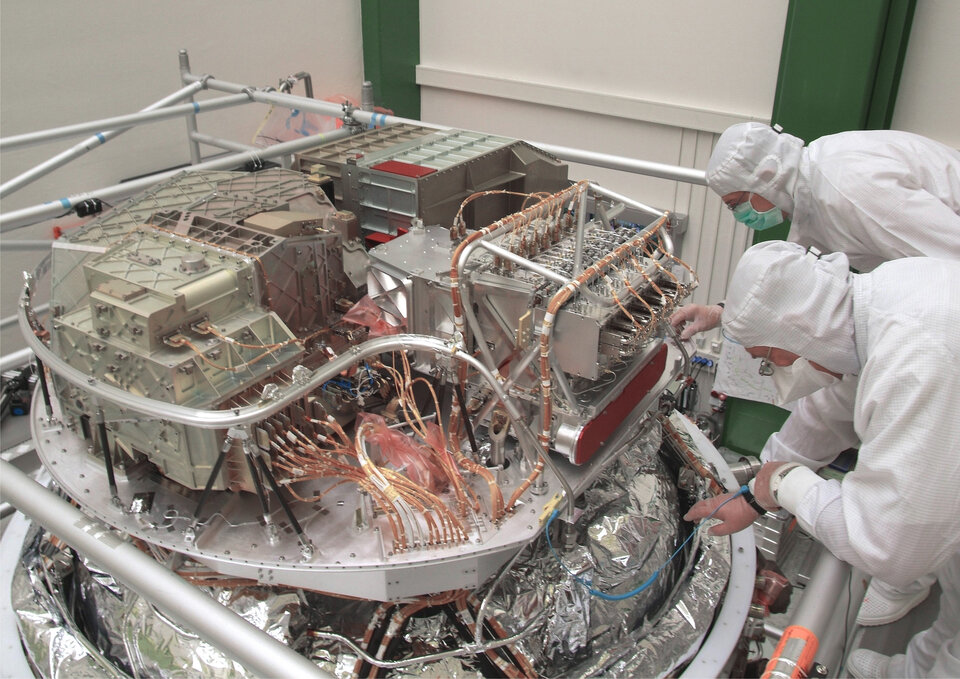
    Integrating the instruments

    The science observing programme was carefully planned to take full advantage of the lifetime of the mission, with all of the highest-priority observations already completed.

    In addition, Herschel is performing numerous other interesting observations specifically chosen to exploit every last drop of helium.

    “When observing comes to an end, we expect to have performed over 22 000 hours of science observations, 10% more than we had originally planned, so the mission has already exceeded expectations,” says Leo Metcalfe, the Herschel Science Operations and Mission Manager at ESA’s European Space Astronomy Centre in Madrid, Spain.

    Herschel

    “We will finish observing soon, but Herschel data will enable a vast amount of exciting science to be done for many years to come,” says Göran Pilbratt, ESA’s Herschel Project Scientist at ESA’s European Space Research and Technology Centre in Noordwijk, the Netherlands.

    “In fact, the peak of scientific productivity is still ahead of us, and the task now is to make the treasure trove of Herschel data as valuable as possible for now and for the future.”

    Herschel will continue communicating with its ground stations for some time after the helium is exhausted, allowing a range of technical tests. Finally, in early May, it will be propelled into its long-term stable parking orbit around the Sun. 


    Notes for Editors

    An announcement will follow to confirm when the liquid helium coolant has been exhausted.

    Herschel carries three science instruments: HIFI (Heterodyne Instrument for the Far Infrared), a high-resolution spectrometer; PACS (Photoconductor Array Camera and Spectrometer); SPIRE (Spectral and Photometric Imaging REceiver). PACS and SPIRE are both cameras and imaging spectrometers that together cover the wavelength range 55–672 microns. HIFI covers the two wavelength bands 157–212 microns and 240–625 microns. All three instruments are cooled to –271ºC inside a cryostat filled with liquid superfluid helium.

    Herschel is an ESA space observatory with science instruments provided by European-led Principal Investigator consortia and with important participation from NASA.

    For further information, please contact:

    Markus Bauer


    ESA Science and Robotic Exploration Communication Officer


    Tel: +31 71 565 6799


    Mob: +31 61 594 3 954


    Email: markus.bauer@esa.int

    Micha Schmidt
    Herschel Mission Operations Manager
    European Space Operations Centre (ESOC), Darmstadt, Germany
    Email: micha.schmidt@esa.int

    Leo Metcalfe
    Herschel Science Operations and Mission Manager
    European Space Astronomy Centre (ESAC), Madrid, Spain
    Email: leo.metcalfe@sciops.esa.int

    Göran Pilbratt

    ESA Herschel Project Scientist


    European Space Research and Technology Centre (ESTEC), Noordwijk, the Netherlands
    Tel: +31 71 565 3621


    Email: gpilbratt@rssd.esa.int
    Rate this

    Views

    Share

    • Currently 5 out of 5 Stars.
    • 1
    • 2
    • 3
    • 4
    • 5
    Rating: 4.87/5 (54 votes cast)

    Thank you for rating!

    You have already rated this page, you can only rate it once!

    Your rating has been changed, thanks for rating!

    11013
    Tweet

    Related articles

    'Cigar' Galaxy M 82

    More about the infrared08 May 2008

    'Cigar' Galaxy M 82

    More about the infrared08 May 2008 Observations in the infrared have revolutionised astronomy, revealing previously hidden aspects of the Universe that have changed our perception of the world around us. The Universe seen in the infrared has proved amazingly rich and diverse. It has gi...

    Herschel telescope inspection

    The largest infrared space telescope08 May 2008

    Herschel telescope inspection

    The largest infrared space telescope08 May 2008 Herschel is the largest infrared space telescope ever launched. With its 3.5-m primary mirror, it is four times bigger than any previous infrared space telescope and almost one and a half times larger than the Hubble Space Telescope.

    Cutting-edge spacecraft08 May 2008

    Cutting-edge spacecraft08 May 2008

    Herschel's instruments

    Instruments08 May 2008

    Herschel's instruments

    Instruments08 May 2008 Herschel is equipped with three instruments that turn the telescope from a mere light-collector into powerful infrared eyes.

    Science objectives08 May 2008

    Science objectives08 May 2008 Herschel is set to revolutionise our understanding of the Universe. A versatile infrared space telescope, Herschel's main objective is to study relatively cool objects across the Universe: in particular the formation and evolution of stars and galaxie...

    Ariane 5 lifts off with Herschel and Planck on board

    ESA en route to the origins of the Universe14 May 2009

    Ariane 5 lifts off with Herschel and Planck on board

    ESA en route to the origins of the Universe14 May 2009 ESA PR 10-2009 Two of the most ambitious missions ever attempted to unveil the secrets of the darkest, coldest and oldest parts of the Universe got off to a successful start this afternoon with the dual launch of ESA’s far infrared space telescope Her...

    • Herschel: ESA's giant infrared observatory
    • More about...
    • Herschel overview
    • Online Showcase of Herschel Images OSHI
      • Herschel operations
      • Herschel on YouTube
      • Inside Herschel
      • Herschel mission objectives
      • In depth
      • Herschel in depth
      • Herschel Science Centre
      • Related links
      • Herschel postcard gallery
      • The Milky Way Project

    Connect with us

    • RSS
    • Youtube
    • Twitter
    • Flickr
    • G+
    • Facebook
    • Livestream
    • Subscribe
    • App Store
    • ESA Science Twitter

    Follow ESA science

    • LATEST ARTICLES
    • · Rare merger reveals secrets of gal…
    • · Watching for hazards: ESA opens as…
    • · ESA astronaut Timothy Peake set fo…
    • · Space drives e-mobility
    • · Proba-V opens its eyes
    • FAQ

    • Jobs at ESA

    • Site Map

    • Contacts

    • Terms and conditions