• → European Space Agency

      • Space for Europe
      • Space News
      • Space in Images
      • Space in Videos
    • About Us

      • Welcome to ESA
      • DG's News and Views
      • For Member State Delegations
      • Business with ESA
      • ESA Exhibitions
      • ESA Publications
      • Careers at ESA
    • Our Activities

      • Space News
      • Observing the Earth
      • Human Spaceflight
      • Launchers
      • Navigation
      • Space Science
      • Space Engineering
      • Operations
      • Technology
      • Telecommunications & Integrated Applications
    • For Public

    • For Media

    • For Educators

    • For Kids

    • ESA

    • ESA Science

    • Mars Express

    • Europe goes to Mars

      • Europe reclaims a stake in Mars exploration
      • Space age transforms our knowledge about Mars
    • About Mars Express

      • Mars Express mission facts
      • Mars Express instruments
      • The mission
      • The spacecraft
      • The launcher
    • About Mars

      • Geography of Mars
      • Water on early Mars?
      • Signatures of life
      • Facts about Mars
    • Meet the team

      • International collaboration
      • Project Manager
      • Project Scientist
      • Mars Lead Scientist
      • Principal Investigators
      • Operations
      • Industry
    • Multimedia
    • VideoTalk
    • Mars Express images
    • Mars Express videos
    • HRSC videos
    • Animation in 11 languages
    • Download wallpapers
    • Download screensavers
    • 3D Flash 'model'
    • Make a model
    • Services
    • Comments

    ESA > Our Activities > Space Science > Mars Express

    Exhumed rocks reveal Mars water ran deep

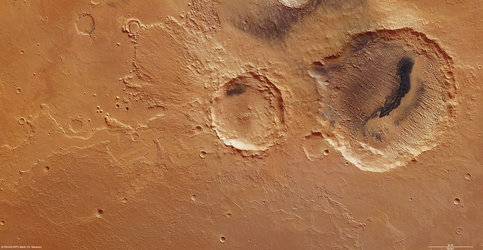
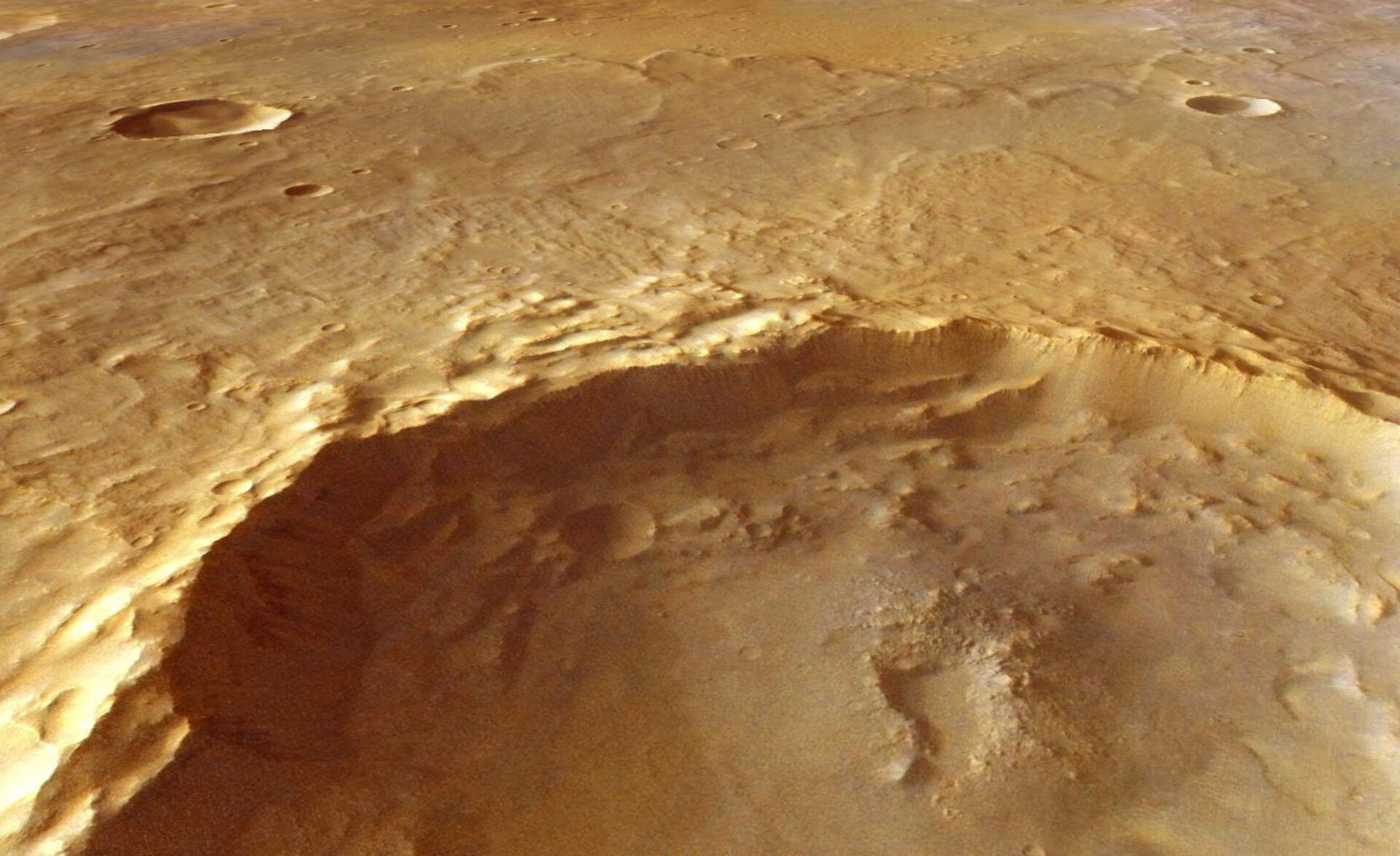
    Excavating water-rich rocks
    Excavating water-rich rocks
    27 June 2012

    By studying rocks blasted out of impact craters, ESA’s Mars Express has found evidence that underground water persisted at depth for prolonged periods during the first billion years of the Red Planet’s existence.

    Impact craters are natural windows into the history of planetary surfaces – the deeper the crater, the further back in time you can probe.

    In addition, rocks blasted out during the impact offer a chance to study material that once lay hidden beneath the surface.

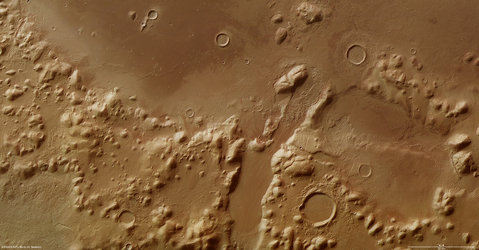
    In a new study, ESA’s Mars Express and NASA’s Mars Reconnaissance Orbiter zoomed in on craters in a 1000 x 2000 km region of the ancient southern highlands, called Tyrrhena Terra, to learn more about the history of water in this region.

    Focusing on the chemistry of rocks embedded in the crater walls, rims and central uplifts, as well as the surrounding exhumed material, scientists identified 175 sites bearing minerals formed in the presence of water.

    Tyrrhena Terra

    “The large range of crater sizes studied, from less than 1 km to 84 km wide, indicates that these hydrated silicates were excavated from depths of tens of metres to kilometres,” says Damien Loizeau, lead author of the study.

    “The composition of the rocks is such that underground water must have been present here for a long period of time in order to have altered their chemistry.”

    While the material excavated by impacts appears to have been in close contact with water, there is little evidence for rocks on the surface lying between the craters in Tyrrhena Terra having been altered by water.

    “Water circulation occurred several kilometres deep in the crust some 3.7 billion years ago, before the majority of craters formed in this region,” says co-author Nicolas Mangold.

    “The water generated a diverse range of chemical changes in the rocks that reflect low temperatures near the surface to high temperatures at depth, but without a direct relationship to the surface conditions at that time.”

    By comparison, Mawrth Vallis, one of the largest identified clay-rich regions of Mars, displays a more uniform aqueous mineralogy that indicates a closer link with surface processes.

    “The role of liquid water on Mars is of great importance for its habitability and this study using Mars Express describes a very large zone where groundwater was present for a long time,” says Olivier Witasse, ESA’s Mars Express project scientist.


    Contact for further information

    Rate this

    Views

    Share

    • Currently 0 out of 5 Stars.
    • 1
    • 2
    • 3
    • 4
    • 5
    Rating: 0/5 (0 votes cast)

    Thank you for rating!

    You have already rated this page, you can only rate it once!

    Your rating has been changed, thanks for rating!

    165
    Tweet
    • Mars Express
    • Phobos up close
      Phobos up close
      Mars Express blog
    • See the Mars Webcam from ESA's Spacecraft Operations team
      See the Mars Webcam from ESA's Spacecraft Operations team
      Mars Webcam
    • Mars Express on YouTube
    • Traces of Martian life
    • Related articles
      • Mars crater shows evidence for climate evolution
        • Signs of ancient flowing water on Mars
          • First Mars Express gravity results plot volcanic history
            • The pit-chains of Mars – a possible place for life?
              • ESA's Mars Express radar gives strong evidence for former Mars ocean
                • Mars Express reveals wind-blown deposits on Mars
                  • Mountains and buried ice on Mars
                    • Battered Tharsis Tholus volcano on Mars
                      • Mars Express observes clusters of recent craters in Ares Vallis
                        • Rare martian lake delta spotted by Mars Express
                          • Mars’ northern polar regions in transition
                            • Phobos slips past Jupiter
                              • Springtime at Mars’ south pole
                                • Mars Express sees deep fractures on Mars
                                • In depth
                                • This article in depth
                                • Mars Express in depth
                                • Follow us
                                • ESA Sci on Twitter
                                • ESA on Flickr

    Connect with us

    • RSS
    • Youtube
    • Twitter
    • Flickr
    • G+
    • Facebook
    • Livestream
    • Subscribe
    • App Store
    • LATEST ARTICLES
    • · ESA astronaut Timothy Peake set fo…
    • · Space drives e-mobility
    • · Proba-V opens its eyes
    • · First new Galileo satellite arrive…
    • · Next destination: space
    • FAQ

    • Jobs at ESA

    • Site Map

    • Contacts

    • Terms and conditions