• → European Space Agency

      • Space for Europe
      • Space News
      • Space in Images
      • Space in Videos
    • About Us

      • Welcome to ESA
      • DG's News and Views
      • For Member State Delegations
      • Business with ESA
      • ESA Exhibitions
      • ESA Publications
      • Careers at ESA
    • Our Activities

      • Space News
      • Observing the Earth
      • Human Spaceflight
      • Launchers
      • Navigation
      • Space Science
      • Space Engineering
      • Operations
      • Technology
      • Telecommunications & Integrated Applications
    • For Public

    • For Media

    • For Educators

    • For Kids

    • ESA

    • ESA Science

    • Mars Express

    • Europe goes to Mars

      • Europe reclaims a stake in Mars exploration
      • Space age transforms our knowledge about Mars
    • About Mars Express

      • Mars Express mission facts
      • Mars Express instruments
      • The mission
      • The spacecraft
      • The launcher
    • About Mars

      • Geography of Mars
      • Water on early Mars?
      • Signatures of life
      • Facts about Mars
    • Meet the team

      • International collaboration
      • Project Manager
      • Project Scientist
      • Mars Lead Scientist
      • Principal Investigators
      • Operations
      • Industry
    • Multimedia
    • VideoTalk
    • Mars Express images
    • Mars Express videos
    • HRSC videos
    • Animation in 11 languages
    • Download wallpapers
    • Download screensavers
    • 3D Flash 'model'
    • Make a model
    • Services
    • Comments

    ESA > Our Activities > Space Science > Mars Express

    Danielson and Kalocsa craters

    Mars crater shows evidence for climate evolution

    7 June 2012

    ESA’s Mars Express has provided images of a remarkable crater on Mars that may show evidence that the planet underwent significant periodic fluctuations in its climate due to changes in its rotation axis.

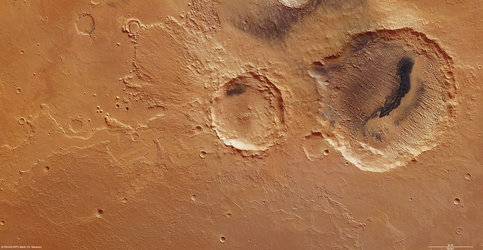
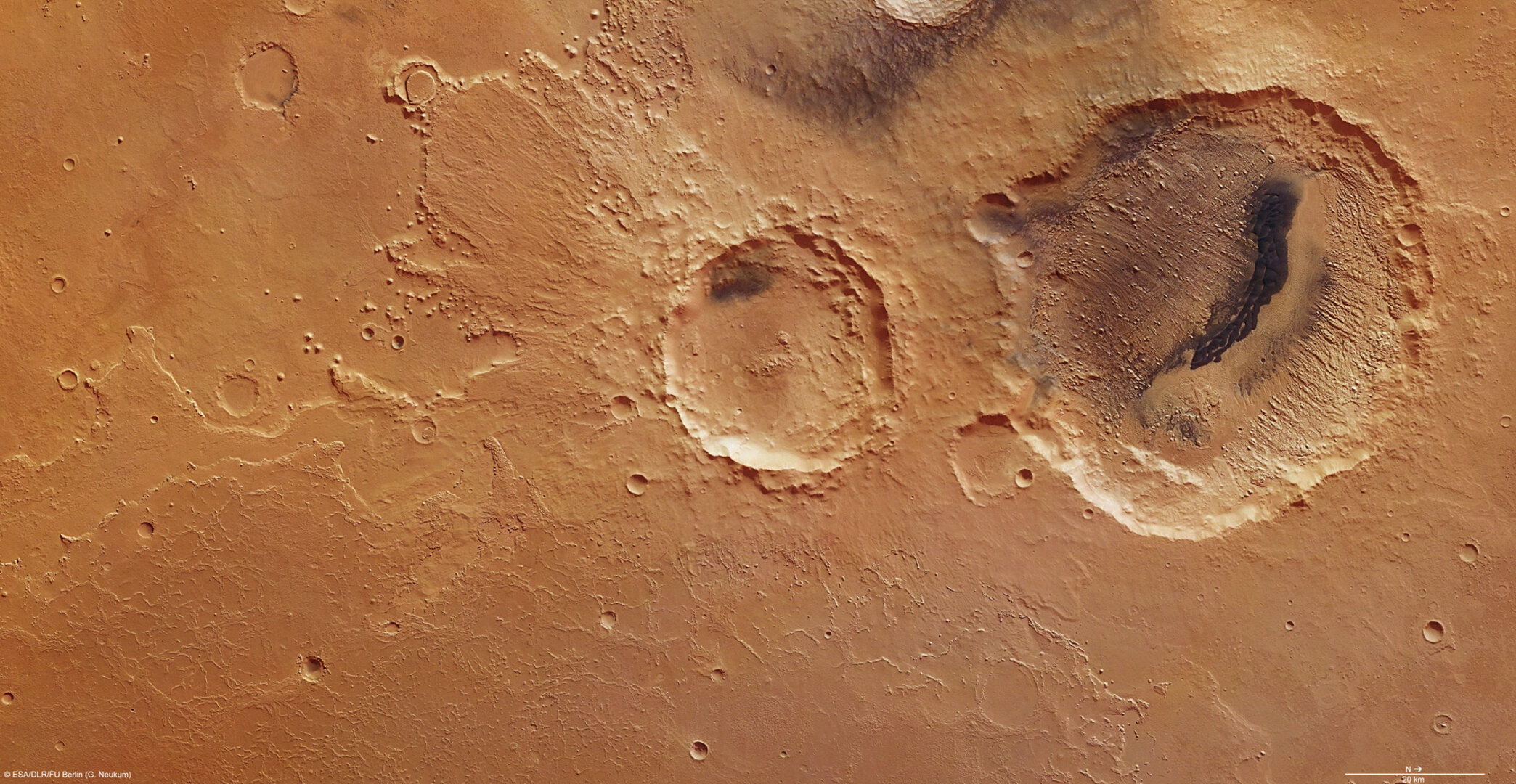
    On 19 June 2011, Mars Express pointed its high-resolution stereo camera at the Arabia Terra region of Mars, imaging the Danielson and Kalocsa craters.

    Danielson crater is named after the late George E Danielson, who was instrumental in the development of many spacecraft cameras flown to Mars. Seen to the right (north) in the image, it is the larger crater, roughly 60 km across.

    Kalocsa crater lies in the centre of the image and is smaller, about 33 km in diameter and a kilometre shallower than Danielson. It is named after a town in Hungary famed for its astronomical observatory.

    Danielson and Kalocsa craters context

    Danielson crater, like many in the Arabia Terra region, is filled with layered sediments, which in this instance have been heavily eroded over time. Within the crater are peculiarly layered buttes, known as yardangs.

    Yardangs are streamlined hills carved from bedrock or any consolidated or semi-consolidated material by abrasive dust and sand particles carried in the wind.

    They are seen on Earth in desert regions, with notable examples in North Africa, Central Asia and Arizona in the United States.


    Danielson and Kalocsa context

    In the case of Danielson crater, it is believed that sediments were cemented by water, possibly from an ancient deep groundwater reservoir, before being eroded by the wind.

    The orientation of the yardangs leads scientists to theorise that strong north–northeasterly winds (from the lower right in the image) both deposited the original sediments and then caused their subsequent erosion in a later drier period of martian history.

    A 30 km-long field of darker dunes can be seen bisecting the yardangs and is thought to have formed at a later epoch.
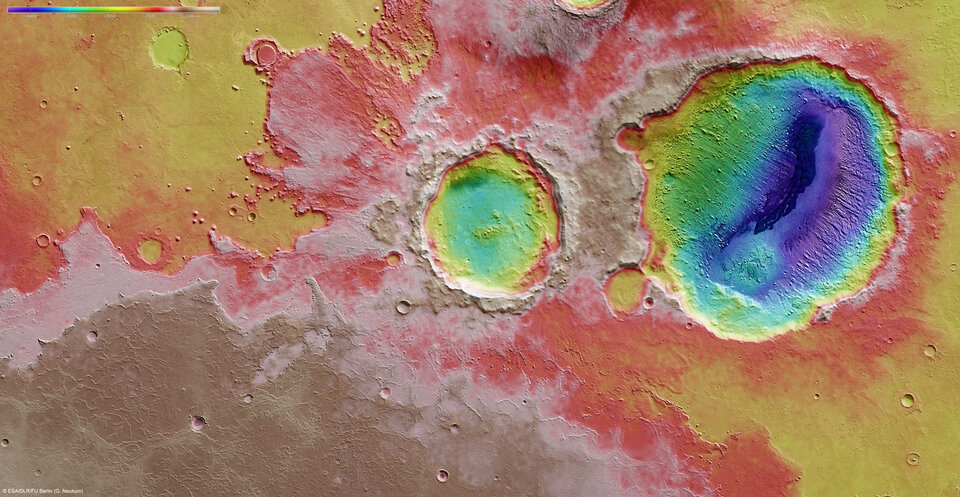
    Danielson and Kalocsa topography

    The crater floor of Danielson shows evidence for a series of alternating sedimentary layers with roughly uniform thickness and separation.

    Some scientists believe that this indicates periodic fluctuations in the climate of Mars, triggered by regular changes in the planet’s axis of rotation. The different layers would have been laid down during different epochs.

    By marked contrast, Kalocsa crater shows a completely different topography.

    Here, no layered sediments are seen. This is thought to be due to the higher altitude of its floor, with the crater not tapping in to the suspected underlying ancient water reservoir.

    Another hypothesis is that this crater is younger than its neighbour, created when water was not present anymore.
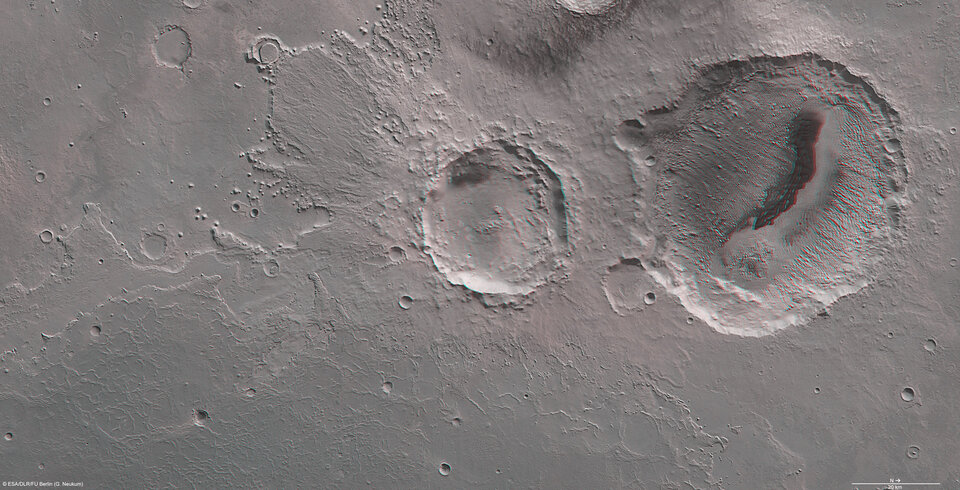

    Danielson and Kalocsa 3D anaglyph

    Rate this

    Views

    Share

    • Currently 0 out of 5 Stars.
    • 1
    • 2
    • 3
    • 4
    • 5
    Rating: 0/5 (0 votes cast)

    Thank you for rating!

    You have already rated this page, you can only rate it once!

    Your rating has been changed, thanks for rating!

    64
    facebook
    twitter
    reddit
    google plus
    digg
    tumbler
    digg
    blogger
    myspace
    • Mars Express
    • Phobos up close
      Phobos up close
      Mars Express blog
    • See the Mars Webcam from ESA's Spacecraft Operations team
      See the Mars Webcam from ESA's Spacecraft Operations team
      Mars Webcam
    • Mars Express on YouTube
    • Traces of Martian life
    • Related articles
      • Mars crater shows evidence for climate evolution
        • Signs of ancient flowing water on Mars
          • First Mars Express gravity results plot volcanic history
            • The pit-chains of Mars – a possible place for life?
              • ESA's Mars Express radar gives strong evidence for former Mars ocean
                • Mars Express reveals wind-blown deposits on Mars
                  • Mountains and buried ice on Mars
                    • Battered Tharsis Tholus volcano on Mars
                      • Mars Express observes clusters of recent craters in Ares Vallis
                        • Rare martian lake delta spotted by Mars Express
                          • Mars’ northern polar regions in transition
                            • Phobos slips past Jupiter
                              • Springtime at Mars’ south pole
                                • Mars Express sees deep fractures on Mars
                                • Related links
                                • High Resolution Stereo Camera
                                  • Behind the lens...
                                    • Frequently asked questions
                                    • Follow us
                                    • ESA Sci on Twitter
                                    • ESA on Flickr
                                    • ESA 3D on Flickr
                                    • For specialists
                                    • ESA Planetary Science archive (PSA)
                                    • NASA Planetary Data System
                                    • HRSC data viewer
                                    • In depth
                                    • Mars Express in depth

    Connect with us

    • RSS
    • Youtube
    • Twitter
    • Flickr
    • Google Buzz
    • Subscribe
    • App Store
    • LATEST ARTICLES
    • · CryoSat hits land
    • · Ariane 5 completes seven launches …
    • · Measuring skull pressure without t…
    • · Malargüe station inauguration
    • · The solar wind is swirly
    • FAQ

    • Jobs at ESA

    • Site Map

    • Contacts

    • Terms and conditions