• → European Space Agency

      • Space for Europe
      • Space News
      • Space in Images
      • Space in Videos
    • About Us

      • Welcome to ESA
      • DG's News and Views
      • For Member State Delegations
      • Business with ESA
      • ESA Exhibitions
      • ESA Publications
      • Careers at ESA
    • Our Activities

      • Space News
      • Observing the Earth
      • Human Spaceflight
      • Launchers
      • Navigation
      • Space Science
      • Space Engineering
      • Operations
      • Technology
      • Telecommunications & Integrated Applications
    • For Public

    • For Media

      • Media
      • ESA TV
      • Videos for professionals
      • Photos
    • For Educators

    • For Kids

    • ESA

    • ESA Science

    • Mars Express

    • Europe goes to Mars

      • Europe reclaims a stake in Mars exploration
      • Space age transforms our knowledge about Mars
    • About Mars Express

      • Mars Express mission facts
      • Mars Express instruments
      • The mission
      • The spacecraft
      • The launcher
    • About Mars

      • Geography of Mars
      • Water on early Mars?
      • Signatures of life
      • Facts about Mars
    • Meet the team

      • International collaboration
      • Project Manager
      • Project Scientist
      • Mars Lead Scientist
      • Principal Investigators
      • Operations
      • Industry
    • Multimedia
    • VideoTalk
    • Mars Express images
    • Mars Express videos
    • HRSC videos
    • Animation in 11 languages
    • Download wallpapers
    • Download screensavers
    • 3D Flash 'model'
    • Make a model
    • Services
    • Comments

    ESA > Our Activities > Space Science > Mars Express

    Holden and Eberswalde craters

    Rare martian lake delta spotted by Mars Express

    2 September 2011

    ESA’s Mars Express has spotted a rare case of a crater once filled by a lake, revealed by the presence of a delta. The delta is an ancient fan-shaped deposit of dark sediments, laid down in water. It is a reminder of Mars’ past, wetter climate.

    Eberswalde crater in context

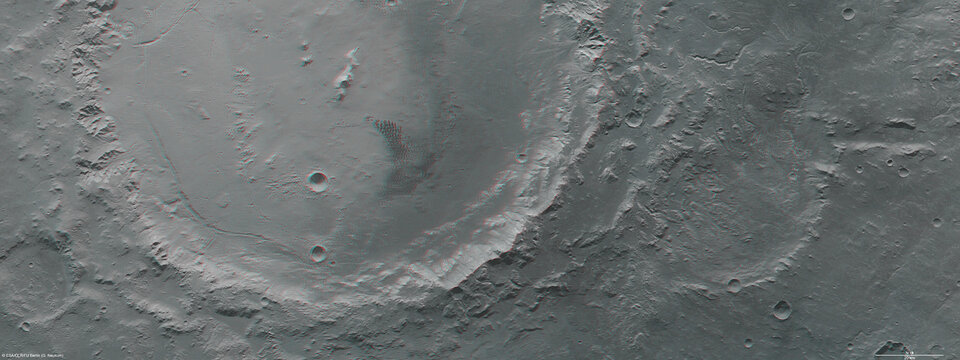
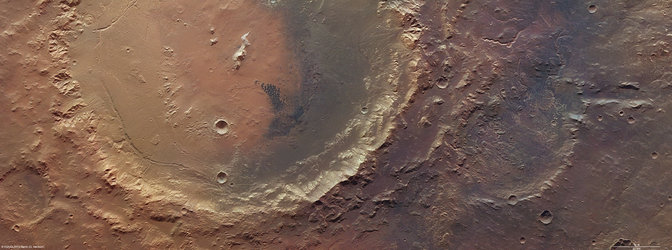
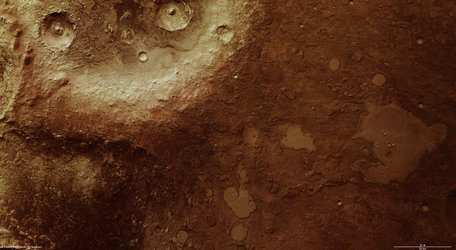
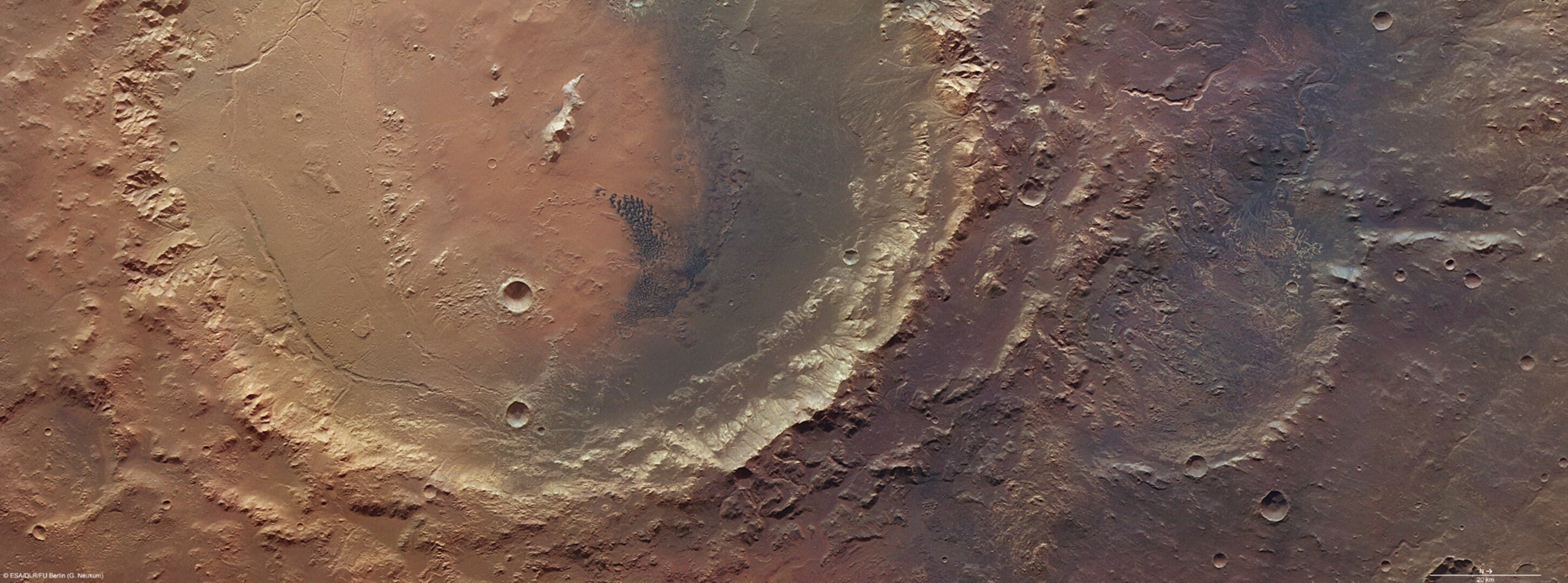
    The delta is in the Eberswalde crater, in the southern highlands of Mars. The 65 km-diameter crater is visible as a semi-circle on the right of the image and was formed more than 3.7 billion years ago when an asteroid hit the planet.

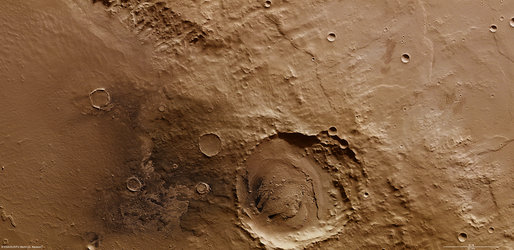
    The rim of the crater is intact only on its right-hand side. The rest appears only faintly or is not visible at all. A later impact created the 140 km diameter Holden crater that dominates the centre and left side of the image. The expulsion of large amounts of material from that impact buried parts of Eberswalde.
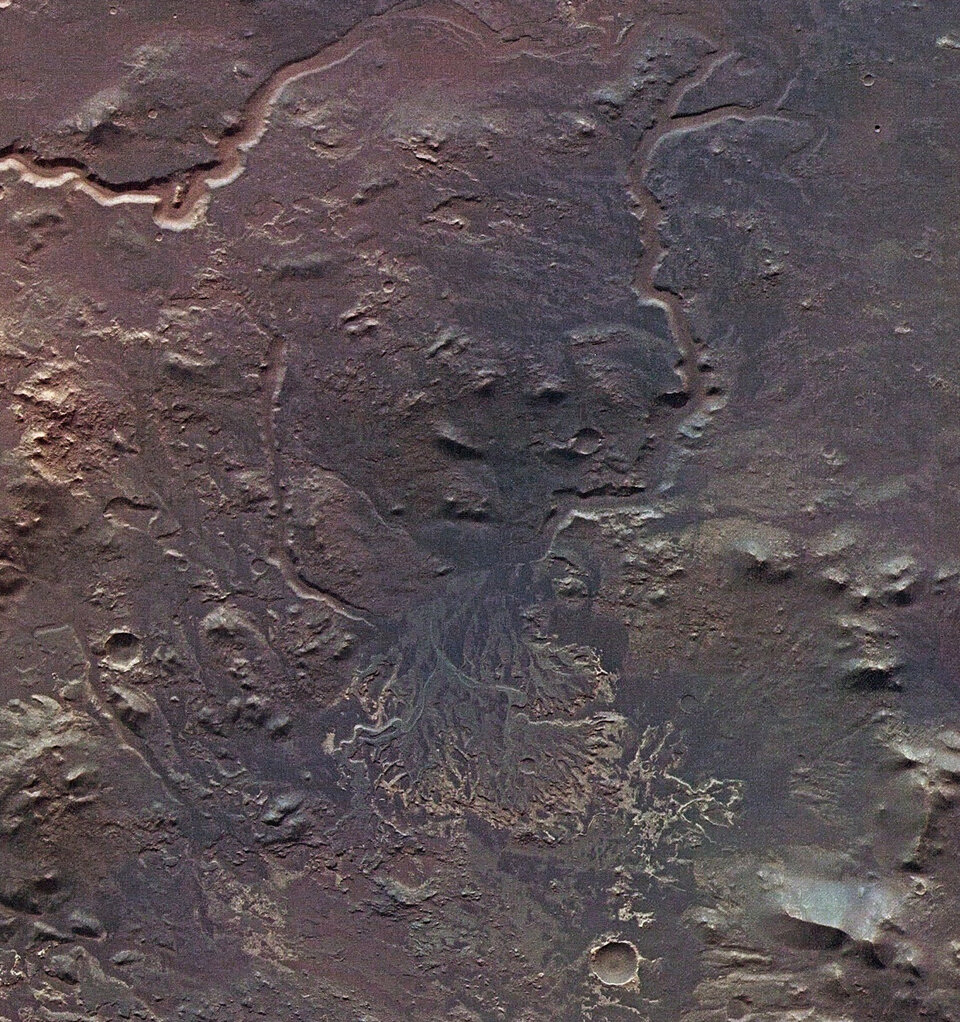

    Delta in Eberswalde crater

    However, within the visible part of Eberswalde, the delta and its feeder channels are well preserved , as seen near the top right of the crater. The delta covers an area of 115 square kilometres. Small, meandering feeder channels are visible towards the top of the crater, which would have filled it to form a lake.

    After the deposition of the delta sediments in the crater’s ancient lake, fresher sediments accumulated to cover up a major part of both the channels and the delta. These secondary sediments, presumably deposited by the wind, were later eroded in the delta area, exposing an inverted relief of the delta structure.

    Features in Eberswalde crater

    This delta structure, first identified with NASA’s Mars Global Surveyor spacecraft, is characteristic of the presence of a lake in the crater at that time. Such features provide a clear indication that liquid water flowed across the surface of Mars in the planet’s early history.

    Both Eberswalde crater and Holden crater were on the shortlist of four possible destinations for the next NASA Mars rover, to be launched late this year. The main objective of the Mars Science Laboratory mission is the search for present or previously habitable environments on Mars. ESA’s Mars Express mission has been helping in the search for the best landing site.

    Eberswalde crater in perspective

    Eberswalde was proposed because its delta indicates the long-lasting presence of liquid water in the past and Holden Crater was a candidate because of its mineral diversity and many structures that again suggest past liquid water. Another candidate, Mawrth Vallis, exposes some of the oldest clay-rich layers on Mars. However, in July, Gale crater, the final entry on the shortlist, was selected as the mission’s landing site, given its high mineral and structural diversity related to water.

    Eberswalde, Holden and Mawrth Vallis will get to hold on to their secrets for a while longer.
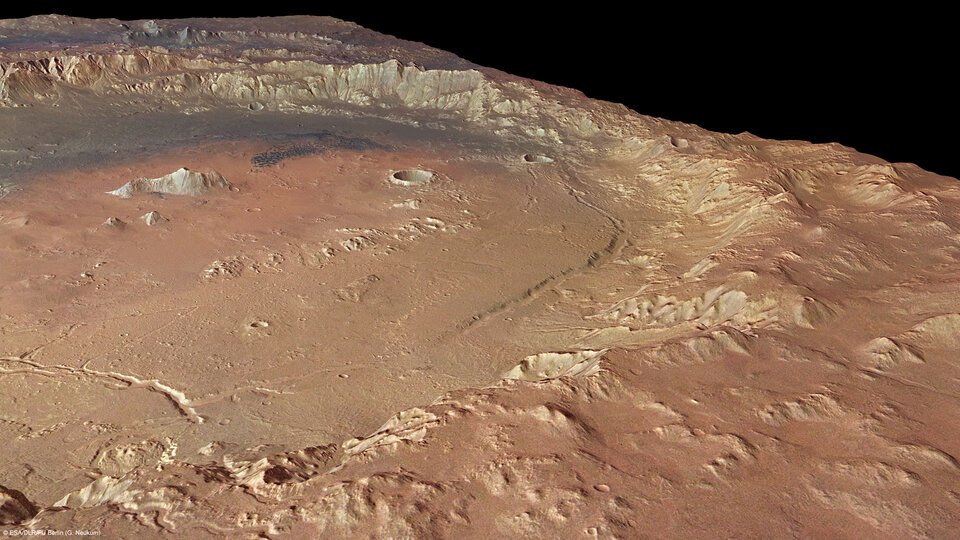
    Holden crater in perspective
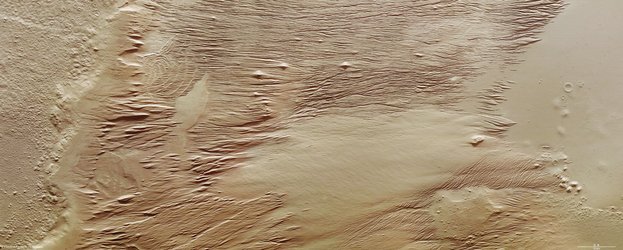
    Eberswalde crater in perspective
    Holden and Eberswalde in high resolution
    Holden and Eberswalde crater in 3D

    Rate this

    Views

    Share

    • Currently 5 out of 5 Stars.
    • 1
    • 2
    • 3
    • 4
    • 5
    Rating: 5/5 (2 votes cast)

    Thank you for rating!

    You have already rated this page, you can only rate it once!

    Your rating has been changed, thanks for rating!

    548
    Tweet
    • Mars Express on YouTube
    • Traces of Martian life
    • Related articles
      • Rare martian lake delta spotted by Mars Express
        • Mars’ northern polar regions in transition
          • Phobos slips past Jupiter
            • Springtime at Mars’ south pole
              • Mars Express sees deep fractures on Mars
                • Neighbouring volcanoes on Mars
                  • The scars of impacts on Mars
                    • Mars Express puts craters on a pedestal
                      • Mars Express close flybys of martian moon Phobos
                        • Wind and water have shaped Schiaparelli on Mars
                          • Light and dark in the Phoenix Lake
                            • Mars: how low can you go?
                              • Mars’s mysterious elongated crater
                                • Rocky mounds and a plateau on Mars
                                  • Wet era on early Mars was global
                                    • Volcanic ash in Meridiani Planum
                                      • Craters young and old in Sirenum Fossae
                                        • Craters, lava flows and tectonic features near Ma'adim Vallis
                                          • Craters and channels in Hephaestus Fossae
                                            • Chaotic terrain in Ariadnes Colles
                                              • Ice-covered martian North Pole
                                                • The Euminedes Dorsum mountains on Mars
                                                  • Lava deposits in Mangala Fossae
                                                  • Related links
                                                  • High Resolution Stereo Camera
                                                    • Behind the lens...
                                                      • Frequently asked questions
                                                      • For specialists
                                                      • ESA Planetary Science archive (PSA)
                                                      • NASA Planetary Data System
                                                      • HRSC data viewer

    Connect with us

    • RSS
    • Youtube
    • Twitter
    • Flickr
    • G+
    • Facebook
    • Livestream
    • Subscribe
    • App Store
    • LATEST ARTICLES
    • · Earth Explorers take centre stage …
    • · The fast winds of Venus are gettin…
    • · ExoMars 2016 set to complete const…
    • · Herschel ends operations as orbiti…
    • · Europe’s largest spaceship reache…
    • FAQ

    • Jobs at ESA

    • Site Map

    • Contacts

    • Terms and conditions