• → European Space Agency

      • Space for Europe
      • Space News
      • Space in Images
      • Space in Videos
    • About Us

      • Welcome to ESA
      • DG's News and Views
      • For Member State Delegations
      • Business with ESA
      • ESA Exhibitions
      • ESA Publications
      • Careers at ESA
    • Our Activities

      • Space News
      • Observing the Earth
      • Human Spaceflight
      • Launchers
      • Navigation
      • Space Science
      • Space Engineering
      • Operations
      • Technology
      • Telecommunications & Integrated Applications
    • For Public

    • For Media

      • Media
      • ESA TV
      • Videos for professionals
      • Photos
    • For Educators

    • For Kids

    • ESA

    • ESA Science

    • Mars Express

    • Europe goes to Mars

      • Europe reclaims a stake in Mars exploration
      • Space age transforms our knowledge about Mars
    • About Mars Express

      • Mars Express mission facts
      • Mars Express instruments
      • The mission
      • The spacecraft
      • The launcher
    • About Mars

      • Geography of Mars
      • Water on early Mars?
      • Signatures of life
      • Facts about Mars
    • Meet the team

      • International collaboration
      • Project Manager
      • Project Scientist
      • Mars Lead Scientist
      • Principal Investigators
      • Operations
      • Industry
    • Multimedia
    • VideoTalk
    • Mars Express images
    • Mars Express videos
    • HRSC videos
    • Animation in 11 languages
    • Download wallpapers
    • Download screensavers
    • 3D Flash 'model'
    • Make a model
    • Services
    • Comments

    ESA > Our Activities > Space Science > Mars Express

    Elongated crater on Mars

    The scars of impacts on Mars

    4 March 2011

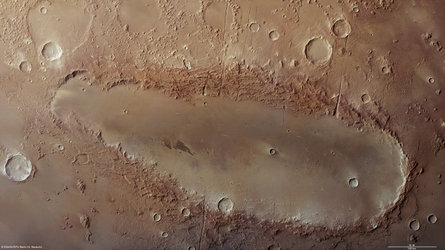
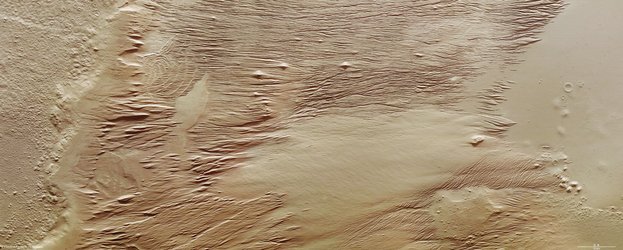
    ESA’s Mars Express has returned new images of an elongated impact crater in the southern hemisphere of Mars. Located just south of the Huygens basin, it could have been carved out by a train of projectiles striking the planet at a shallow angle.
    Elongated crater, south of Huygens crater

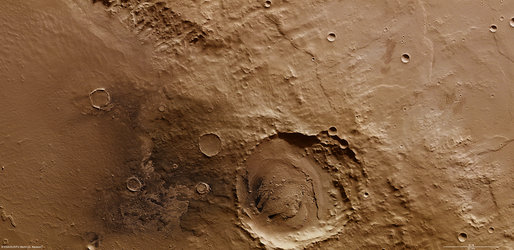
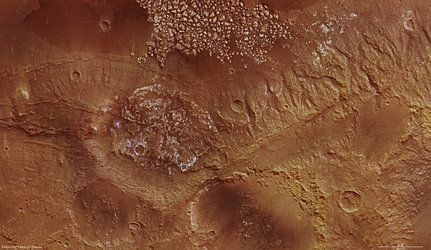
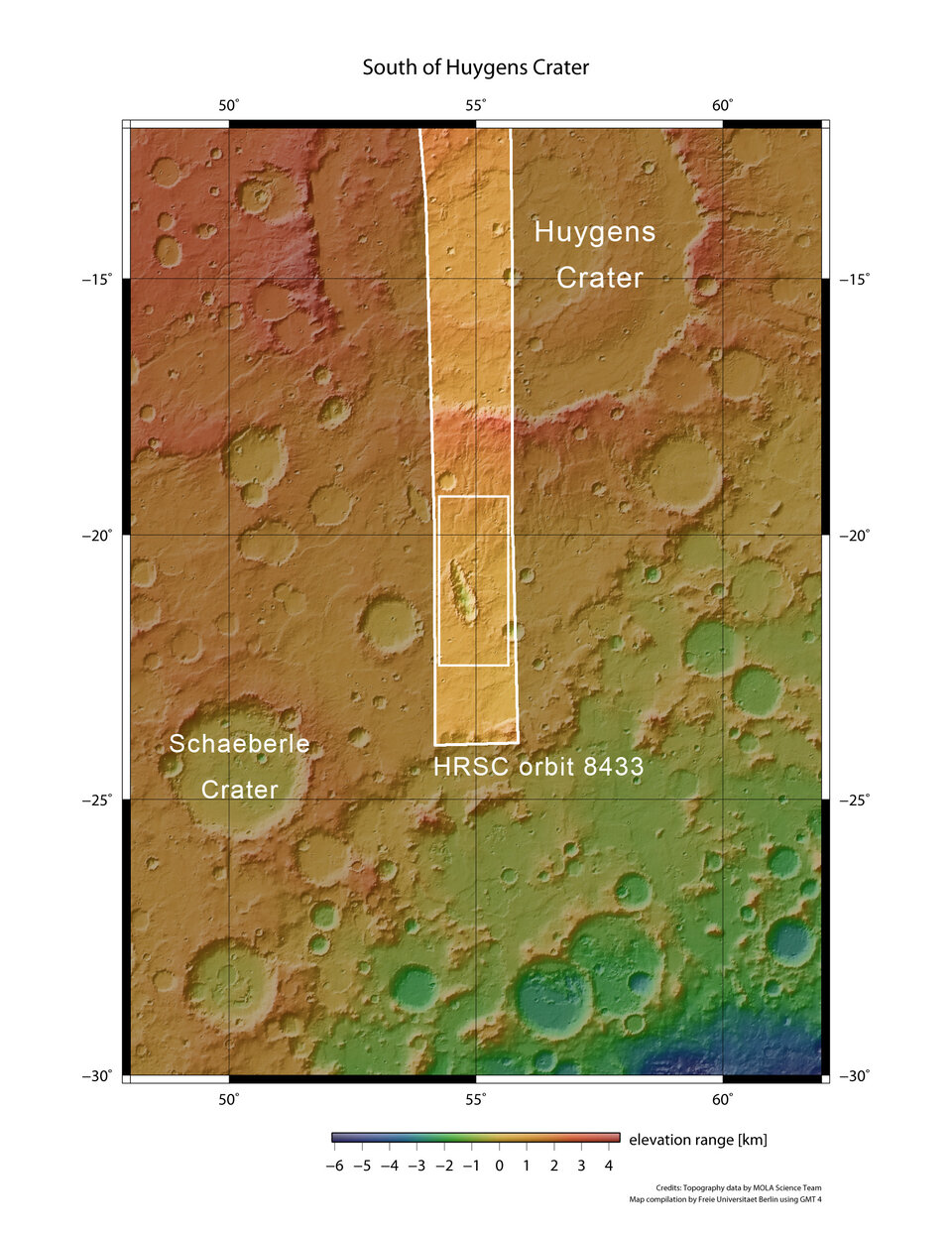
    The large Huygens basin (not visible in the main image but seen in the wider contextual image) is about 450 km in diameter and lies in the heavily cratered southern highlands. In this area there are many impact scars but none perhaps are more intriguing than the ‘elongated craters’.

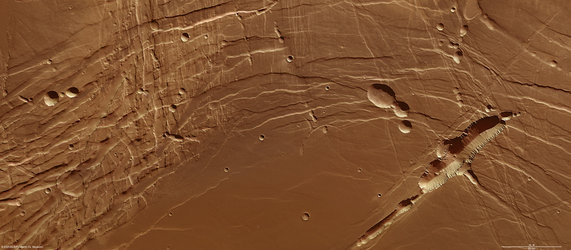
    One of these craters is seen in this new image, which covers an area of 133 x 53 km at 21°S / 55°E. The scene was captured on 4 August 2010 and the smallest objects distinguishable by the camera are about 15 m across.

    Features in the elongated crater

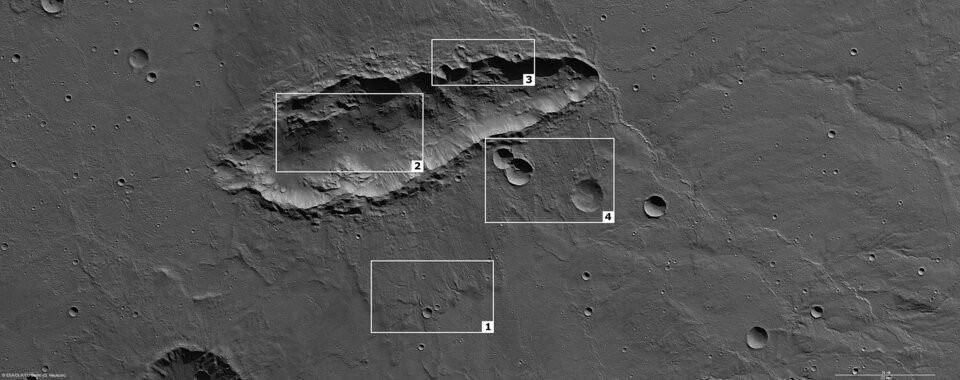
    This unnamed elongated crater sits just to the south of the much larger Huygens basin. It is about 78 km in length, opens from just under 10 km wide at one end to 25 km at the other, and reaches a depth of 2 km.
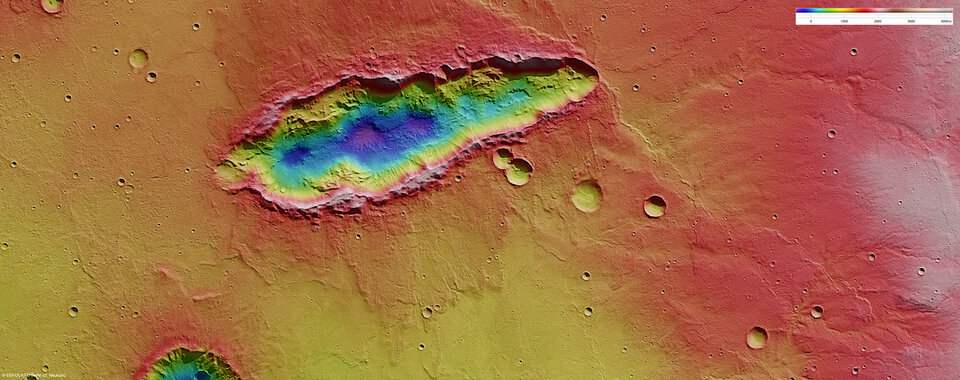
    Elevation of the elongated crater

    Impact craters are generally round because the projectiles that create them push into the ground before the shockwave of the impact can explode outwards. So why is this one elongated?

    The clue comes from the surrounding blanket of material, thrown out in the initial impact. This ‘ejecta blanket’ is shaped like a butterfly’s wings, with two distinct lobes. This hints that two projectiles, possibly halves of a once-intact body, slammed into the surface here.
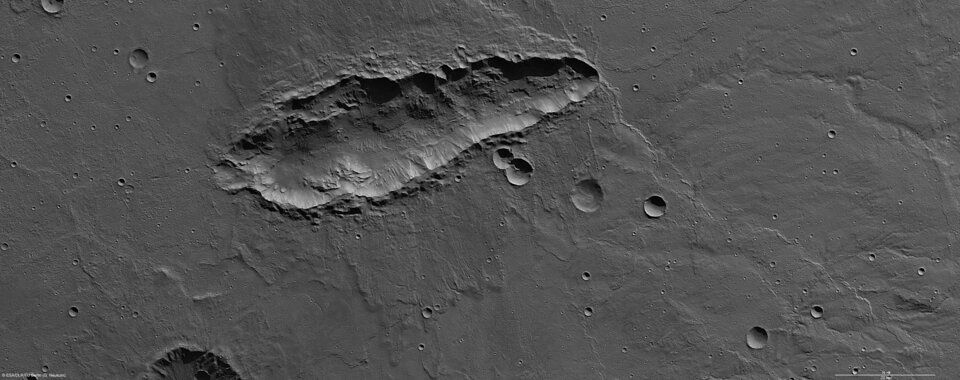
    Elongated crater in high resolution

    In the crater itself, there are three deeper areas that could be evidence for more than two projectiles. In addition, a second elongated crater lies to the north-northwest. It can be seen in the wider contextual image and is in line with the one seen here, reinforcing the notion that these structures were the result of a train of projectiles.

    Perspective view of elongated crater

    In the early 1980s, scientists proposed that elongated impact craters were formed by incoming chains of orbital debris following trajectories that decayed with time. As the debris spiralled downwards, it eventually struck the planet at shallow angles, gouging out the elongated craters.
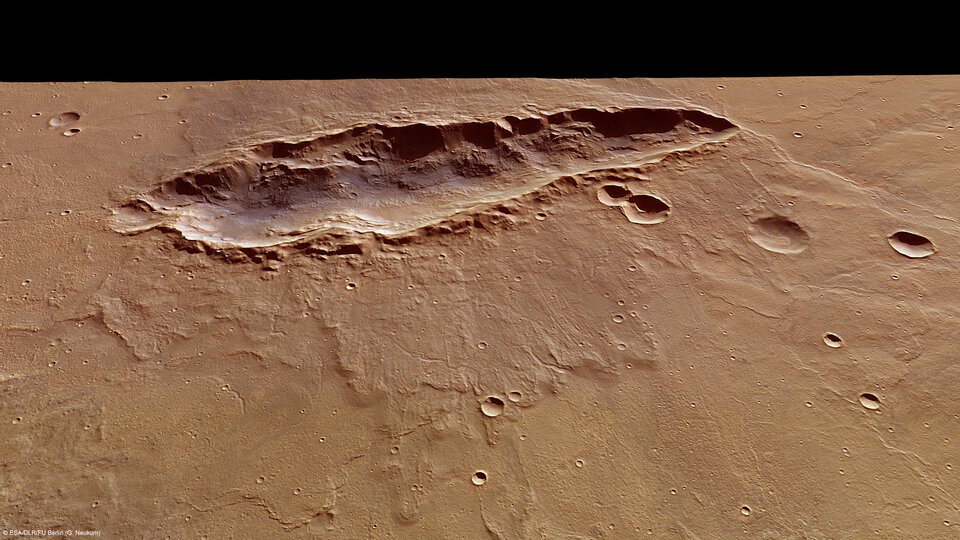
    Perspective view of elongated crater

    This particular ejecta blanket contains many smaller craters, indicating that the original formed a relatively long time ago and then itself become a target.

    In addition, there are several small channels on the blanket, suggesting that the strike took place into a surface rich in volatiles, perhaps even water, that were melted by the heat of impact and flowed away.

    Perspective view of elongated crater

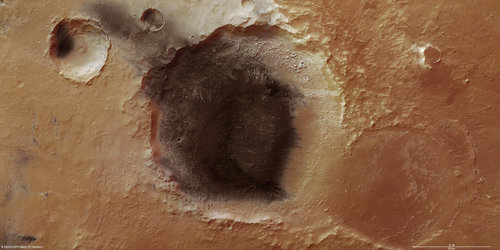
    Below the eastern crater rim are two well-formed and relatively deep craters. They have punched through the ejecta blanket and so must have appeared after the formation of the large crater. Despite their sizes of 4 km and 5 km, these smaller craters show no indication of the presence of water.

    Perspective view of elongated crater

    To the north there is another crater that must be older because the butterfly-ejecta blanket has partially flowed into it.

    Several landslides have modified the steep crater rim. This can be most clearly seen on the two smaller craters on the rim, which are only partially preserved, parts of them having fallen away.

    Elongated crater in 3D

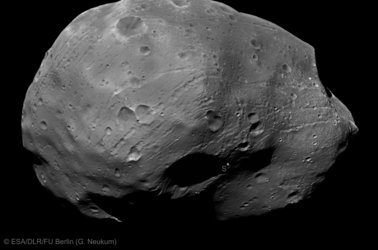
    The formation of these elongated features is not over: the martian moon Phobos will plough into the planet in a few tens of millions of years, breaking up in the process, and likely creating new chains across the surface.

    Rate this

    Views

    Share

    • Currently 0 out of 5 Stars.
    • 1
    • 2
    • 3
    • 4
    • 5
    Rating: 0/5 (0 votes cast)

    Thank you for rating!

    You have already rated this page, you can only rate it once!

    Your rating has been changed, thanks for rating!

    511
    Tweet
    • Mars Express on YouTube
    • Traces of Martian life
    • Related articles
      • Rare martian lake delta spotted by Mars Express
        • Mars’ northern polar regions in transition
          • Phobos slips past Jupiter
            • Springtime at Mars’ south pole
              • Mars Express sees deep fractures on Mars
                • Neighbouring volcanoes on Mars
                  • The scars of impacts on Mars
                    • Mars Express puts craters on a pedestal
                      • Mars Express close flybys of martian moon Phobos
                        • Wind and water have shaped Schiaparelli on Mars
                          • Light and dark in the Phoenix Lake
                            • Mars: how low can you go?
                              • Mars’s mysterious elongated crater
                                • Rocky mounds and a plateau on Mars
                                  • Wet era on early Mars was global
                                    • Volcanic ash in Meridiani Planum
                                      • Craters young and old in Sirenum Fossae
                                        • Craters, lava flows and tectonic features near Ma'adim Vallis
                                          • Craters and channels in Hephaestus Fossae
                                            • Chaotic terrain in Ariadnes Colles
                                              • Ice-covered martian North Pole
                                                • The Euminedes Dorsum mountains on Mars
                                                  • Lava deposits in Mangala Fossae
                                                  • Related links
                                                  • High Resolution Stereo Camera
                                                    • Behind the lens...
                                                      • Frequently asked questions
                                                      • For specialists
                                                      • ESA Planetary Science archive (PSA)
                                                      • NASA Planetary Data System
                                                      • HRSC data viewer

    Connect with us

    • RSS
    • Youtube
    • Twitter
    • Flickr
    • G+
    • Facebook
    • Livestream
    • Subscribe
    • App Store
    • LATEST ARTICLES
    • · Earth Explorers take centre stage …
    • · The fast winds of Venus are gettin…
    • · ExoMars 2016 set to complete const…
    • · Herschel ends operations as orbiti…
    • · Europe’s largest spaceship reache…
    • FAQ

    • Jobs at ESA

    • Site Map

    • Contacts

    • Terms and conditions