• → European Space Agency

      • Space for Europe
      • Space News
      • Space in Images
      • Space in Videos
    • About Us

      • Welcome to ESA
      • DG's News and Views
      • For Member State Delegations
      • Business with ESA
      • ESA Exhibitions
      • ESA Publications
      • Careers at ESA
    • Our Activities

      • Space News
      • Observing the Earth
      • Human Spaceflight
      • Launchers
      • Navigation
      • Space Science
      • Space Engineering
      • Operations
      • Technology
      • Telecommunications & Integrated Applications
    • For Public

    • For Media

    • For Educators

    • For Kids

    • ESA

    • ESA Science

    • Mars Express

    • Europe goes to Mars

      • Europe reclaims a stake in Mars exploration
      • Space age transforms our knowledge about Mars
    • About Mars Express

      • Mars Express mission facts
      • Mars Express instruments
      • The mission
      • The spacecraft
      • The launcher
    • About Mars

      • Geography of Mars
      • Water on early Mars?
      • Signatures of life
      • Facts about Mars
    • Meet the team

      • International collaboration
      • Project Manager
      • Project Scientist
      • Mars Lead Scientist
      • Principal Investigators
      • Operations
      • Industry
    • Multimedia
    • VideoTalk
    • Mars Express images
    • Mars Express videos
    • HRSC videos
    • Animation in 11 languages
    • Download wallpapers
    • Download screensavers
    • 3D Flash 'model'
    • Make a model
    • Services
    • Comments

    ESA > Our Activities > Space Science > Mars Express

    Schiaparelli on Mars

    Wind and water have shaped Schiaparelli on Mars

    10 December 2010

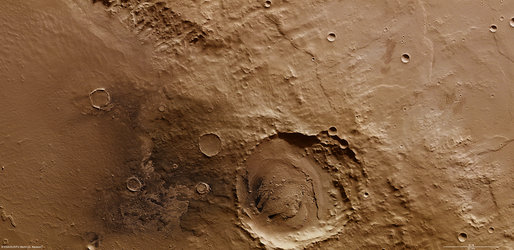
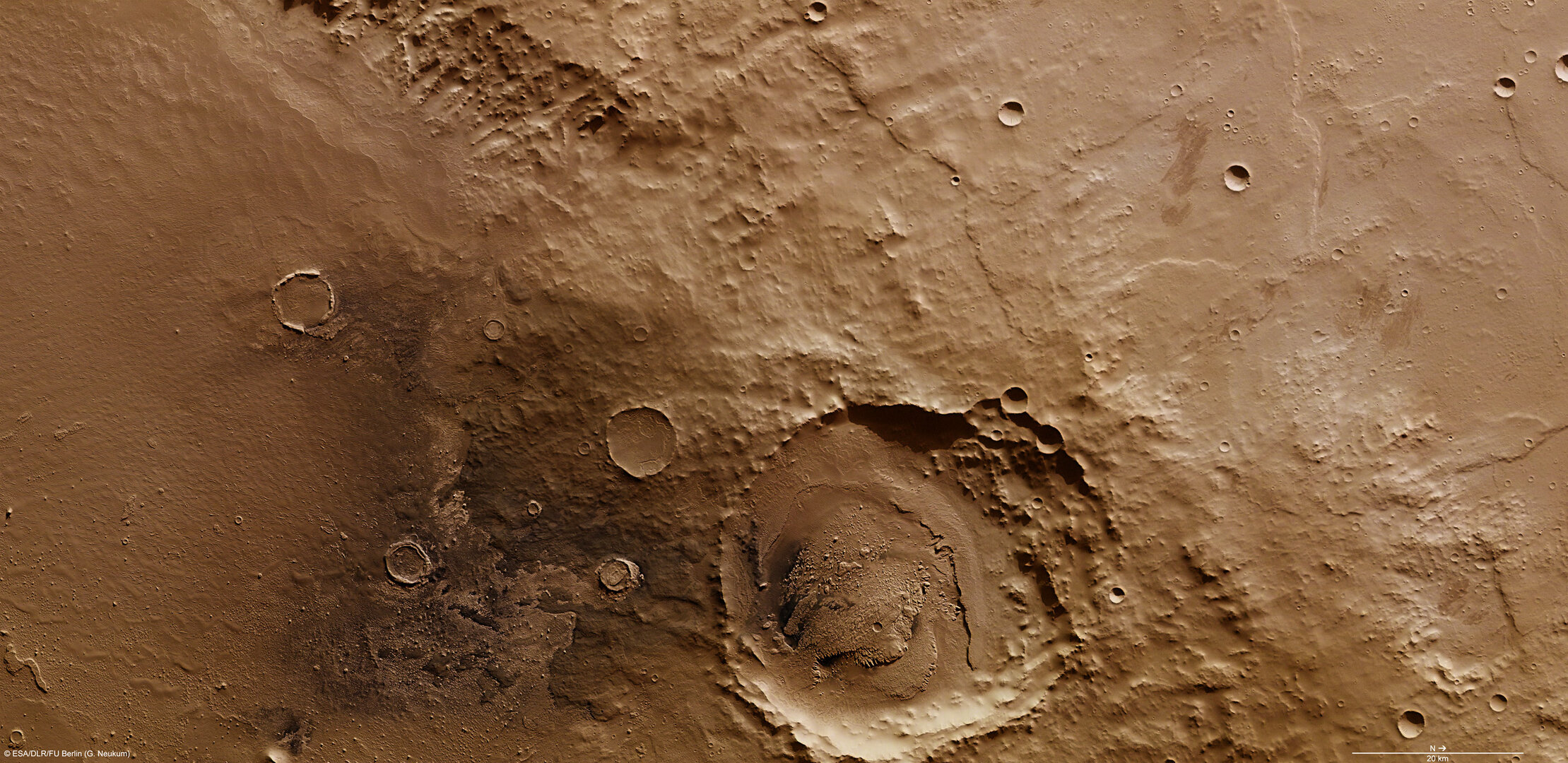
    The small crater embedded in the northwestern rim of the Schiaparelli impact basin features prominently in this new image from ESA’s Mars Express. All around is evidence for past water and the great martian winds that periodically blow.

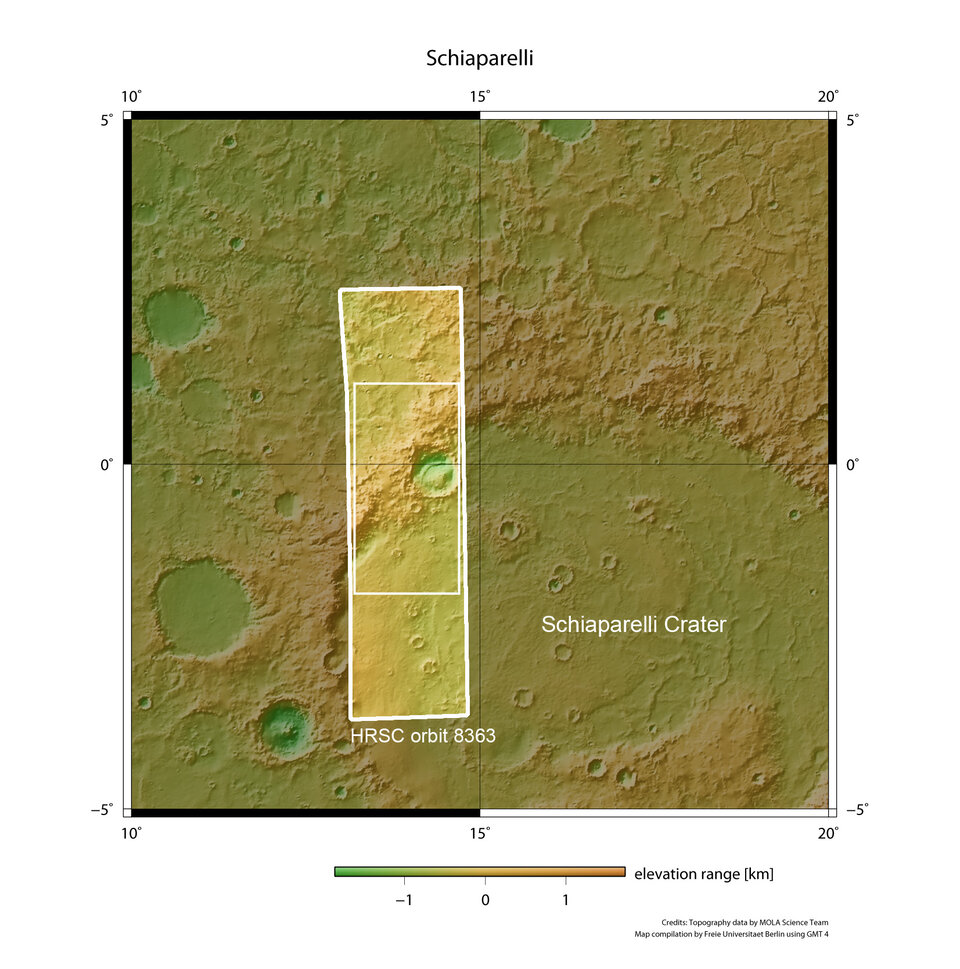
    Schiaparelli is a large impact basin about 460 km in diameter located in the eastern Terra Meridiani region of the equator of Mars. The centre of the basin lies at about 3°S/17°E and is named after the Italian astronomer Giovanni Schiaparelli (1835–1910). Although he also studied Mercury and Venus, he is best known for his observations of the Red Planet.
    Schiaparelli in context

    During the ‘Great Opposition’ of 1877, when Mars passed close to Earth, Schiaparelli mapped the planet, perceiving a number of straight dark lines across the red surface. He assumed that these were natural water-filled channels and used the equivalent Italian word, ‘canali’.

    However, other astronomers thought he meant canals, meaning artificial irrigation and transportation routes, which led to a few astronomers, and a large number of the general public, believing that they had been created by intelligent Martians.

    Now we know that Schiaparelli’s ‘canali’ were illusions created by the comparatively poor telescopes of the time and there are no water-filled channels on Mars today. Nevertheless, there is evidence in this new picture that water was once present in this region of the planet, perhaps in the form of a lake.
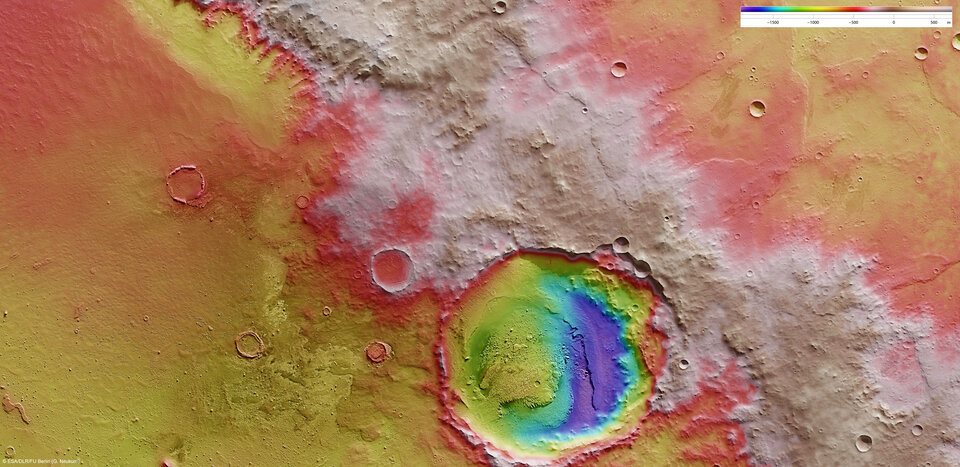

    Schiaparelli Elevation

    This image was taken on 15 July 2010 by the High-Resolution Stereo Camera of ESA’s Mars Express.

    The scene shows a small part of the northwestern area of the Schiaparelli basin with the crater rim, the crater interior and parts of the surrounding highlands. Evidence for water can be seen in the form of dark sediments that appear on the floor of Schiaparelli, resembling those deposited by evaporated lakes on Earth.
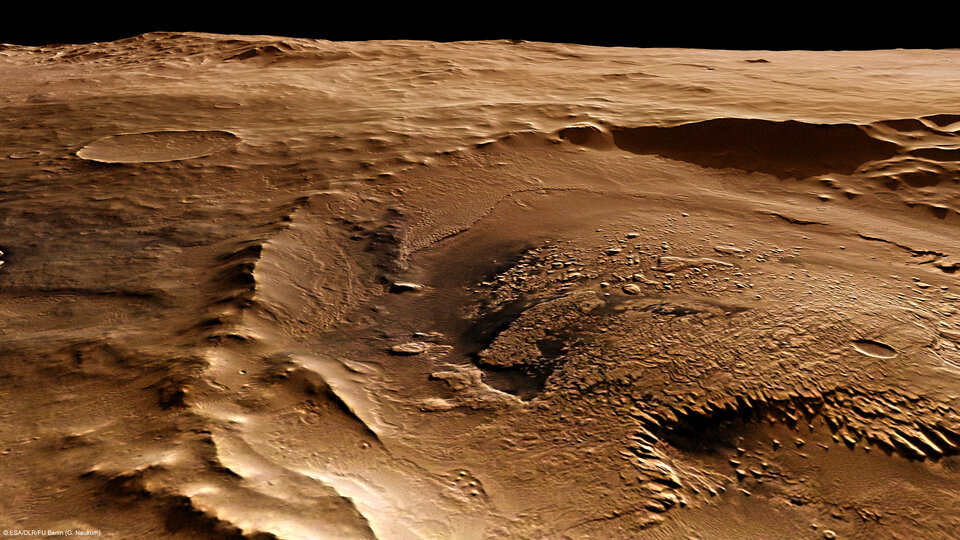
    Schiaparelli in perspective

    The interior of Schiaparelli has been modified by multiple geological processes, including the fall of ejecta blasted upwards by the initial impact, flows of lava to create the smooth plains, and watery sediments. Box 1 shows part of these sedimentary deposits. Also in the crater floor, smaller impact craters have been partially flooded and filled.

    Schiaparelli in perspective

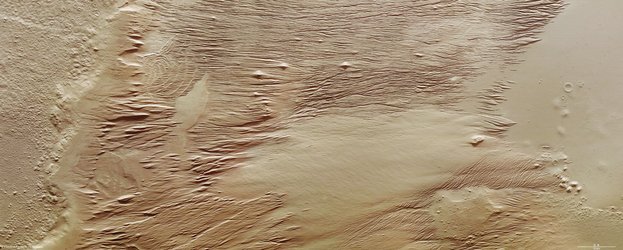
    The sediments forming the smooth plains in Box 2 have been modified by erosion, either by wind, water or both to form sharp contours such as the skinny plateau at bottom left. In other places, material has been deposited by the wind to form hills and dunes.

    Features in Schiaparelli

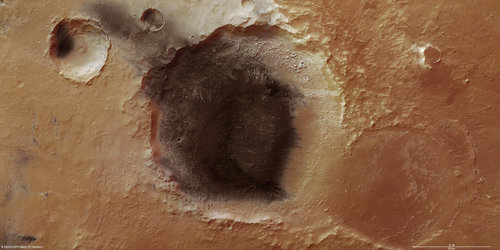
    The prominent crater in Box 3 is 42 km across and rests on the inner rim of Schiaparelli. The interior of the smaller crater is filled with sediments that appear to form a terrace in the northern part and a delta-like structure near the centre. The latter seems to be partially composed of rounded light-coloured mounds. Dark wind-borne material has accumulated in the southern portion of the crater.
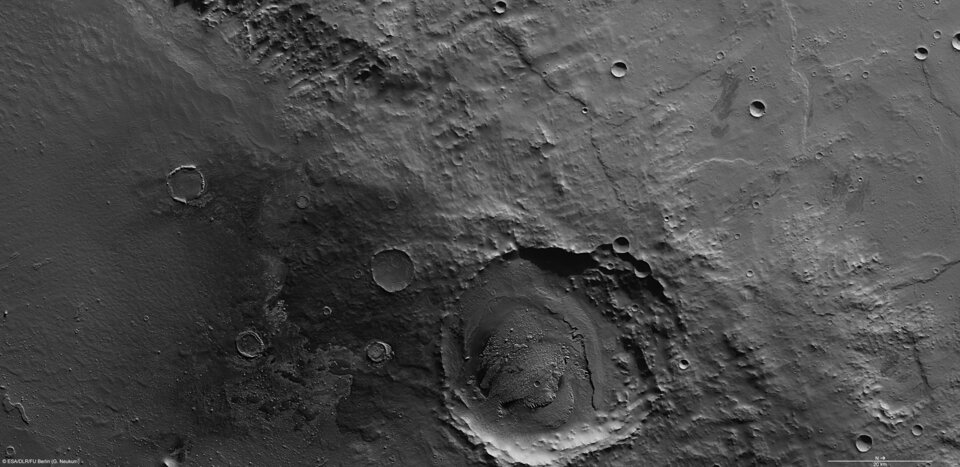
    Schiaparelli in high resolution
    Schiaparelli in 3D

    Rate this

    Views

    Share

    • Currently 4 out of 5 Stars.
    • 1
    • 2
    • 3
    • 4
    • 5
    Rating: 4/5 (1 votes cast)

    Thank you for rating!

    You have already rated this page, you can only rate it once!

    Your rating has been changed, thanks for rating!

    231
    Tweet
    • Mars Express image browser
    • Mars Express on YouTube
    • Traces of Martian life
    • Related articles
      • Mars Express close flybys of martian moon Phobos
        • Wind and water have shaped Schiaparelli on Mars
          • Light and dark in the Phoenix Lake
            • Mars: how low can you go?
              • Mars’s mysterious elongated crater
                • Rocky mounds and a plateau on Mars
                  • Wet era on early Mars was global
                    • Volcanic ash in Meridiani Planum
                      • Craters young and old in Sirenum Fossae
                        • Craters, lava flows and tectonic features near Ma'adim Vallis
                          • Craters and channels in Hephaestus Fossae
                            • Chaotic terrain in Ariadnes Colles
                              • Ice-covered martian North Pole
                                • The Euminedes Dorsum mountains on Mars
                                  • Lava deposits in Mangala Fossae
                                  • Related links
                                  • High Resolution Stereo Camera
                                    • Behind the lens...
                                      • Frequently asked questions
                                      • For specialists
                                      • ESA Planetary Science archive (PSA)
                                      • NASA Planetary Data System
                                      • HRSC data viewer

    Connect with us

    • RSS
    • Youtube
    • Twitter
    • Flickr
    • G+
    • Facebook
    • Livestream
    • Subscribe
    • App Store
    • LATEST ARTICLES
    • · Proba-V opens its eyes
    • · First new Galileo satellite arrive…
    • · Next destination: space
    • · Leak repaired on International Spa…
    • · After Chelyabinsk: European expert…
    • FAQ

    • Jobs at ESA

    • Site Map

    • Contacts

    • Terms and conditions