• → European Space Agency

      • Space for Europe
      • Space News
      • Space in Images
      • Space in Videos
    • About Us

      • Welcome to ESA
      • DG's News and Views
      • For Member State Delegations
      • Business with ESA
      • ESA Exhibitions
      • ESA Publications
      • Careers at ESA
    • Our Activities

      • Space News
      • Observing the Earth
      • Human Spaceflight
      • Launchers
      • Navigation
      • Space Science
      • Space Engineering
      • Operations
      • Technology
      • Telecommunications & Integrated Applications
    • For Public

    • For Media

    • For Educators

    • For Kids

    • ESA

    • Launch Special

    • Planck

    • Herschel

    • ESA Science

    • About Planck

      • Planck at a glance
      • Science objectives
      • Planck highlights
      • History of microwave astronomy
    • The Microwave Universe

      • Why the microwave
      • Key questions
    • The spacecraft

      • Vital stats
      • Telescope
      • Instruments
      • Sophisticated spacecraft
    • The mission

      • Journey
      • Launch and early operations
      • Operating Planck
    • Meet the team

      • Planck Project Scientist: An interview with Jan Tauber
      • Herschel and Planck Programme Manager: An interview with Thomas Passvogel
    • Multimedia
    • Planck images
    • Planck videos
    • Science@ESA vodcast

    ESA > Our Activities > Space Science > Planck

    Journey

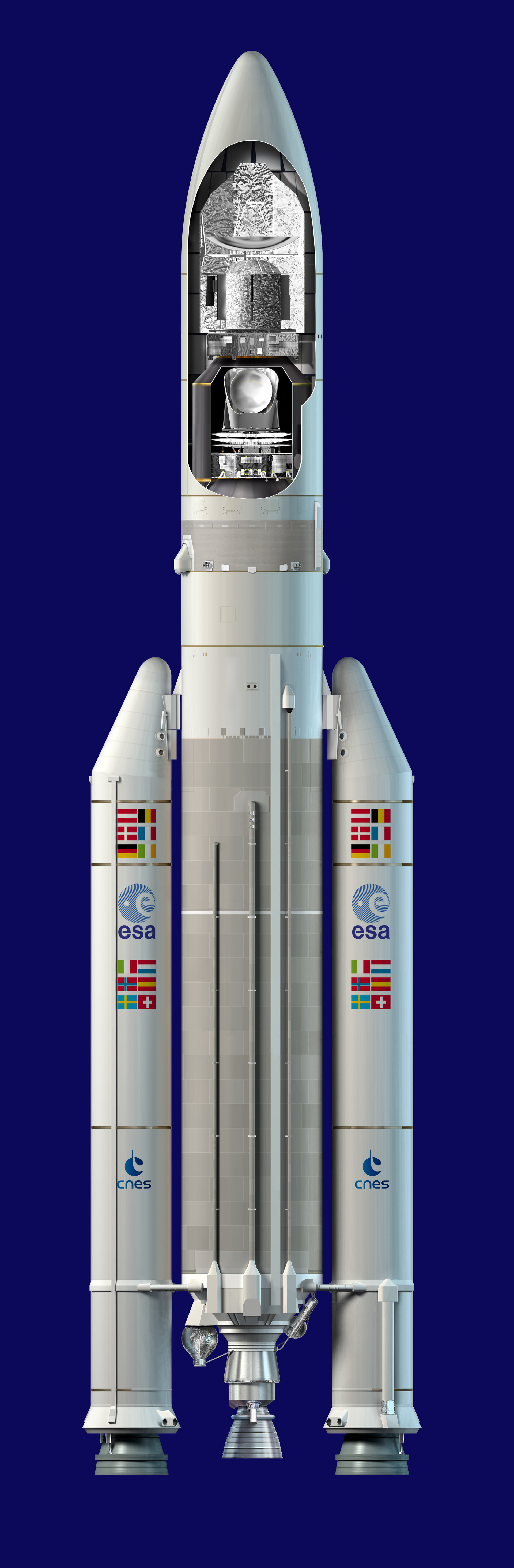
    Herschel and Planck launch configuration

    Planck was launched on 14 May 2009 on an Ariane 5 along with ESA’s Herschel infrared observatory. The mission is designed to study the Cosmic Microwave Background (CMB), the relic radiation from the Big Bang, with an accuracy defined by fundamental astrophysical limits.

    At launch, the Herschel-Planck combination measured approximately 11 m high and 4.5 m wide, with a weight of about 5.7 tonnes. They separated soon after launch and headed into different orbits. The two spacecraft are being operated independently.

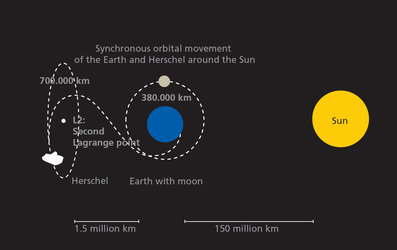
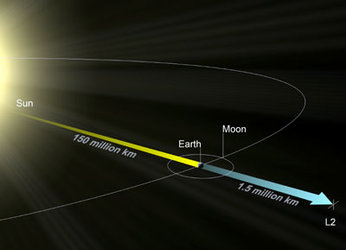
    If Planck were placed in orbit around Earth, heat from our planet, the Moon and the Sun would interfere with its instruments, reducing their sensitivity. Instead, the telescope is orbiting the second Lagrange point of the Earth-Sun system (L2), a point in space located 1.5 million km from Earth.

    L2 has the important property that a spacecraft there can stay fixed in the Earth-Sun system and is situated on Earth’s night-side.

    It is an excellent location for Planck: the satellite will avoid unwanted emission from the Earth, Moon and Sun, which would otherwise confuse the signal from the CMB. Because Earth and the Sun are in the same general direction, it also offers good sky visibility for astronomical observations. In addition, this orbit keeps Planck outside Earth’s radiation belts, which may otherwise disturb observations.

    For more information, see L2, the second Lagrangian point.

    It took Planck about 60 days to enter its final operational orbit around L2. The observatory settled into an orbit that resembles a halo around L2, with an average amplitude of 400 000 km.
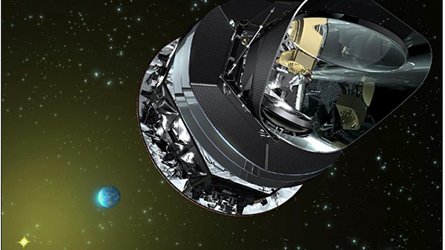
    Illustration of the satellites inside the fairing of the Ariane 5

    Rate this

    Views

    Share

    • Currently 5 out of 5 Stars.
    • 1
    • 2
    • 3
    • 4
    • 5
    Rating: 5/5 (1 votes cast)

    Thank you for rating!

    You have already rated this page, you can only rate it once!

    Your rating has been changed, thanks for rating!

    61
    facebook
    twitter
    reddit
    google plus
    digg
    tumbler
    digg
    blogger
    myspace
    • Planck: looking back at the dawn of time
    • Spacecraft Operations
      Spacecraft Operations
      Operations
    • Related articles
      • Journey
        • Launch and early operations
          • Operating Planck
          • Read more
            • What are Lagrange points?
              • L2, the second Lagrangian Point
                • Cosmic Microwave Background (CMB) radiation
                  • So, how did everything start?
                    • The electromagnetic spectrum
                    • In depth
                    • Planck in depth
                    • Planck Science Team

    Connect with us

    • RSS
    • Youtube
    • Twitter
    • Flickr
    • Google Buzz
    • Subscribe
    • App Store
    • LATEST ARTICLES
    • · CryoSat hits land
    • · Ariane 5 completes seven launches …
    • · Measuring skull pressure without t…
    • · Malargüe station inauguration
    • · The solar wind is swirly
    • FAQ

    • Jobs at ESA

    • Site Map

    • Contacts

    • Terms and conditions