• → European Space Agency

      • Space for Europe
      • Space News
      • Space in Images
      • Space in Videos
    • About Us

      • Welcome to ESA
      • DG's News and Views
      • For Member State Delegations
      • Business with ESA
      • ESA Exhibitions
      • ESA Publications
      • Careers at ESA
    • Our Activities

      • Space News
      • Observing the Earth
      • Human Spaceflight
      • Launchers
      • Navigation
      • Space Science
      • Space Engineering
      • Operations
      • Technology
      • Telecommunications & Integrated Applications
    • For Public

    • For Media

      • Media
      • ESA TV
      • Videos for professionals
      • Photos
    • For Educators

    • For Kids

    • ESA

    • Rosetta

    • ESA Science

    • About Rosetta

      • Europe's comet chaser
      • Why 'Rosetta'?
    • About the spacecraft

      • The Rosetta orbiter
      • Orbiter: Instruments
      • The Rosetta lander
      • Lander: Instruments
    • About the journey

      • The long trek
      • Debris of the Solar System: Asteroids
      • Asteroid (2867) Steins: a portrait
      • Life and survival in deep space
      • Long-distance communication
      • The Rosetta ground segment
    • About the arrival

      • Comets - an introduction
      • Comet 67P/Churyumov- Gerasimenko
      • Comet rendezvous
      • Giotto - ESA's first comet mission
    • Meet the team
    • Mission Manager
    • Project Scientist
    • Multimedia
    • VideoTalk
    • 3D Flash 'model'
    • Rosetta images
    • Rosetta videos
    • Rosetta Animations
    • Rosetta wallpaper
    • Life of a comet
    • Services
    • Frequently asked questions

    ESA > Our Activities > Space Science > Rosetta

    Giotto’s second comet encounter

    10 March 2006

    After the encounter on 15 March, the Giotto spacecraft still had 60 kilograms of fuel available, so the option was open to continue Giotto’s voyage of exploration.

    A series of three small orbital corrections ensured that it would return to Earth almost exactly five years after launch. On 2 April 1986, the spacecraft was placed into hibernation in the hope that it could be successfully revived and dispatched on another mission.

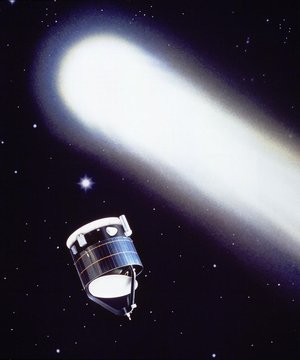
    Giotto and Comet Grigg-Skjellerup approaching each other

    In February 1990, the signal was sent to reawaken Giotto. After such a long period without contact, controllers had no idea whether the harsh environment of space had damaged its systems.

    Another unknown was the direction in which the main antenna was pointing. The only hope was that an omni-directional low-gain antenna would detect the wake-up signal.

    Two hours later, a weak answer from Giotto was received at the NASA Deep Space Network ground station near Madrid, Spain. Within a week, full control was regained and the ESA team was able to assess its condition.

    Three science instruments proved fully operational, while four more were partially damaged but usable. Although the remaining three instruments, including the camera, were disabled, it was decided to redirect the spacecraft towards a second comet, Grigg-Skjellerup.


    Earth's magnetic field
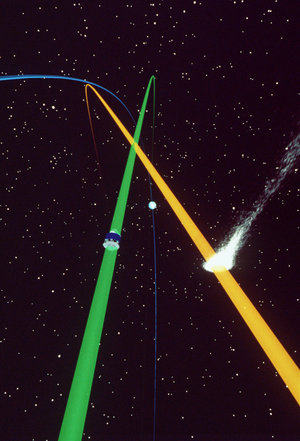
    Artist impression of Earth's magnetic field

    On 2 July 1990, Giotto’s orbit was altered as it flew past Earth at a distance of 22 730 kilometres. This was the first time a spacecraft coming from deep space had used Earth for a gravity-assist.

    During the fly-by, observations were made of Earth’s magnetic field and energetic particle environment.

    After another prolonged hibernation, Giotto’s payload was switched on in the evening of 9 July 1992. The Grigg-Skjellerup fly-by took place the following day, about 215 million kilometres from Earth.

    Giotto crossed the bow shock and entered the dust coma about 17 000 kilometres from the comet. Aimed directly at the nucleus, Giotto missed by a mere 100 to 200 kilometres — the closest ever cometary fly-by.

    For more information:

    Gerhard Schwehm, ESA Rosetta Project Scientist
    E-mail: gerhard.schwehm @ esa.int

    Rate this

    Views

    Share

    • Currently 0 out of 5 Stars.
    • 1
    • 2
    • 3
    • 4
    • 5
    Rating: 0/5 (0 votes cast)

    Thank you for rating!

    You have already rated this page, you can only rate it once!

    Your rating has been changed, thanks for rating!

    80
    Tweet
    • ESA's comet chaser
    • More about...
      • Giotto overview
        • Rosetta factsheet
        • Related articles
          • Giotto’s brief encounter
            • Giotto’s second comet encounter
              • The birth of Giotto
                • Giotto’s comet results
                  • The post-Halley era
                    • Life of a comet
                      • ESA observes Deep Impact from Earth
                        • Dust and gas from Comet 9P/Tempel 1 seen by ESA OGS
                        • Related links
                        • NASA Stardust
                        • video  20 years of GIOTTO

    Connect with us

    • RSS
    • Youtube
    • Twitter
    • Flickr
    • G+
    • Facebook
    • Livestream
    • Subscribe
    • App Store
    • LATEST ARTICLES
    • · Earth Explorers take centre stage …
    • · The fast winds of Venus are gettin…
    • · ExoMars 2016 set to complete const…
    • · Herschel ends operations as orbiti…
    • · Europe’s largest spaceship reache…
    • FAQ

    • Jobs at ESA

    • Site Map

    • Contacts

    • Terms and conditions