• → European Space Agency

      • Space for Europe
      • Space News
      • Space in Images
      • Space in Videos
    • About Us

      • Welcome to ESA
      • DG's News and Views
      • For Member State Delegations
      • Business with ESA
      • ESA Exhibitions
      • ESA Publications
      • Careers at ESA
    • Our Activities

      • Space News
      • Observing the Earth
      • Human Spaceflight
      • Launchers
      • Navigation
      • Space Science
      • Space Engineering
      • Operations
      • Technology
      • Telecommunications & Integrated Applications
    • For Public

    • For Media

      • Media
      • ESA TV
      • Videos for professionals
      • Photos
    • For Educators

    • For Kids

    • ESA

    • SMART-1

    • ESA Science

    • About SMART-1
    • SMART-1 factsheet
    • Towards final impact
    • Approaching the mission end
    • Frequently Asked Questions
    • Ask about the SMART-1 impact
    • Join the SMART-1 impact observation campaign
    • About the journey

      • The magic of ion engines
      • The SMART way to travel
      • A spiral pathway to the Moon
    • About the mission

      • Masterpieces of miniaturisation
      • What do all the instruments do?
    • About the Moon

      • Welcome to the double planet
      • Lunar science - still plenty left to do!
      • Where did the Moon come from?
    • Multimedia
    • SMART-1 images
    • SMART-1 videos
    • SMART-1 animations
    • 3D Flash 'model'
    • SMART-1 wallpaper
    • Launch replay
    • Services
    • Comments

    ESA > Our Activities > Space Science > SMART-1

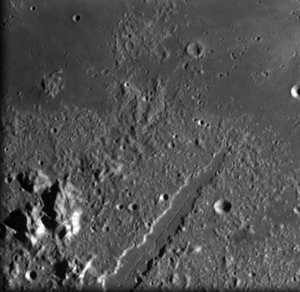
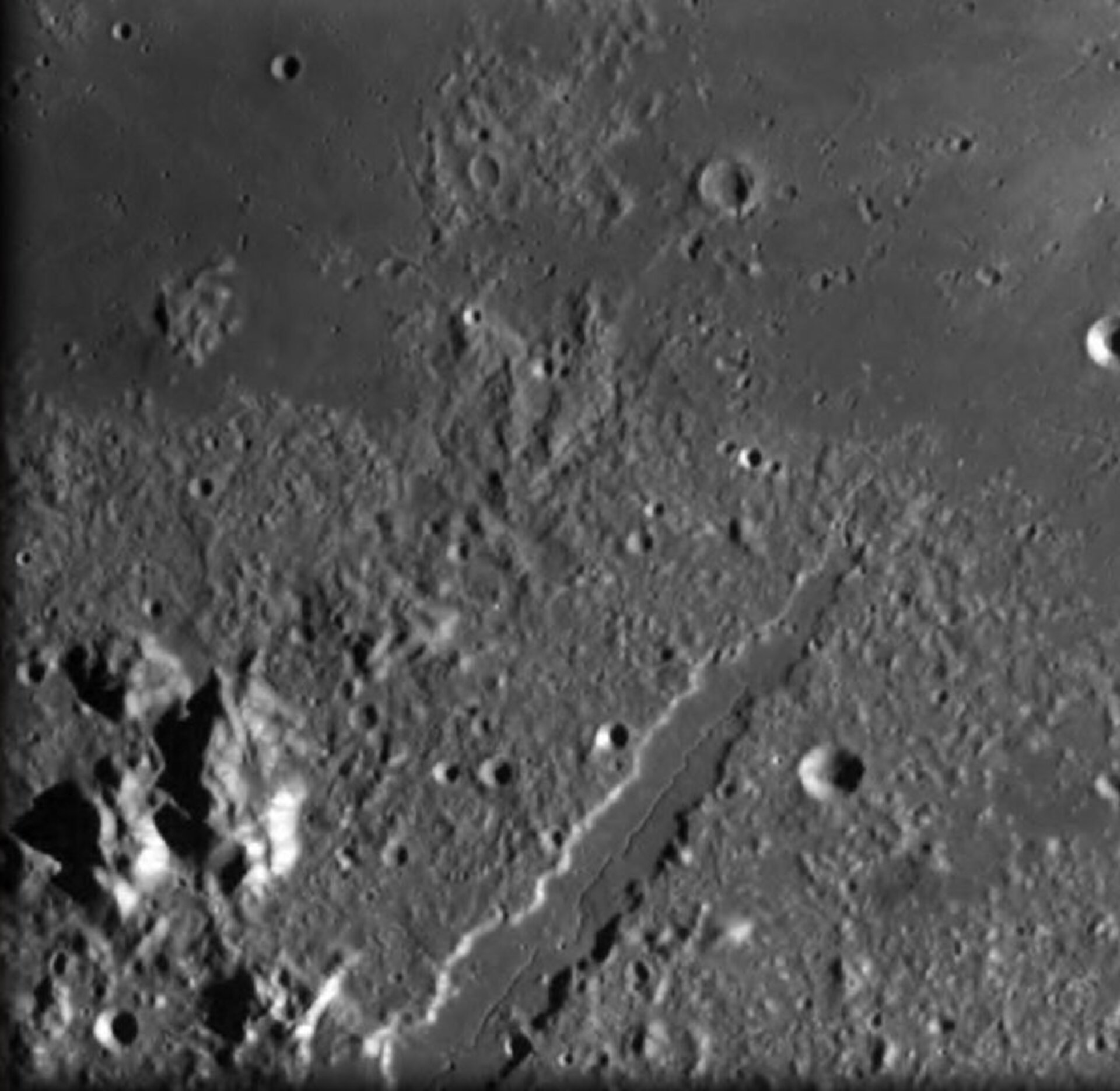
    Vallis Alpes on the Moon, seen by SMART-1

    ‘Alpine’ landscape on the Moon

    16 September 2005

    This image, taken by the Advanced Moon Micro-Imager Experiment (AMIE) on board ESA’s SMART-1 spacecraft, shows the lunar Alps (Montes Alpes) on the Moon.

    AMIE obtained this image from a distance of about 3000 kilometres, with a resolution of 300 metres per pixel. The field of view of this image is about 150 kilometres and is centred on an area around 48.5° North, 3.2° East.

    The European Alps were formed over millions of years by slow-moving sections of Earth’s crust pushed together, squeezing the land to form a giant arc of upthrust mountains, but the lunar Alps were formed in an instant. It is thought that the Moon collided with a huge object, such as an asteroid, 3850 million years ago. The collision formed a huge crater, about 1000 kilometres in diameter.

    This crater was later filled with basaltic lava, forming the dark circular basin known as Mare Imbrium (Sea of Rains). After the explosive collision, fragments, rocks and dust fell back to the surface. While there is considerable debate as to the actual mechanism which formed the concentric rings, it is agreed they are not 'fallback' material.

    Some scientists argue that the the impact caused the lower layers to act as a liquid and that the rings then 'froze' in place. A flood of lava covered the lower inner one, but the outer one remains as a series of arc-shaped mountain ranges.

    In places these mountains rise over 3000 metres. Their inner walls are steep and well defined, but their outer slopes become more broken as elevation decreases away from the impact site. Early European astronomers named them after familiar mountain ranges, such as the Juras, the Apennines and the Alps.

    Seen in this image, Vallis Alpes (Alpine Valley) is a spectacular feature that bisects the Montes Alpes range. This valley was discovered in 1727 by Francesco Bianchini. It extends 166 kilometres from Mare Imbrium, trending north-east to the edge of the Mare Frigoris (Sea of Cold). The valley is narrow at both ends and widens to about 10 kilometres across.

    The valley floor is a flat, lava-flooded surface that has narrow sinous ‘rille’ running down the middle. It is generally considered to be a 'graben', an area between two parallel faults which has dropped below the surrounding area. This is believed to have formed after the formation of the basin, but before the full maria lava flows. The rille corresponds to a ‘lava tube’ formed in a later geological episode by high-speed and low viscosity magma.

    "SMART-1 is studying the signature of violent processes that took place during the formation of these giant impact basins, as well as the sequence of late volcanic history over the lunar surface until 3000 million years ago,” said ESA’s SMART-1 Project Scientist Bernard Foing.

    For more information:

    Bernard H. Foing, ESA SMART-1 Project Scientist
    E-mail: bernard.foing @ esa.int

    A review of SMART-1 results will be discussed in the context of future missions, at the International Lunar Conference in Toronto, 18-23 September 2005, organised by the International Lunar Exploration Working Group (www.ilewg.org).
    Rate this

    Views

    Share

    • Currently 4 out of 5 Stars.
    • 1
    • 2
    • 3
    • 4
    • 5
    Rating: 4/5 (1 votes cast)

    Thank you for rating!

    You have already rated this page, you can only rate it once!

    Your rating has been changed, thanks for rating!

    206
    Tweet
    • SMART-1
    • More about...
      • SMART-1 uses new imaging technique in lunar orbit
        • SMART-1's dancing shadows at lunar north pole
          • ‘Alpine’ landscape on the Moon
            • SMART-1 views Glushko crater on the Moon
              • SMART-1 views Hadley Rille near Apollo 15 landing site
                • SMART-1's tribute to Cassini
                  • SMART-1's first images from the Moon
                    • SMART-1 views Middle East and Mediterranean
                    • Related links
                    • Space-X
                    • Advanced Moon micro-Imager Experiment (AMIE)

    Connect with us

    • RSS
    • Youtube
    • Twitter
    • Flickr
    • G+
    • Facebook
    • Livestream
    • Subscribe
    • App Store
    • LATEST ARTICLES
    • · Earth Explorers take centre stage …
    • · The fast winds of Venus are gettin…
    • · ExoMars 2016 set to complete const…
    • · Herschel ends operations as orbiti…
    • · Europe’s largest spaceship reache…
    • FAQ

    • Jobs at ESA

    • Site Map

    • Contacts

    • Terms and conditions