• → European Space Agency

      • Space for Europe
      • Space News
      • Space in Images
      • Space in Videos
    • About Us

      • Welcome to ESA
      • DG's News and Views
      • For Member State Delegations
      • Business with ESA
      • ESA Exhibitions
      • ESA Publications
      • Careers at ESA
    • Our Activities

      • Space News
      • Observing the Earth
      • Human Spaceflight
      • Launchers
      • Navigation
      • Space Science
      • Space Engineering
      • Operations
      • Technology
      • Telecommunications & Integrated Applications
    • For Public

    • For Media

      • Media
      • ESA TV
      • Videos for professionals
      • Photos
    • For Educators

    • For Kids

    • ESA

    • Space Science

    • Our Universe
    • About Space Science
    • ESA's 'Cosmic Vision'
    • Science missions
    • Mission navigator
    • Target groups
    • For Media
    • For Scientists
    • For Kids
    • Multimedia
    • Science images
    • Science videos
    • Animations
    • Downloads
    • Sounds from space
    • Resources
    • Reference section
    • Services
    • FAQs
    • Glossary
    • Help
    • Portal terms of use
    • Comments
    • Follow us
    • RSS feeds
    • ESA Sci on Twitter
    • ESA Space Science Images on Flickr
    • ESA 3D on Flickr

    ESA > Our Activities > Space Science

    Loading...
    The Huygens experience
    Access the video

    The Huygens experience

    14 January 2013

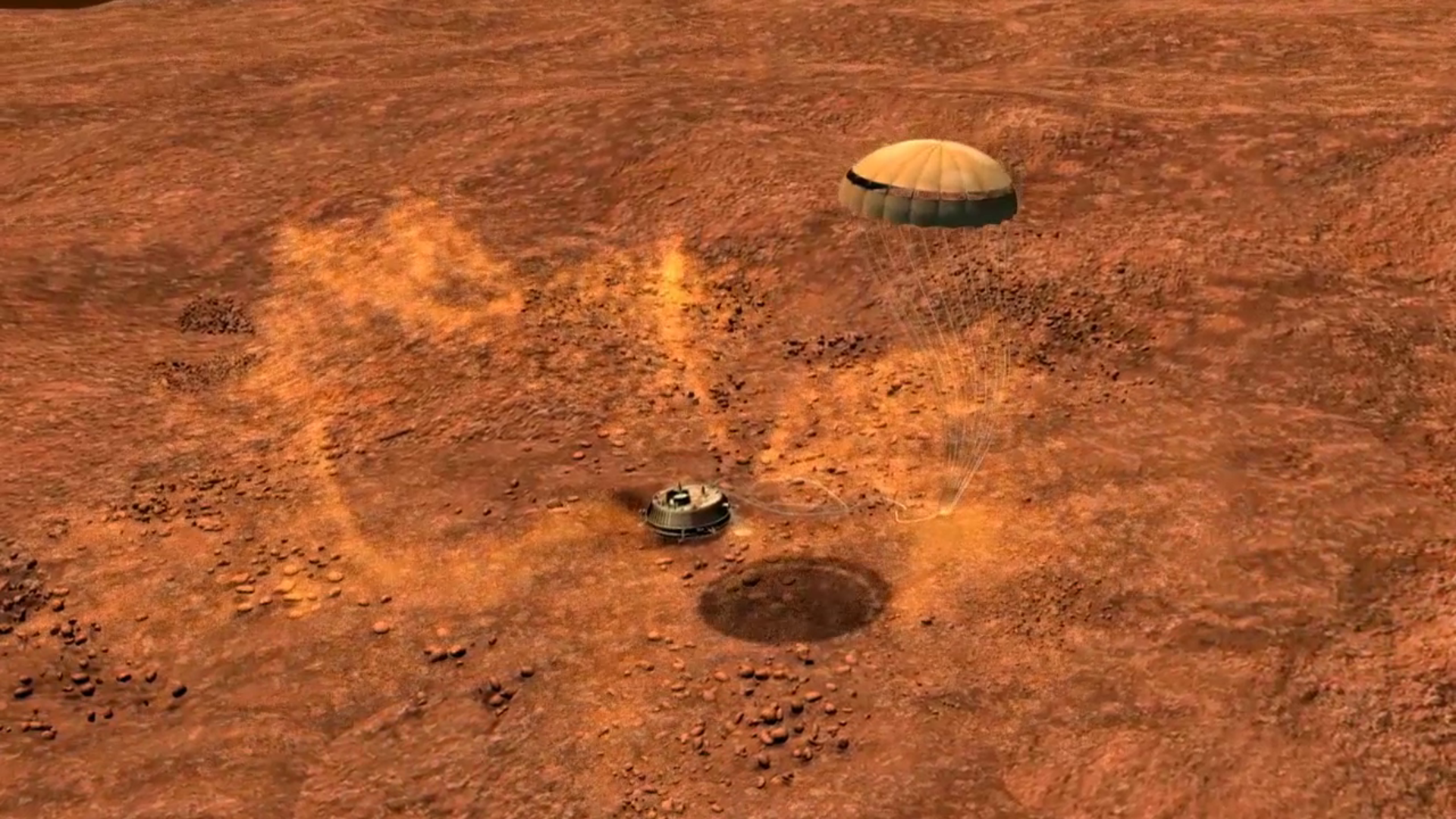
    Eight years ago today, ESA’s Huygens bounced, slid and wobbled its way to rest on the surface of Saturn’s moon Titan, the first time a probe had touched down on an alien world in the outer Solar System.

    The animation was created using real data recorded by Huygen’s instruments, allowing us to witness this historical moment as if we had been there.

    The animation takes into account Titan’s atmospheric conditions, including the Sun and wind direction, the behaviour of the parachute (with some artistic interpretation only on the movement of the ropes after touchdown), and the dynamics of the landing itself. 

    Even the stones immediately facing Huygens were rendered to match the photograph of the landing site returned from the probe, which is revealed at the end of the animation.

    Split into four sequences, the animation first shows a wide-angle view of the descent and landing followed by two close-ups of the touchdown from different angles, and finally a simulated view from Huygens itself – the true Huygens experience.

    New results published last year revealed that on first contact with Titan’s surface, Huygens dug a hole 12 cm deep, before bouncing out and sliding 30–40 cm across a flat surface.

    The probe then wobbled back and forth five times until coming to a standstill about 10 seconds after touchdown – this is best seen in the final two sequences.

    A ‘fluffy’ dust-like material – most likely organic aerosols that are known to drizzle out of the Titan atmosphere – was thrown up and suspended for around four seconds around the probe following the impact. The dust was easily lifted, suggesting it was most likely dry and that there had not been any ‘rain’ of liquid ethane or methane for some time prior to the landing.

    Huygens was released from the international Cassini spacecraft on Christmas Day 2004, arriving at Titan three weeks later. Cassini has been in orbit around Saturn since July 2004, and will continue operations until 2017.

    The Cassini–Huygens mission is a cooperative project of NASA, ESA and ASI, the Italian space agency. NASA’s Jet Propulsion Laboratory, a division of the California Institute of Technology in Pasadena, manages the mission for NASA’s Science Mission Directorate, Washington.

    Rate this

    Views

    Share

    • Currently 5 out of 5 Stars.
    • 1
    • 2
    • 3
    • 4
    • 5
    Rating: 4.81/5 (38 votes cast)

    Thank you for rating!

    You have already rated this page, you can only rate it once!

    Your rating has been changed, thanks for rating!

    17383
    Tweet

    Related articles

    Cassini spots mini Nile River on Saturn moon12 December 2012

    Cassini spots mini Nile River on Saturn moon12 December 2012 The international Cassini mission has spotted what appears to be a miniature extraterrestrial version of the Nile River: a river valley on Saturn’s moon Titan that stretches more than 400 km from its ‘headwaters’ to a large sea. 

    Titan’s seasons make sharp turn28 November 2012

    Titan’s seasons make sharp turn28 November 2012 Scientists using the international Cassini spacecraft have studied the rapid change in seasons on Saturn’s moon Titan, following equinox in August 2009, which saw the formation of a swirling vortex and a build up of exotic gases at unexpectedly high a...

    Bouncing on Titan

    Bouncing on Titan11 October 2012

    Bouncing on Titan

    Bouncing on Titan11 October 2012 ESA’s Huygens probe bounced, slid and wobbled its way to rest in the 10 seconds after touching down on Saturn’s moon, Titan, in January 2005, a new analysis reveals. The findings provide novel insight into the nature of the moon’s surface.

    • Space Science Image of the Week Archive
    • Space Live
      Space Live
      Space science image gallery
    • At Saturn and Titan

    Connect with us

    • RSS
    • Youtube
    • Twitter
    • Flickr
    • G+
    • Facebook
    • Livestream
    • Subscribe
    • App Store
    • ESA Science Twitter

    Follow ESA science

    • LATEST ARTICLES
    • · Rare merger reveals secrets of gal…
    • · Watching for hazards: ESA opens as…
    • · ESA astronaut Timothy Peake set fo…
    • · Space drives e-mobility
    • · Proba-V opens its eyes
    • FAQ

    • Jobs at ESA

    • Site Map

    • Contacts

    • Terms and conditions