• → European Space Agency

      • Space for Europe
      • Space News
      • Space in Images
      • Space in Videos
    • About Us

      • Welcome to ESA
      • DG's News and Views
      • For Member State Delegations
      • Business with ESA
      • ESA Exhibitions
      • ESA Publications
      • Careers at ESA
    • Our Activities

      • Space News
      • Observing the Earth
      • Human Spaceflight
      • Launchers
      • Navigation
      • Space Science
      • Space Engineering
      • Operations
      • Technology
      • Telecommunications & Integrated Applications
    • For Public

    • For Media

      • Media
      • ESA TV
      • Videos for professionals
      • Photos
    • For Educators

    • For Kids

    • ESA

    • Space Science

    • Our Universe
    • About Space Science
    • ESA's 'Cosmic Vision'
    • Science missions
    • Mission navigator
    • Target groups
    • For Media
    • For Scientists
    • For Kids
    • Multimedia
    • Science images
    • Science videos
    • Animations
    • Downloads
    • Sounds from space
    • Resources
    • Reference section
    • Services
    • FAQs
    • Glossary
    • Help
    • Portal terms of use
    • Comments
    • Follow us
    • RSS feeds
    • ESA Sci on Twitter
    • ESA Space Science Images on Flickr
    • ESA 3D on Flickr

    ESA > Our Activities > Space Science

    Ulysses scores a hat-trick

    Ulysses
    7 February 2007

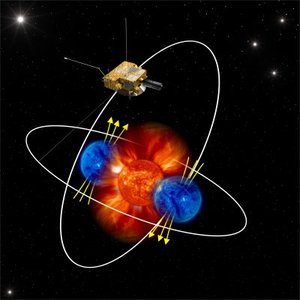
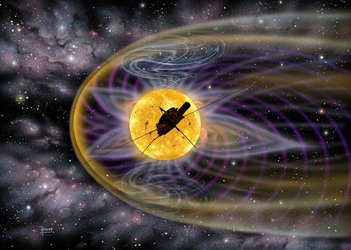
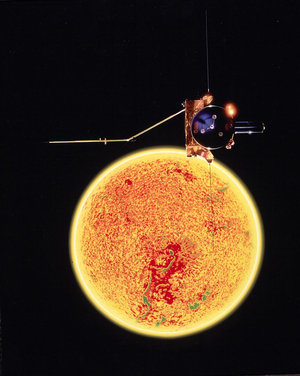
    Today the joint ESA-NASA Ulysses mission has marked another high point in its mission. For the third time in a long and highly successful career, Ulysses has reached its maximum south solar latitude of 80 degrees as it flies over the Sun's southern polar cap.

    Launched in 1990, the European-built spacecraft visits both polar regions once every 6.2 years as it circles the Sun in an orbit that is almost perpendicular to the ecliptic, the plane in which the Earth and the planets move.

    Although originally designed for a mission lasting 5 years, the Ulysses space probe and its suite of 9 scientific experiments are still going strong after more than 16 years in orbit.

    Operating the spacecraft has become more demanding over the years, however, as one consequence of the mission's longevity is a decrease in the electrical power available on board. "Ulysses uses a Radioisotope Thermoelectric Generator, or RTG for short, to generate the electricity needed for the spacecraft subsystems and science instruments", said Nigel Angold, ESA's Mission Operations Manager for Ulysses.

    The RTG converts the heat produced by radioactive decay of its fuel into electrical power. "As a result of the decay process, the RTG output decreases with time", said Angold. In recent years, this has necessitated sharing the available power among the science instruments in such a way that key instruments are kept on permanently, while others are operated only part of the time.

    Starting in May, as Ulysses comes closer to the Sun, one of the power-hungry heaters on board the spacecraft will be switched off. "This will free up sufficient power to have the full suite of instruments switched on during a key phase of the mission, the rapid transit from the south to the Sun’s north polar cap", said Richard Marsden, ESA's Ulysses Project Scientist and Mission Manager.

    For more information

    Richard Marsden, ESA Ulysses Project Scientist and Mission Manager
    Email: richard.marsden @ esa.int

    Rate this

    Views

    Share

    • Currently 0 out of 5 Stars.
    • 1
    • 2
    • 3
    • 4
    • 5
    Rating: 0/5 (0 votes cast)

    Thank you for rating!

    You have already rated this page, you can only rate it once!

    Your rating has been changed, thanks for rating!

    26
    Tweet
    • More about...
      • Ulysses overview
      • Related articles
        • Ulysses embarks on third set of polar passes
          • Ulysses, fifteen years and going strong
            • Solar magnetism: a simple or complex business?
              • A piece of our Galaxy in our backyard
                • Particles and comet tails...
                  • The 'Great Observatory'
                    • Ulysses: looking at the future
                    • Related links
                    • NASA's Ulysses web site

    Connect with us

    • RSS
    • Youtube
    • Twitter
    • Flickr
    • G+
    • Facebook
    • Livestream
    • Subscribe
    • App Store
    • ESA Science Twitter

    Follow ESA science

    • LATEST ARTICLES
    • · Rare merger reveals secrets of gal…
    • · Watching for hazards: ESA opens as…
    • · ESA astronaut Timothy Peake set fo…
    • · Space drives e-mobility
    • · Proba-V opens its eyes
    • FAQ

    • Jobs at ESA

    • Site Map

    • Contacts

    • Terms and conditions