• → European Space Agency

      • Space for Europe
      • Space News
      • Space in Images
      • Space in Videos
    • About Us

      • Welcome to ESA
      • DG's News and Views
      • For Member State Delegations
      • Business with ESA
      • ESA Exhibitions
      • ESA Publications
      • Careers at ESA
    • Our Activities

      • Space News
      • Observing the Earth
      • Human Spaceflight
      • Launchers
      • Navigation
      • Space Science
      • Space Engineering
      • Operations
      • Technology
      • Telecommunications & Integrated Applications
    • For Public

    • For Media

      • Media
      • ESA TV
      • Videos for professionals
      • Photos
    • For Educators

    • For Kids

    • ESA

    • Venus Express

    • ESA Science

    • Europe goes to Venus

      • Tribute to the cryptic planet
      • Penetrating an impenetrable world
      • Past missions to Venus
    • About Venus Express

      • Venus Express mission facts
      • Venus Express objectives
      • The spacecraft
      • Orbiter instruments
      • The launcher
      • Operating Venus Express
    • About Venus

      • Venusian geography
      • The surface
      • Acid clouds and lightning
      • Greenhouse effect, clouds and winds
      • Venus compared to Earth
    • Meet the team

      • International collaboration
      • Project Manager: An interview with Don McCoy
      • Project Scientist: An interview with Håkan Svedhem
      • Launch Campaign Manager: An interview with Michael Witting
      • Spacecraft Operations Manager: An interview with Andrea Accomazzo
      • Venus Express Flight Control Team
      • Principal Investigators
    • Multimedia
    • Venus Express images
    • Venus Express videos
    • VideoTalk
    • 3D Flash 'model'
    • Build a model (pdf)
    • Wallpapers
    • Screensavers
    • Services
    • Comments

    ESA > Our Activities > Space Science > Venus Express

    Venus Express finds planetary atmospheres such a drag

    Venus Express atmospheric drag measurements
    7 October 2010

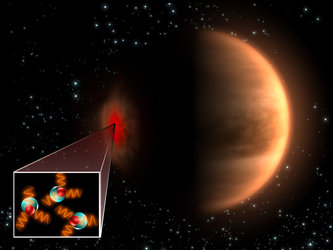
    The polar atmosphere of Venus is thinner than expected. How do we know? Because ESA’s Venus Express has actually been there. Instead of looking from orbit, Venus Express has flown through the upper reaches of the planet’s poisonous atmosphere.

    Venus Express went diving into the alien atmosphere during a series of low passes in July–August 2008, October 2009, and February and April 2010. The aim was to measure the density of the upper polar atmosphere, an experiment that had never been attempted before at Venus.

    The campaign has returned 10 measurements so far and shown that the atmosphere high above the poles is a surprising 60% thinner than predicted. This could indicate that unanticipated natural processes are at work in the atmosphere. A team led by Ingo Mueller-Wodarg of Imperial College, London, are currently investigating.

    The density is critical information for mission controllers, who are investigating the possibility of driving the spacecraft even lower into the atmosphere in order to change its orbit and extend the lifetime of the mission.

    “It would be dangerous to send the spacecraft deep into the atmosphere before we understand the density,” says team member Pascal Rosenblatt, Royal Observatory of Belgium.

    Venus Express does the twist

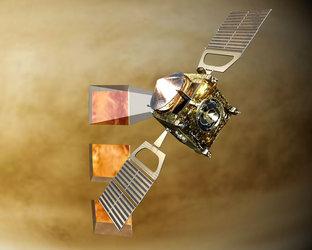
    The fact that Venus Express can make these measurements at all is remarkable. The spacecraft was not designed for it and so does not have instruments capable of directly sampling the atmosphere. Instead, radio tracking stations on Earth watch for the drag on the spacecraft as it dips into the atmosphere and is decelerated by the Venusian equivalent of air resistance.

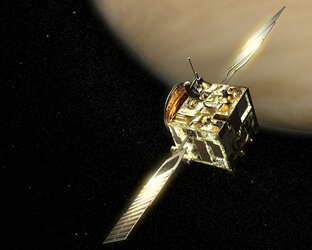
    In addition, operators at ESA’s European Space Operations Centre in Darmstadt, Germany, turned one solar wing edge-on and the other face-on so that air resistance would twist the spacecraft.

    Venus’ atmosphere extends from the surface up to an altitude of around 250 km. During April, Venus Express briefly skimmed down to 175 km above the planetary surface.

    As well as the surprisingly low density overall, the twisting of the spacecraft has also registered a sharp density change from the day to the night side of the planet. Next week, Venus Express will go diving again, this time lowering itself to 165 km.
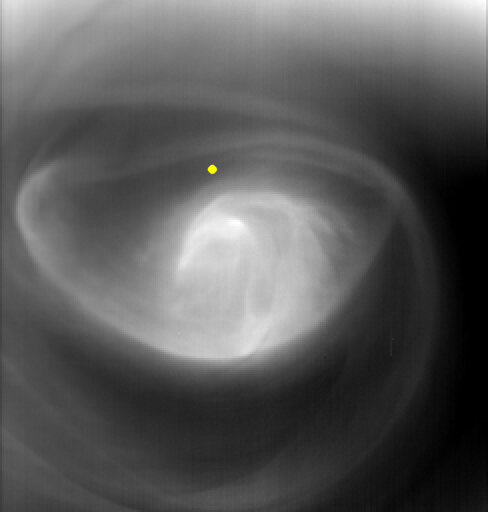

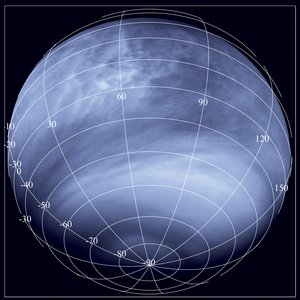
    Venus's polar vortex

    These measurements may be used eventually to help make changes to the orbit of Venus Express, halving the time it takes to circle the planet and providing new opportunities for additional scientific measurements.

    The current elliptical orbit takes 24 hours to complete and loops from 250 km to 66 000 km. When Venus Express is far away from the planet, it is pulled off course slightly by the Sun’s gravity. So, every 40-50 days, its engines must be fired to compensate. The fuel to do this will run out in 2015 unless the orbit can be lowered using the drag of Venus’ atmosphere to slow the spacecraft. It is a delicate, potentially dangerous operation and cannot be rushed.

    “The timetable is still open because a number of studies have yet to be completed,” says Håkan Svedhem, ESA Project Scientist Venus Express. “If our experiments show we can carry out these manoeuvres safely, then we may be able to lower the orbit in early 2012.”

    In the meantime, Venus Express may be feeling it’s all a bit of a drag, but the science teams involved are happier than ever with their new data. “We couldn’t see this region with our instruments because the atmosphere was too thin to register, but now we are sampling it directly,” says Dr Mueller-Wodarg.

    Rate this

    Views

    Share

    • Currently 4 out of 5 Stars.
    • 1
    • 2
    • 3
    • 4
    • 5
    Rating: 4/5 (1 votes cast)

    Thank you for rating!

    You have already rated this page, you can only rate it once!

    Your rating has been changed, thanks for rating!

    170
    Tweet
    • Looking at Venus
    • ESApod: Venus Express
    • Related articles
      • Venus Express finds planetary atmospheres such a drag
        • Was Venus once a habitable planet?
          • Venus is alive – geologically speaking
            • New map hints at Venus' wet, volcanic past
              • Watching Venus glow in the dark
                • ESA extends missions studying Mars, Venus and Earth’s magnetosphere
                  • Where did Venus’s water go?
                    • Venus comes to life at wavelengths invisible to human eyes
                      • Venus Express searching for life – on Earth
                        • How windy is it on Venus? Venus Express answers
                          • Closing in on Venus
                            • New details on venusian clouds revealed
                              • Key molecule discovered in Venus’s atmosphere
                              • In depth
                                • Notes for editors
                                • This story in depth

    Connect with us

    • RSS
    • Youtube
    • Twitter
    • Flickr
    • G+
    • Facebook
    • Livestream
    • Subscribe
    • App Store
    • LATEST ARTICLES
    • · Rare merger reveals secrets of gal…
    • · Watching for hazards: ESA opens as…
    • · ESA astronaut Timothy Peake set fo…
    • · Space drives e-mobility
    • · Proba-V opens its eyes
    • FAQ

    • Jobs at ESA

    • Site Map

    • Contacts

    • Terms and conditions