Venus Express searching for life – on Earth
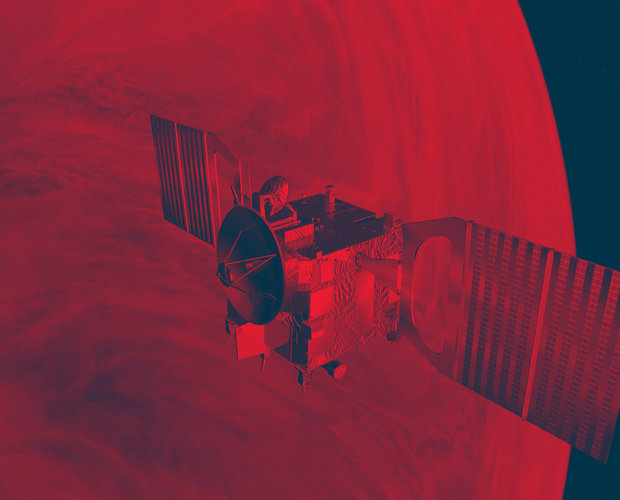
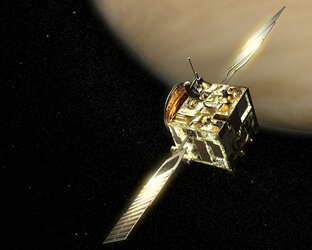
Scientists using ESA’s Venus Express are trying to observe whether Earth is habitable. Silly, you might think, when we know that Earth is richly stocked with life. In fact, far from being a pointless exercise, Venus Express is paving the way for an exciting new era in astronomy.
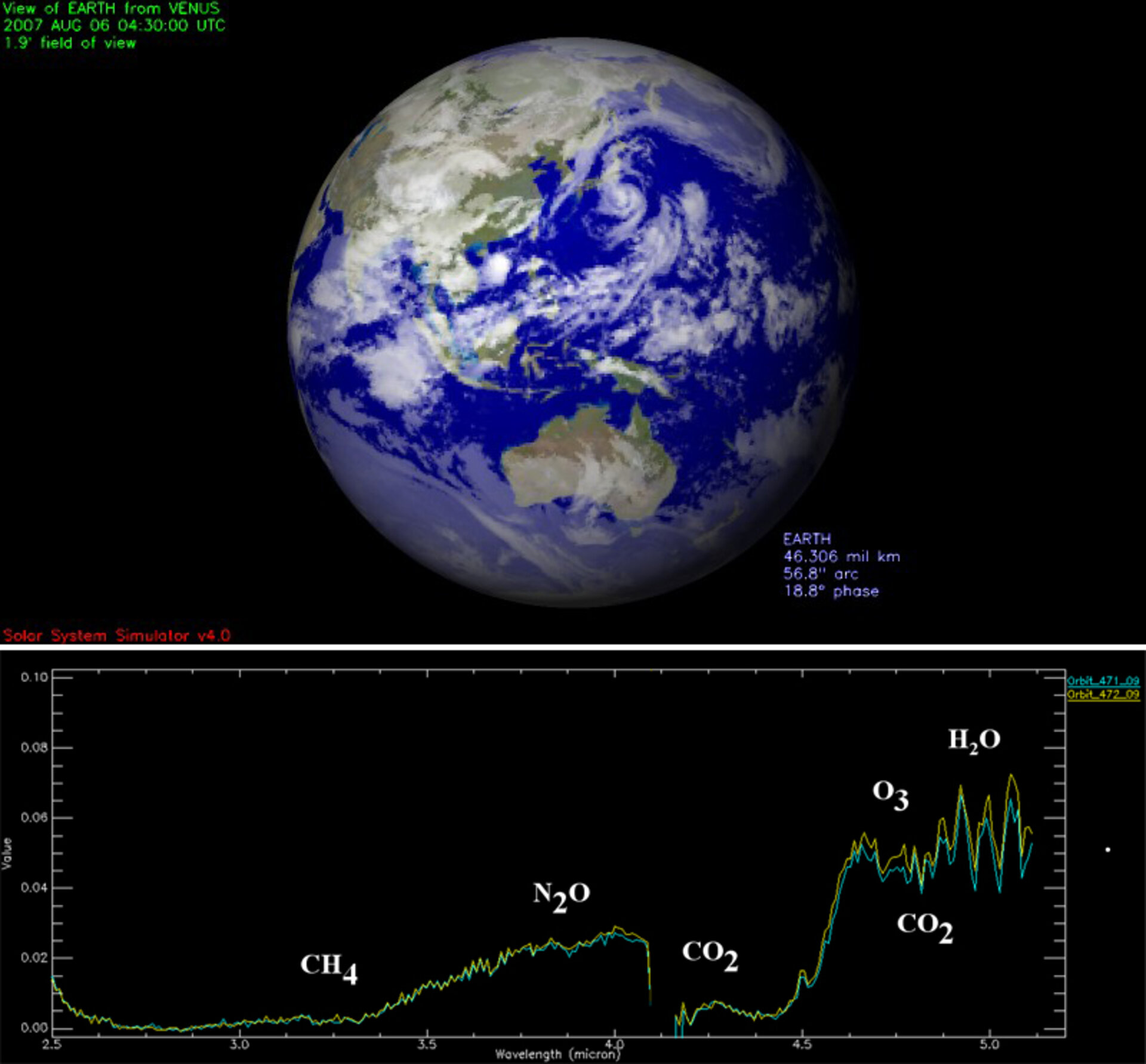
Venus Express took its first image of Earth with its Visible and Infrared Thermal Imaging Spectrometer (VIRTIS) soon after its launch in November 2005. About a year after the spacecraft established itself in Venus’s orbit, David Grinspoon, a Venus Express Interdisciplinary Scientist from the Denver Museum of Nature & Science, Colorado, suggested a programme of sustained Earth observation.
“When the Earth is in a good position, we observe it two or three times per month,” says Giuseppe Piccioni, Venus Express VIRTIS Co-Principal Investigator, at IASF-INAF, Rome, Italy. The instrument has now amassed approximately 40 images of Earth over the last two years.
The images of Earth cover both visible and near-infrared regions of the spectrum and can be split into spectra, in order to search for the signature of molecules in the Earth’s atmosphere.
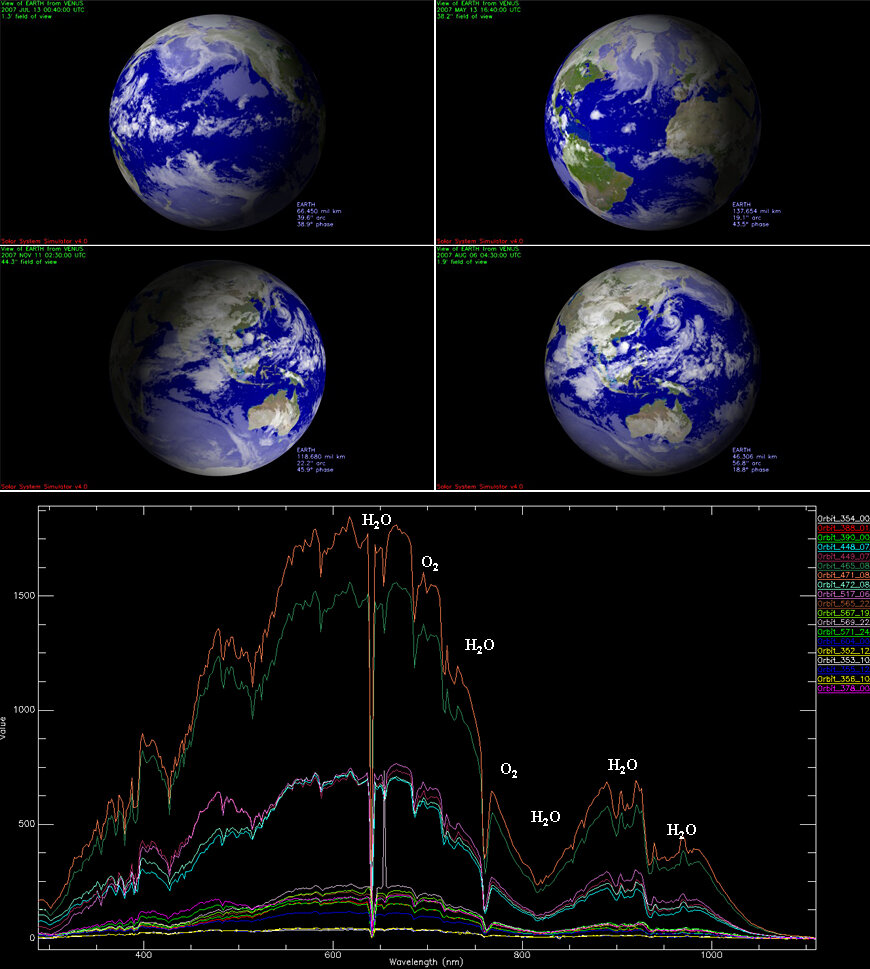
The value of the images lies in the fact that Earth spans less than a pixel in Venus Express’s cameras. In other words, it appears as a single dot with no visible surface details. This situation is something that astronomers expect to soon face in their quest for Earth-sized worlds around other stars.
“We want to know what can we discern about the Earth’s habitability based on such observations. Whatever we learn about Earth, we can then apply to the study of other worlds,” says Grinspoon.
Since 1995, astronomers have been discovering these extrasolar planets and now know of more than three hundred. As observational techniques have been refined and the data continuously taken, so smaller and smaller planets have been discovered.
Now, with CNES–ESA’s COROT and NASA’s Kepler missions, the prospect of discovering Earth-sized worlds in Earth-like orbits around other stars is better than ever. “We are now on the verge of finding Earth-like planets,” says Grinspoon.
As has been proved with the discovery of gas giant planets, as soon as astronomers know that they are there, they invent all sorts of innovative methods to separate the planet’s feeble light from the overwhelming glare of the star.
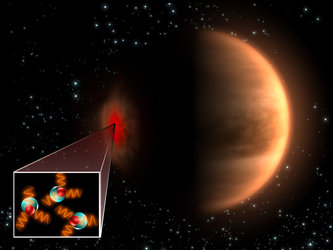
One thing has become obvious from the study of Earth using Venus Express: determining whether a planet is habitable is not going to be easy. “We see water and molecular oxygen in Earth’s atmosphere, but Venus also shows these signatures. So looking at these molecules is not enough,” says Piccioni.
Instead, astronomers are going to have to search for more subtle signals, perhaps the so-called red edge caused by photosynthetic life. “Green plants are bright in the near infrared,” says Grinspoon. The analysis to see whether this red edge is visible is just beginning.
The team will also compare spectra of the Earth’s oceans with those taken when the continents are facing Venus Express. “We have initiated the first sustained programme of Earth observation from a distant platform,” says Grinspoon. Although the observations may not tell us anything new about the Earth, they will allow us to unveil far-off worlds, making them seem more real than simply dots of light.
For more information:
David Grinspoon, Venus Express interdisciplinary scientist, Denver Museum of Nature & Science, Colorado, USA
Email: David.Grinspoon @ dmns.org
Giuseppe Piccioni, VIRTIS co-Principal Investigator, IASF-INAF, Rome, Italy
Email: Giuseppe.piccioni @ iasf-roma.inaf.it
Pierre Drossart, VIRTIS co-Principal Investigator, Observatoire de Paris-LESIA, France
Email: Pierre.Drossart @ obspm.fr
Håkan Svedhem, ESA Venus Express Project Scientist
Email: Hakan.Svedhem @ esa.int