• → European Space Agency

      • Space for Europe
      • Space News
      • Space in Images
      • Space in Videos
    • About Us

      • Welcome to ESA
      • DG's News and Views
      • For Member State Delegations
      • Business with ESA
      • ESA Exhibitions
      • ESA Publications
      • Careers at ESA
    • Our Activities

      • Space News
      • Observing the Earth
      • Human Spaceflight
      • Launchers
      • Navigation
      • Space Science
      • Space Engineering
      • Operations
      • Technology
      • Telecommunications & Integrated Applications
    • For Public

    • For Media

    • For Educators

    • For Kids

    • ESA

    • Technology

    • Technology Transfer

    • About technology
    • Foundation of innovation
    • A solid investment
    • Going up
    • Competitive edge
    • Supporting science
    • Giant leaps
    • Cross-Cutting Initiatives
    • Strategy and harmonisation
    • About strategy and harmonisation
    • Generic technology programmes
    • Basic Technology Research Programme (TRP)
    • General Support Technology Programme (GSTP)
    • Technology Transfer Programme (TTP)
    • European Components Initiative (ECI)
    • Technology in domain programmes
    • Technology in Domain programmes
    • Services
    • ESA Conferences
    • RSS feeds
    • Subscribe

    ESA > Our Activities > Technology

    Eye of Gaia: billion-pixel camera to map Milky Way

    Gaia camera array
    6 July 2011

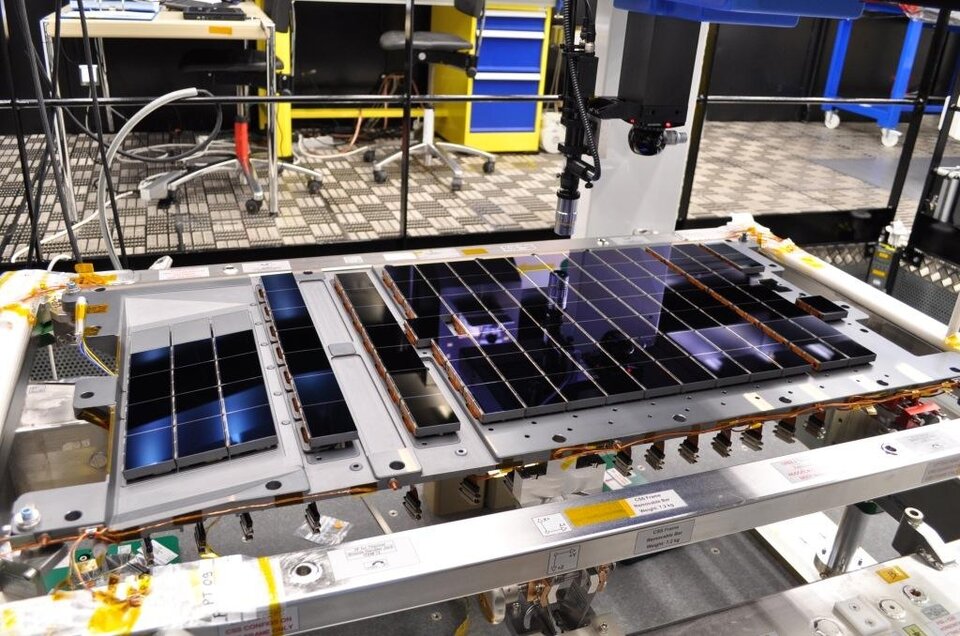
    The largest digital camera ever built for a space mission has been painstakingly mosaicked together from 106 separate electronic detectors. The resulting “billion-pixel array” will serve as the super-sensitive ‘eye’ of ESA’s Galaxy-mapping Gaia mission.

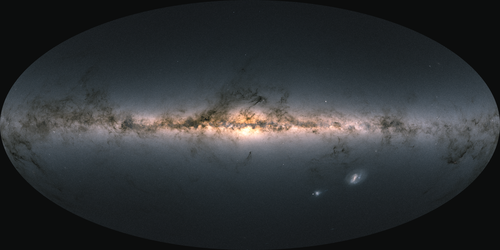
    While the naked human eye can see several thousand stars on a clear night, Gaia will map a billion stars within our own Milky Way Galaxy and its neighbours over the course of its five-year mission from 2013, charting their brightness and spectral characteristics along with their three-dimensional positions and motions.

    In order to detect distant stars up to a million times fainter than the eye can see, Gaia will carry 106 charge coupled devices (CCDs), advanced versions of chips within standard digital cameras.

    Developed for the mission by e2v Technologies of Chelmsford, UK, these rectangular detectors are a little smaller than a credit card, each one measuring 4.7x6 cm but thinner than a human hair.

    The 0.5x1.0 m mosaic has been assembled at the Toulouse facility of Gaia prime contractor Astrium France.

    Gaia's telescope elements and focal plane

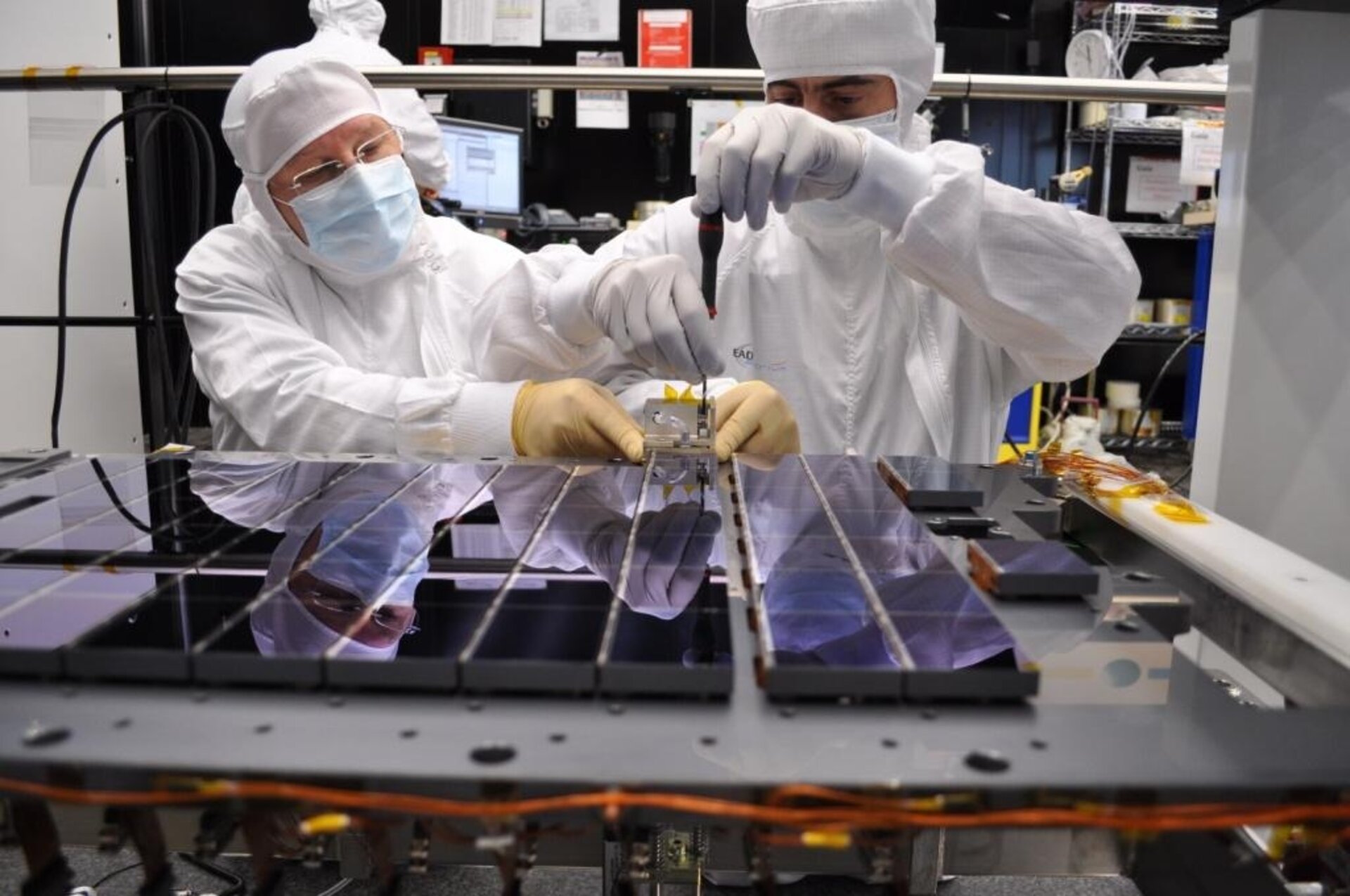
    Technicians spent much of May carefully fitting together each CCD package on the support structure, leaving only a 1 mm gap between them. Working in double shifts in strict cleanroom conditions, they added an average four CCDs per day, finally completing their task on 1 June.

    “The mounting and precise alignment of the 106 CCDs is a key step in the assembly of the flight model focal plane assembly,” said Philippe Garé, ESA’s Gaia payload manager.

    The completed mosaic is arranged in seven rows of CCDs. The main array comprises 102 detectors dedicated to star detection. Four others check the image quality of each telescope and the stability of the 106.5º angle between the two telescopes that Gaia uses to obtain stereo views of stars.

    In order to increase the sensitivity of its detectors, the spacecraft will maintain their temperature of –110ºC.

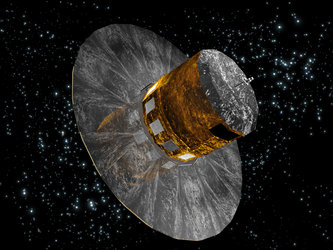
    Gaia’s CCD support structure, like much of the rest of the spacecraft, is made of silicon carbide – a ceramic like material, extraordinarily resistant to deforming under temperature changes.

    Completed CCD array

    First synthesised as a diamond substitute, SiC has the advantage of low weight: the entire support structure with its detectors is only 20 kg.

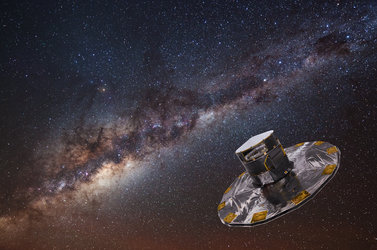
    Gaia will operate at the Earth–Sun L2 Lagrange point, 1,5 million kilometers behind the earth, when looking from the sun, where Earth’s orbital motion balances out gravitational forces to form a stable point in space. As the spinning Gaia’s two telescopes sweep across the sky, the images of stars in each field of view will move across the focal plane array, divided into four fields variously dedicated to star mapping, position and motion, colour and intensity and spectrometry.

    Scheduled for launch in 2013, Gaia’s three-dimensional star map will help to reveal the composition, formation and evolution of the Milky Way, sampling 1% of our Galaxy’s stars.

    Gaia should also sample large numbers of other celestial bodies, from minor bodies in our own Solar System to more distant galaxies and quasars near the edge of the observable Universe.

    Rate this

    Views

    Share

    • Currently 5 out of 5 Stars.
    • 1
    • 2
    • 3
    • 4
    • 5
    Rating: 5/5 (1 votes cast)

    Thank you for rating!

    You have already rated this page, you can only rate it once!

    Your rating has been changed, thanks for rating!

    1113
    Tweet
    • More about...
      • Gaia overview
        • Gaia factsheet
        • Hipparcos overview
        • Related articles
          • Gaia to lift off from Europe’s Spaceport on a Soyuz launcher
            • ESA selects prime contractor for Gaia astrometry mission
              • Most extensive mapping of Milky Way a step closer
                • Keeping ESA’s ‘lady of space’ cool
                  • The billion-pixel camera
                    • Mapping the Galaxy, and watching our backyard
                    • Read more
                      • Why are things in space the shape that they are?
                        • How many stars are there in the Universe?
                        • Related links
                        • The Interactive Books of Gaia
                        • In depth
                        • This article in depth
                        • Gaia in depth

    Connect with us

    • RSS
    • Youtube
    • Twitter
    • Flickr
    • G+
    • Facebook
    • Livestream
    • Subscribe
    • App Store
    • LATEST ARTICLES
    • · Rare merger reveals secrets of gal…
    • · Watching for hazards: ESA opens as…
    • · ESA astronaut Timothy Peake set fo…
    • · Space drives e-mobility
    • · Proba-V opens its eyes
    • FAQ

    • Jobs at ESA

    • Site Map

    • Contacts

    • Terms and conditions