• → European Space Agency

      • Space for Europe
      • Space News
      • Space in Images
      • Space in Videos
    • About Us

      • Welcome to ESA
      • DG's News and Views
      • For Member State Delegations
      • Business with ESA
      • ESA Exhibitions
      • ESA Publications
      • Careers at ESA
    • Our Activities

      • Space News
      • Observing the Earth
      • Human Spaceflight
      • Launchers
      • Navigation
      • Space Science
      • Space Engineering
      • Operations
      • Technology
      • Telecommunications & Integrated Applications
    • For Public

    • For Media

    • For Educators

    • For Kids

    • ESA

    • Technology

    • Technology Transfer

    • About technology
    • Foundation of innovation
    • A solid investment
    • Going up
    • Competitive edge
    • Supporting science
    • Giant leaps
    • Cross-Cutting Initiatives
    • Strategy and harmonisation
    • About strategy and harmonisation
    • Generic technology programmes
    • Basic Technology Research Programme (TRP)
    • General Support Technology Programme (GSTP)
    • Technology Transfer Programme (TTP)
    • European Components Initiative (ECI)
    • Technology in domain programmes
    • Technology in Domain programmes
    • Services
    • ESA Conferences
    • RSS feeds
    • Subscribe

    ESA > Our Activities > Technology

    Gaia spreads its wings

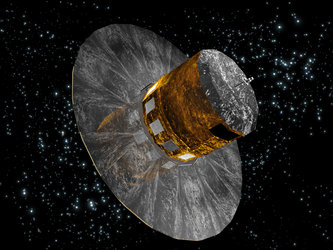
    Gaia sunshield deployment
    7 December 2011

    ESA’s Gaia star-mapper has passed a critical test ahead of its launch in 2013: the spacecraft’s sunshield has been deployed for the first time.

    Gaia's sunshield is an essential component of the mission. It keeps Gaia in shadow, maintaining the scientific instruments at a constant temperature of around –110°C.

    The sunshield is about 10 m across, which is too large for the launch vehicle fairing, so it has been built with a dozen folding panels that will be deployed after launch.

    Since the sunshield is designed for the weightlessness of space, it cannot support its own weight on Earth. So, during this test at Astrium in Toulouse, France, support cables and counterweights simulated weightless conditions and provided a realistic trial.

    The support system can be seen in the video as the white framework that surrounds Gaia.

    The video is an edited, time-lapse sequence of the deployment. In real time, it takes about 20 minutes. As the sunshield opens, the main spacecraft comes into view.

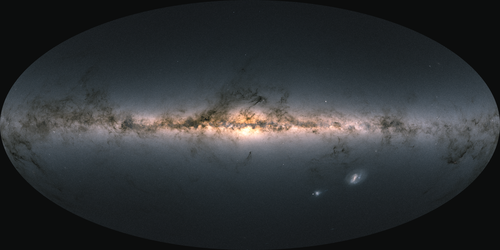
    During its expected lifetime of five years, Gaia will take a census of a billion stars – roughly 1% of all of the stars in our Galaxy. It will observe each star about 70 times, each time recording its brightness, colour and, most importantly, its position.

    By comparing Gaia's series of exquisite observations, astronomers will precisely measure the apparent movement of each star across the heavens, enabling them to determine its distance and true motion through space.

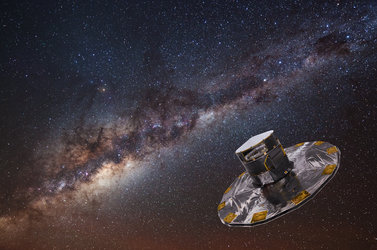
    The unprecedented results will allow astronomers to trace the history of the Milky Way.

    Before the 2013 launch, some of the solar array panels needed to generate power will be fixed to the sunshield. The rest will be placed on the bottom of the spacecraft.

    The Gaia sunshield was developed and manufactured by Sener in Spain. The satellite’s prime contractor is Astrium SAS in France.

    Rate this

    Views

    Share

    • Currently 0 out of 5 Stars.
    • 1
    • 2
    • 3
    • 4
    • 5
    Rating: 0/5 (0 votes cast)

    Thank you for rating!

    You have already rated this page, you can only rate it once!

    Your rating has been changed, thanks for rating!

    80
    Tweet
    • More about...
      • Gaia overview
        • Gaia factsheet
        • Hipparcos overview
        • Related articles
          • Gaia to lift off from Europe’s Spaceport on a Soyuz launcher
            • ESA selects prime contractor for Gaia astrometry mission
              • Most extensive mapping of Milky Way a step closer
                • Keeping ESA’s ‘lady of space’ cool
                  • The billion-pixel camera
                    • Mapping the Galaxy, and watching our backyard
                    • Read more
                      • Why are things in space the shape that they are?
                        • How many stars are there in the Universe?
                        • Related links
                        • The Interactive Books of Gaia
                        • In depth
                        • This article in depth
                        • Gaia in depth

    Connect with us

    • RSS
    • Youtube
    • Twitter
    • Flickr
    • G+
    • Facebook
    • Livestream
    • Subscribe
    • App Store
    • LATEST ARTICLES
    • · Space drives e-mobility
    • · Proba-V opens its eyes
    • · First new Galileo satellite arrive…
    • · Next destination: space
    • · Leak repaired on International Spa…
    • FAQ

    • Jobs at ESA

    • Site Map

    • Contacts

    • Terms and conditions