New moon making waves
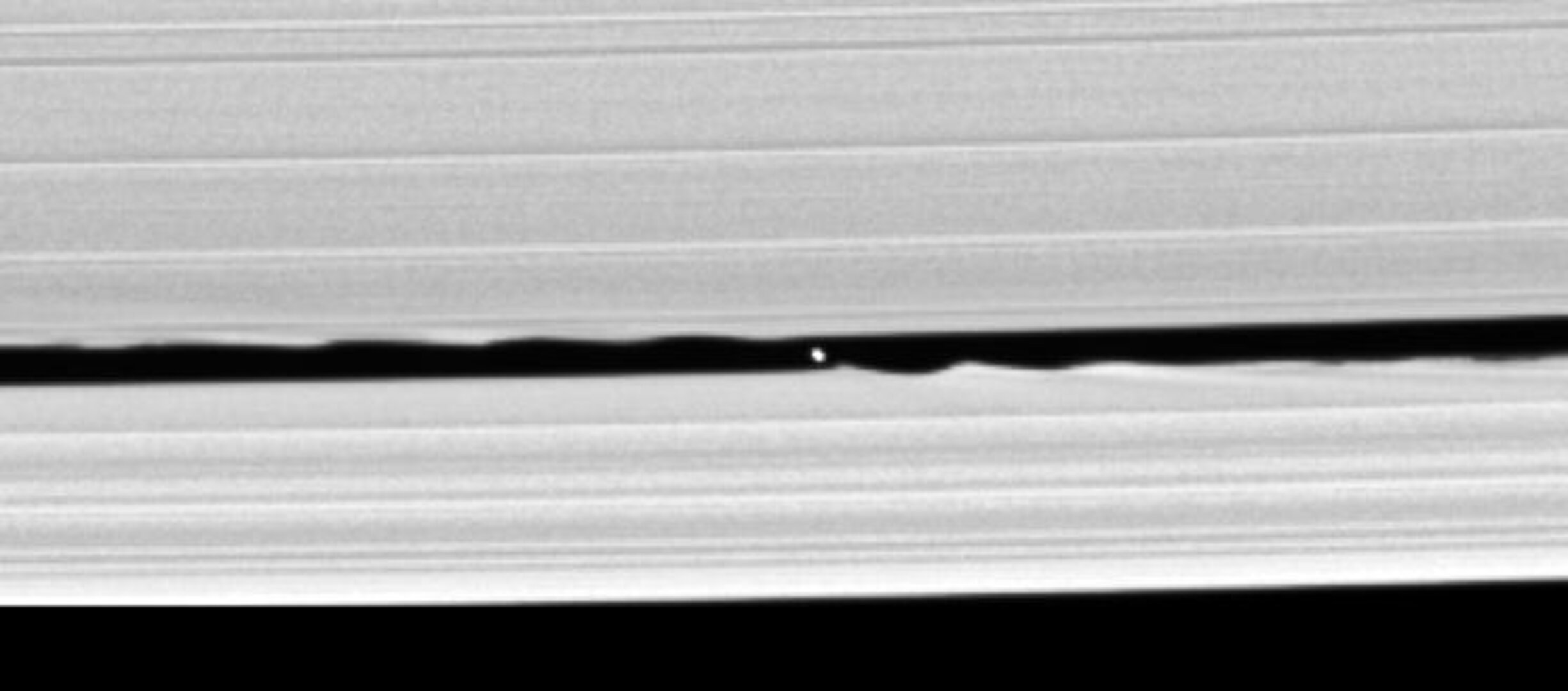
The NASA/ESA/ASI Cassini spacecraft has confirmed earlier suspicions of an unseen moon hidden in a gap in Saturn's outer A ring. A new image shows the new moon and the waves it raises in the surrounding ring material.
The moon, provisionally named S/2005 S1, was first seen in a time-lapse sequence of images taken on 1 May 2005, as Cassini began its climb to higher inclinations in orbit around Saturn. A day later, an even closer view was obtained, which allowed the moon's size and brightness to be measured.
The images show the tiny object in the centre of the Keeler gap and the wavy patterns in the gap edges that are generated by the moon's gravitational influence. The Keeler gap is located about 250 kilometres inside the outer edge of the A ring, which is also the outer edge of the bright main rings.
The new object, or 'moonlet', is about 7 kilometres across and reflects about half the light falling on it - a brightness that is typical of the particles in the nearby rings. It orbits approximately 136 505 kilometres from the centre of Saturn. More Cassini observations will be needed to determine whether the moon's orbit around Saturn is circular or 'eccentric'(like an oval).
S/2005 S1 is the second known moon to exist within Saturn's rings. The other is Pan, 25 kilometres across, which orbits in the Encke gap. Atlas and other moons exist outside the main ring system, as do the two F ring 'shepherd' moons, Prometheus and Pandora.
Imaging scientists had predicted the new moon's presence and its orbital distance from Saturn after last July's sighting of a set of peculiar spiky and wispy features in the Keeler gap's outer edge. The similarities of the Keeler gap features to those noted in Saturn's F ring and the Encke gap led imaging scientists to conclude that a small body, a few kilometres across, was lurking in the centre of the Keeler gap, awaiting discovery.
"The obvious effect of this moon on the surrounding ring material will allow us to determine its mass and test our understanding of how rings and moons affect one another," said Dr Carl Murray, imaging team member from Queen Mary College, University of London.
An estimate of the moon's mass, along with a measure of its size, yields information on its physical composition. For instance, the new moonlet might be porous, like an orbiting icy rubble pile. Other moons near the outer edge of Saturn's rings such as Atlas, Prometheus and Pandora are also porous. Whether a moon is porous or dense says something about how it was formed and its subsequent collision history.
"Some of the most illuminating dynamical systems we might hope to study with Cassini are those involving moons embedded in gaps," said Dr Carolyn Porco, imaging team leader at the Space Science Institute.
"By examining how such a body interacts with its companion ring material, we can learn something about how the planets in our solar system might have formed out of the nebula of material that surrounded the Sun long ago. We anticipate that many of the gaps in Saturn's rings have embedded moons, and we'll be in search of them from here on."
The Cassini-Huygens mission is a co-operative project of NASA, ESA and ASI, the Italian space agency.
Credit: NASA/JPL/Space Science Institute