Saturn's moon Rhea in natural colour
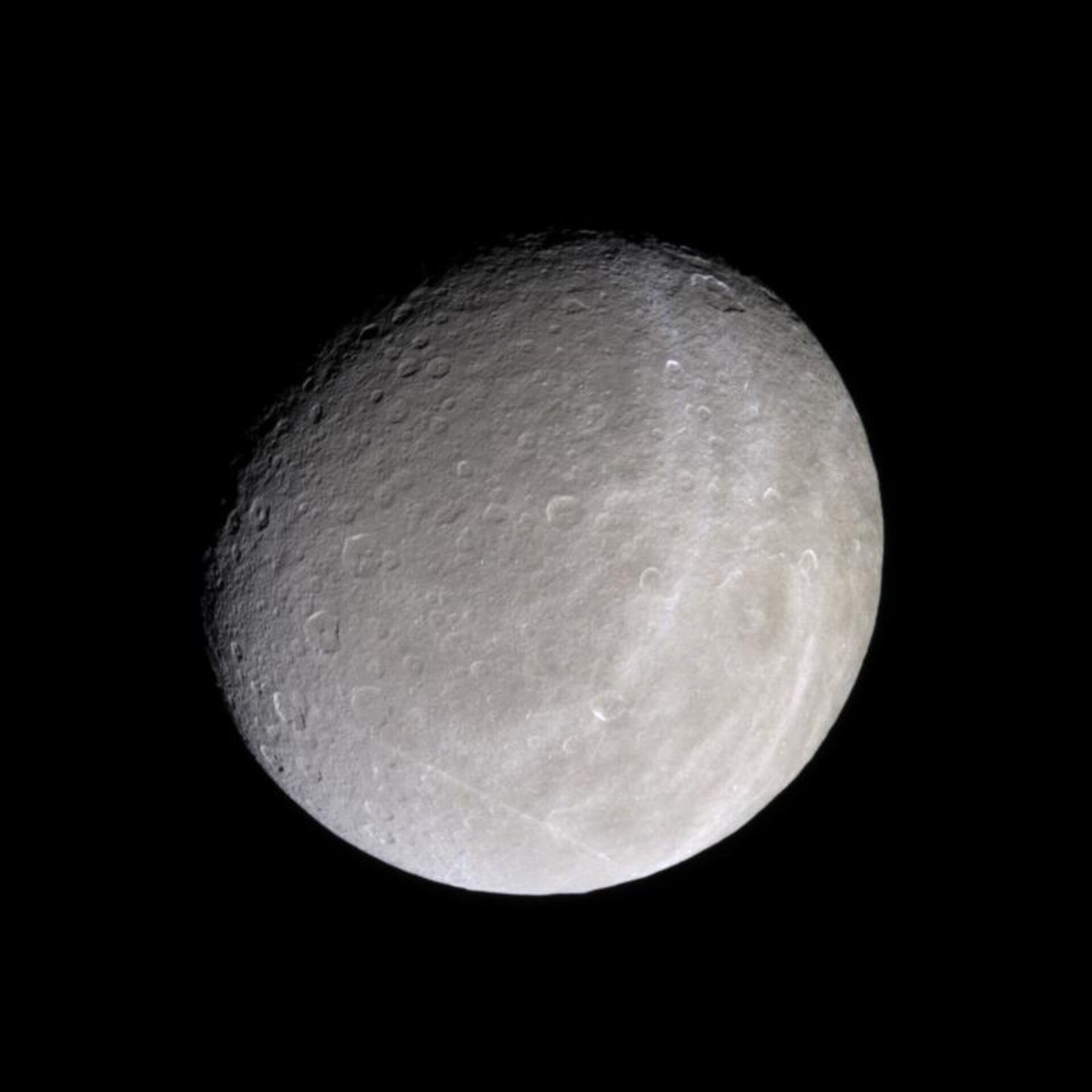
This image of the trailing hemisphere of Saturn's moon Rhea, seen here in natural colour, was taken by the NASA/ESA/ASI Cassini spacecraft on 16 January 2005.
The image shows bright, wispy terrain that is similar in appearance to that of Dione, another of Saturn's moons. At this distance however, the exact nature of these wispy features remains tantalisingly out of the reach of Cassini's cameras.
At this resolution, the wispy terrain on Rhea looks like a thin coating painted onto the moon's surface. Earlier Cassini images revealed that, when seen at moderate resolution, Dione's wispy terrain is comprised of many long, narrow and braided fractures.
This natural colour view was created from combined images taken using red, green and blue spectral filters. The images were acquired with the Cassini spacecraft narrow-angle camera at a distance of approximately 496 500 kilometres from Rhea.
Resolution in the original image was about 3 kilometrres per pixel. The image has been rotated so that north on Rhea is up. Contrast was enhanced and the image was magnified by a factor of two to aid visibility.
The Cassini-Huygens mission is a co-operative project of NASA, ESA and ASI, the Italian space agency.
Credit: NASA/JPL/Space Science Institute