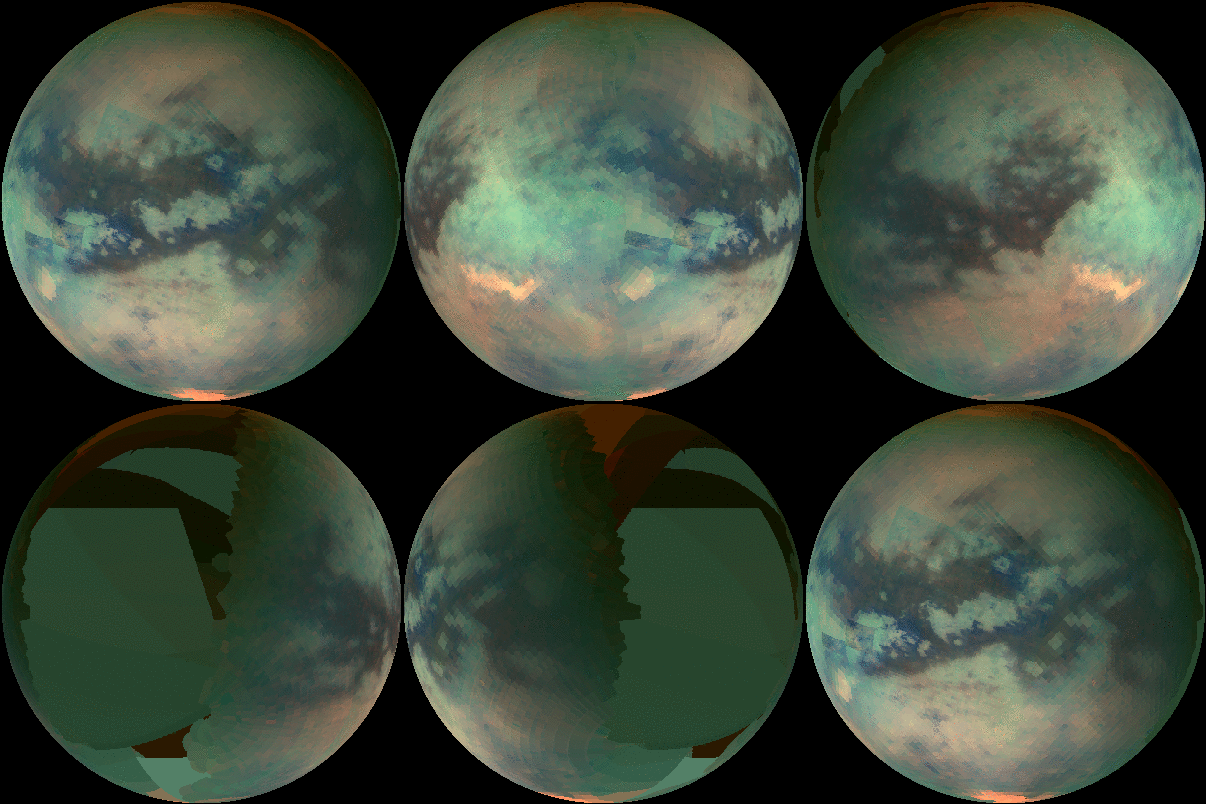
New mosaic of Titan
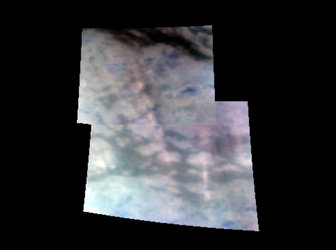
Bright and dark terrain on Titan's trailing hemisphere is revealed by Cassini's Imaging Science Subsystem in this mosaic of images taken during the T28 flyby in April 2007.
The region shown in this image, centred on the northern part of Titan's trailing hemisphere (near 31.2° North, 139.3° East), had only been seen at very low resolution until February 2007, when Cassini flew over this area for the first time. This mosaic consists of images taken during one of a series of flybys in early 2007 designed to study this long unavailable part of Titan (5150 kilometres across).
Several intriguing surface features that warrant further study can be seen in this mosaic. Along the top of the mosaic is a series of dark lineaments, or linear features, that stand out against the bland northern, mid-latitude terrain. These features were also observed by the RADAR instrument in December 2006 and represent an area of potential future co-analysis for the RADAR and camera teams. Another such region is the large bright area known as Adiri at bottom centre, also imaged by RADAR in October 2005.
The mosaic shows a number of dark areas within Adiri that line up with small dune fields observed by RADAR. A portion of the dark terrain surrounding Adiri was also observed by RADAR in 2005 and was similarly found to consist of large stretches of longitudinal dune fields - further supporting the correlation between equatorial dark regions and dune 'seas'.
To the east of Adiri is a dark spot surrounded by a ring of bright material, which may be associated with an impact crater similar to Sinlap, discovered earlier in the mission.
This mosaic consists of 29 separate frames using a total of 116 images. Each frame consists of three images, taken using a filter sensitive to near-infrared light centred at 938 nanometres, allowing for observations of Titan's surface and lower atmosphere, added together.
An image taken using a filter sensitive to visible light centred at 619 nanometres was then subtracted from the product, effectively removing the lower atmosphere contribution to the brightness values in the image, increasing image contrast and improving the visibility of surface features. This process is also intended to reduce noise, but some camera artefacts still remain, such as a dark ring caused by dust in the camera system near the bottom right of each frame.
The images used for this mosaic were taken on April 11, 2007 from distances ranging from
Notes for editors:
The Cassini-Huygens mission is a cooperative project of NASA, the European Space Agency and the Italian Space Agency.