Conditions to apply
Students who would like to participate in the Spin Your Thesis! programme must comply with the following criteria at the time of the application:
- aged minimum 18 years old. ESA Academy and relevant partners will only appraise applications from students who have no or limited professional experience in relevant scientific, engineering or other space-related topics;
- a citizen of an eligible state;
- a full-time student in a university of an eligible state for the period of the experiment development and the time of the campaign;
- studying a scientific or engineering subject.
Conditions for participation
One important condition is that the experiment be an integral part of the student’s syllabus. This can be achieved through bachelor, master of PhD theses, a research programme, or any form of project supported by the applicant’s university.
At the time of the application, the student teams must be able to show ESA's Education Office that they have their universities’ support through a letter of endorsement from an endorsing professor or academic supervisor from each university.
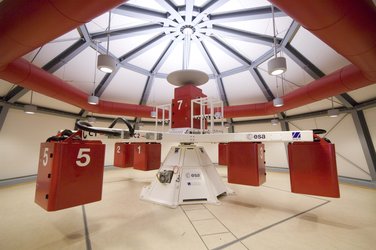
The core team should be composed of two to four students, all of which must fulfil the eligibility criteria. At least one, and preferably two, team members should comply with the condition of involvement in the syllabus (see above). The final number of team members that can personally assist and participate in the execution of the experiments at the Large Diameter Centrifuge (should the team be selected) will depend strictly on the requirements of the experiment itself, and is subject to acceptance from the review board, who may decide to reduce the size of the team.
The initial composition of the core team cannot be changed throughout the programme. If, for exceptional reasons, changes are absolutely necessary, they will be subject to the approval of the review board.
The proposals submitted by the student teams will be evaluated based on the fulfilment of all the required steps. Please read the how to apply page carefully.
Endorsing professors
Overall endorsing professor
The teams will have to be supported by one of their professors or academic supervisors, whose role will be to supervise the work of the students. This person must belong to the same institution of at least one of the students, is expected to endorse the entire application and development process of the team, and will bear responsibility for the experiment.
Additional endorsing professor
If the team consists of students from multiple universities, each student must procure support from their own institute in the form of an additional endorsing letter from an appointed academic of that university. This letter will therefore demonstrate that they have the support from their university as well.
At the moment of application, the endorsing professor will have to provide ESA's Education Office with a Letter of Endorsement. In this letter they should state the names of their students and that they bear responsibility for their involvement in the programme.
ELGRA mentor
Additionally, the European Low Gravity Research Association (ELGRA) will offer each selected team, through a mentorship programme, the possibility to benefit from the support from a European scientist highly experienced in gravity-related research.
The objective of the ELGRA mentors' relationships with the students is to bring some support to the team and to advise them during their experiment rack development. The mentors will primarily focus on the scientific aspects of the projects.
The ELGRA mentor will follow the evolution of the team’s participation until the end of the programme, including the post-campaign activities. He/she will be offered the possibility to visit the institution of the student team.
Selection criteria
In order to assess the experiment proposals, the review board will consider various criteria, such as the scientific or technological interest, the relevance of hypergravity for the proposed research, its novelty, the level of involvement of the project in the students’ syllabus, and others. The selection will be performed in a single step. Please carefully consider the technical constraints of the Large Diameter Centrifuge to make sure your experiment is compatible with the platform’s possibilities.
Please note that the conditions detailed above are subject to change without prior notice.