

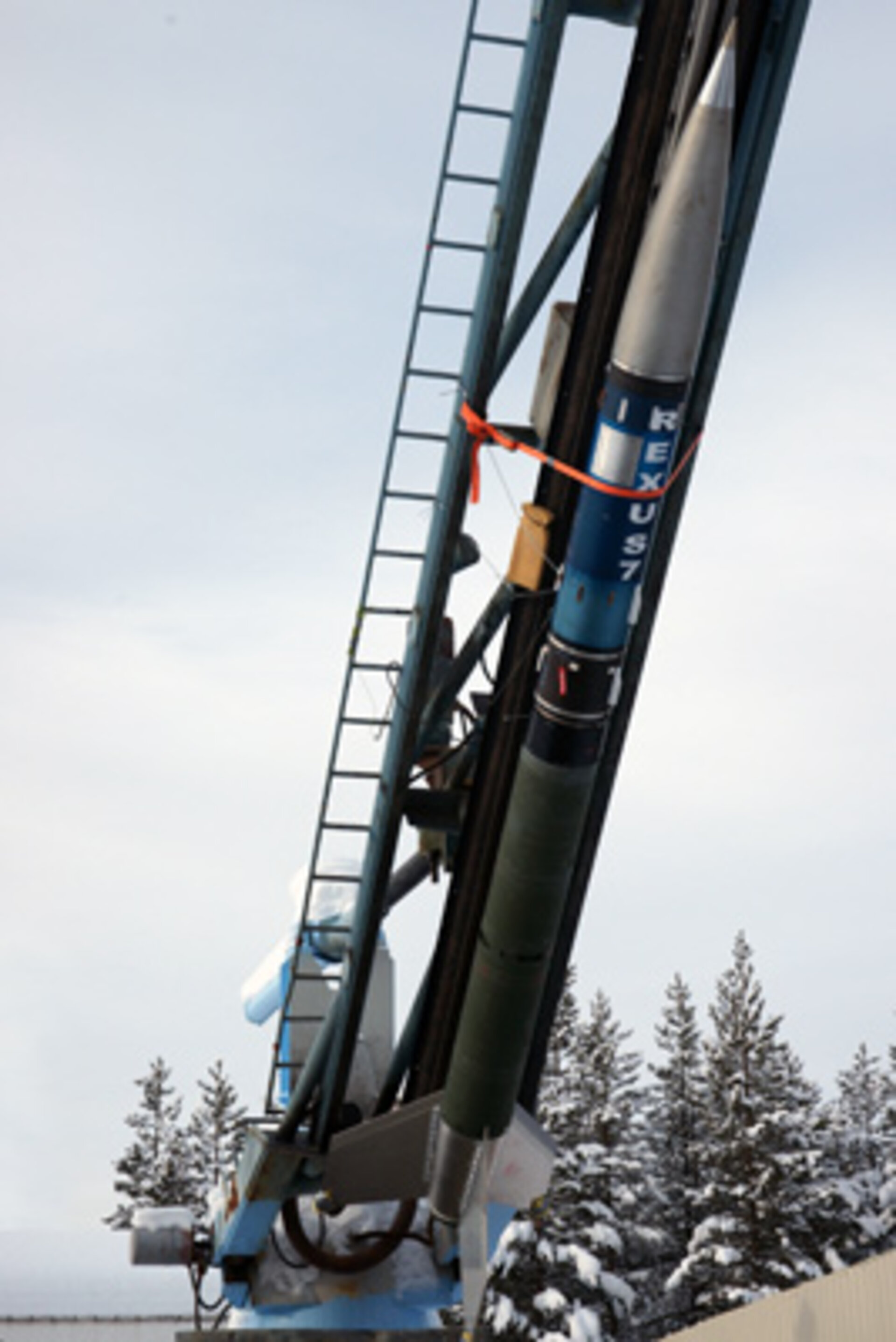
REXUS 7 and 8 campaign completed
The latest launches in the REXUS/BEXUS (Rocket/Balloon EXperiments for University Students) series were successfully completed during the first week of March. Two teams selected by ESA's Education Office flew their experiments on board the REXUS 7 and 8 sounding rockets.
First to go was REXUS 7, which lifted off from the Swedish Space Corporation’s snow-covered launch facility at Esrange Space Centre on 2 March.
On board were three experiments, including the ESA-sponsored BUGS (Boom for University Gravity-gradient stabilised Satellites) provided by a team of Italian students from University Sapienza of Rome and the University of Bologna. BUGS was designed to test and verify deployment of a boom that could be used for gravity gradient attitude stabilisation on a student CubeSat nano-satellite.
Lift off occurred at 08:25 local time and the rocket reached an altitude of 83 km before the experiment section was released. The recovery operation swung into action after landing, and the payload was brought back to Esrange by helicopter for further analysis.
The BUGS-team confirmed that both of their boom structures were correctly deployed and then ejected. Analysis of the boom behaviour will allow them to select the most suitable model to fly on their CubeSat nano-satellite.
The near-identical REXUS 8 flight took place two days later. The rocket reached an altitude of 88 km and the experiment section landed safely north of the launch site.
Once again, it carried three student experiments, including the LAPLander (Light Airbag Protected Lander) experiment developed by a team from KTH Royal Institute of Technology in Stockholm, Sweden. This ESA-sponsored experiment comprised a small prototype for an ejectable payload, equipped with data collection, airbraking, impact protection and recovery systems.
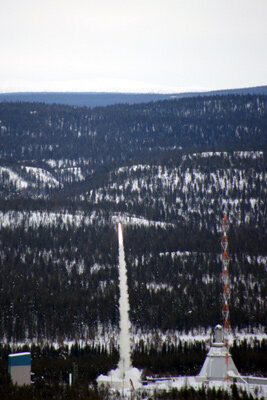
The LAPLander team from Sweden received a good luck message before the flight from the Swedish Minister of Science and Education, Mr. Tobias Krantz, who had followed the project closely.
“The launch was fine and the lander was ejected successfully,” said Johan Julén, the LAPLander team leader. “We were not able to track the descent with our GPS but we hope that it will be recovered eventually and that we will find some interesting data stored onboard.”
The annual programme of REXUS flights provides European students with rare opportunities to design, build and fly their own experiments, giving them invaluable hands-on experience that helps to prepare them for future careers in the fields of science and engineering.
The REXUS/BEXUS programme is realised under a bilateral Agency Agreement between the German Aerospace Center (DLR) and the Swedish National Space Board (SNSB). The Swedish share of the payload has been made available to students from other European countries through a collaboration with the European Space Agency (ESA).
The next student flight campaign will take place in September 2010, with the launch of two stratospheric balloons, BEXUS 10 and 11.

