Launch and early operations
The Launch and Early Operations Phase (LEOP) is the period immediately after launch when critical operations are carried out by the Mission Control Team. For Herschel and Planck, this phase began as soon as the first signal was acquired from the launcher, about 36 minutes after launch on 14 May 2009; it lasted for most of 5 days, and included a number of orbit correction manoeuvres.
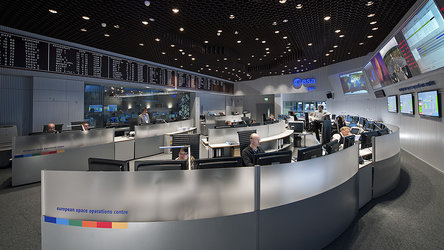
During LEOP, the satellites were monitored 22 hrs/day using ESA’s Deep Space Stations at New Norcia, Australia (primary ground station); Cebreros, Spain; Perth, Australia; Maspalomas, Spain; and Kourou, French Guiana.
The Ariane 5 solid rocket boosters separated from the upper stage of the launcher approximately 2.5 minutes after launch, and the fairing was jettisoned about 4 minutes after launch.
Herschel separated from the upper stage about 26 minutes after launch. After this, the upper stage reoriented itself away from Herschel and ejected the Sylda, a protective cover under which Planck was kept during launch. The upper stage then reoriented to the correct attitude and was spun up, allowing Planck (which must spin at about 1 rpm to conduct its observations) to separate.
Planck had no dedicated engine for trajectory manoeuvres, so the satellite used its thrusters for trajectory corrections.
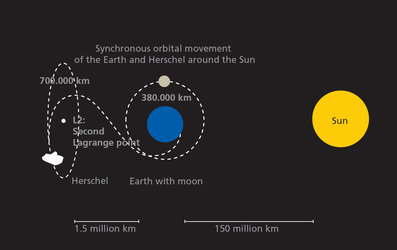
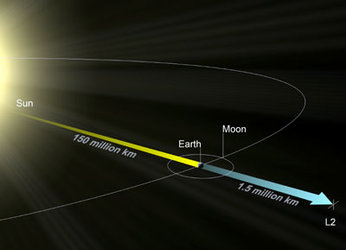
Right after separation, the thrusters were used for one trajectory correction manoeuvre, and another was conducted about 30 hours after separation. Another follow-up manoeuvre for fine-tuning and two more manoeuvres were executed along the way to L2. The third and last manoeuvre on 2 July inserted Planck into its final orbit around L2.
The cooling phase and commissioning phase ran in parallel. The satellite’s detectors reached their lowest temperature of 0.1K above absolute zero in the first week of July. During commissioning, all of the satellite’s subsystems (power, thermal control etc.) were turned on and verified as working normally.