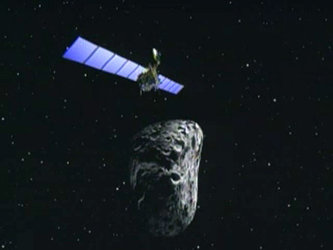
Last visit home for ESA’s comet chaser
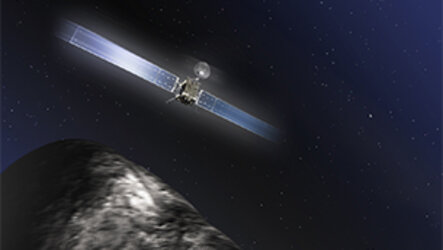
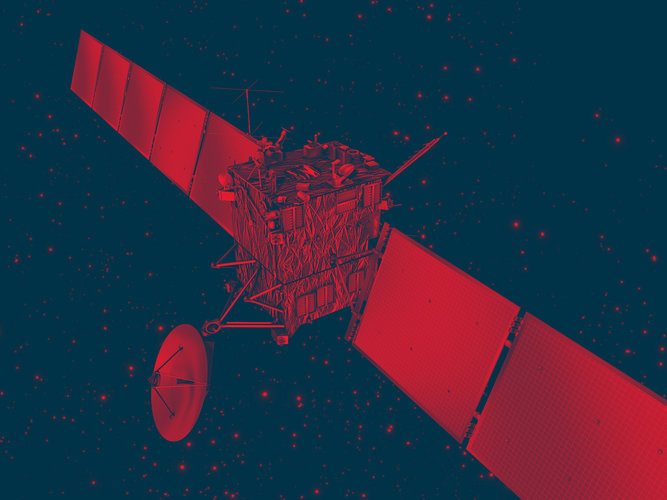
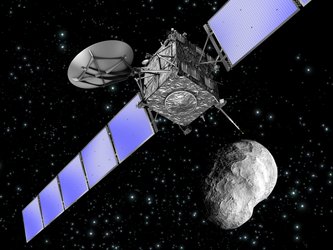
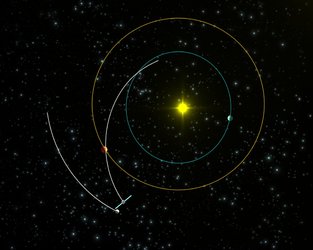
ESA's Rosetta comet chaser will swing by Earth on 13 November to pick up orbital energy and begin the final leg of its 10-year journey to the outer Solar System. Several observations of the Earth–Moon system are planned before the spacecraft heads out to study comet 67/P Churyumov-Gerasimenko.
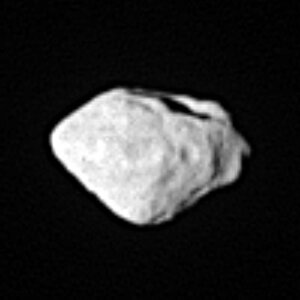
This will be the third Earth swingby, the last of Rosetta’s four planetary gravity assists. Closest approach to Earth is expected at 08:45 CET. The swingby will provide exactly the boost Rosetta needs to continue into the outer Solar System. The craft is scheduled for a close encounter with asteroid 21 Lutetia in July next year.
Rosetta is expected to arrive at its final destination in May 2014. There, it will release the Philae lander for in-situ studies on the surface. The spacecraft will then escort the comet on its journey toward the Sun, studying it closely for up to two years.
As it closes in on Earth next month, Rosetta will have travelled almost 4500 million km since launch. It will speed past Earth at 13.3 km/s, passing above the Indian Ocean at 109°E, 8°S, just south of the Indonesian island of Java. The gravity-assist will increase the spacecraft's speed by 3.6 km/s with respect to the Sun.
Instruments in action

While the swingby is critical for achieving the velocity required to reach its ultimate destination, the close encounter will also be used to study the Earth–Moon system from Rosetta’s unique perspective.
Several instruments that usually hibernate during the long trek will be turned on in the week before the swingby.
Follow the swingby live
The Rosetta Blog will be updated regularly for this final planetary swingby. Follow crucial events live via the blog and the dedicated ESA Rosetta mission website.
Critical swingby events
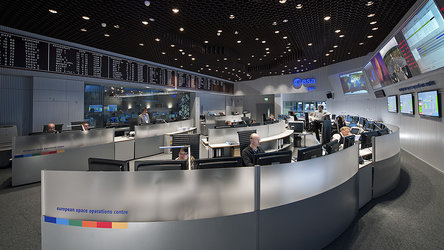
Closest approach is scheduled for 08:45 CET on 13 November, but mission operators will perform a number of critical actions before and after the swingby to ensure that Rosetta is on the right trajectory.
One of the most important will be a trajectory correction manoeuvre (TCM), scheduled for 22 October at 14:30 CET. Results of this manoeuvre will be analysed to determine whether additional TCMs are required to achieve the correct approach trajectory.
Notes:
- All times are in Central European Time (CET/CEST)
- TCM: Trajectory correction manoeuvre
- DSN: Deep Space Network (NASA)
- DSA: Deep Space Antenna (ESA)
| Time | Event |
| 22 October | |
| 14:30 – 21:30 | TCM slot |
| 5 November | |
| 12:30 – 19:30 | Slot for TCM if needed |
| 6 November | |
| Beginning 22:45 | Instruments switched on to begin observations of the Earth-Moon system |
| 12 November | |
| 10:30 – 17:30 | Slot for TCM if needed |
| 13 November | |
| 01:00 – 08:00 | Slot for TCM if needed |
| 08:45 | Earth closest approach |
| 09:04 - 10:55 | Swing by confirmation via Maspalomas ground station, Canary Islands |
| 11:00 – 21:00 | Start science data download via NASA DSN Goldstone, California |
| 16:41 | Moon closest approach |
| 21:13 - 5:04 (14 November) | ESTRACK DSA New Norcia ground station pass, Australia |
| 19 November | |
| By 12:05 | Instruments turned off |
All times are subject to change.