| | Structural verification of payloads and system hardware for human rated vehicles
The Structures Section is providing technical support to various ESA ISS payload and system hardware projects related to the structural verification. The support is provided throughout the complete development phase, starting from requirements definition and SOW preparation to Flight Acceptance Reviews (FAR), support to on-orbit operations and hardware end of life. In a number of cases detailed structural analysis tasks are performed for example;
- derivation of detailed Finite Element models;
- static and dynamic analysis of payloads and racks;
- micro-vibration analysis;
- vibration test predictions;
- post processing of launcher coupled dynamic analysis results;
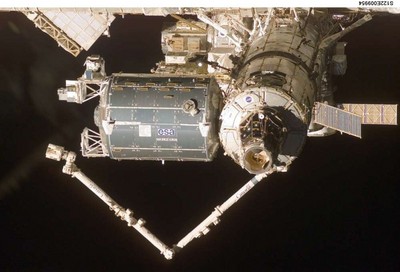
ESA Columbus module
The Structural Verification process can be summarized as follows:
The Structural Verification of ISS (International Space Station) Payloads and system hardware is an important task needed to ensure the safety and the performance of the payload hardware during all ground and flight events to which it is subjected. It is a rather long process, especially if the hardware is launched in hard-mounted configuration.
The structural design of a payload starts with the production, by the Hardware Developer, of a Structural Verification Plan (SVP) that includes the definition of the different structural parts, and interfaces, the identification of the safety critical structural elements, the preliminary design loads to be considered for the design, the verification approach, the chosen model philosophy (proto-flight or prototype) and all the testing the structural hardware will undertake.
In line with the SVP, the Hardware Developer develops a structural design based on existing preliminary (design limit) loads and initial mathematical models structurally representative of the hardware. The design limit loads come from the launcher and ISS generic requirements and, since are based on former missions experience and measurements, are supposed to envelope the actual flight ones. This, as described below, must be verified prior to the flight. The loads affecting the design are of many types. They are listed below.
- Assembly and Installation
- Testing
- Ground Handling & Transportation
- Flight, lift-off, ascent, descent, re-entry, landing & emergency landing (inertial, transients, acoustics, random, constraints)
- ISS On orbit (ISS boost, vehicles docking)
- Crew applied (IVA & EVA)
- Pressure, related to pressurized systems and to pressurization-depressurization of the launch vehicle and of the ISS elements
- Thermal
However, the most common design driver loads are the low frequency transients (including the steady state acceleration), the acoustics and the random loads. All three types of loads must be combined to accomplish the design and subsequent verification of the hardware.
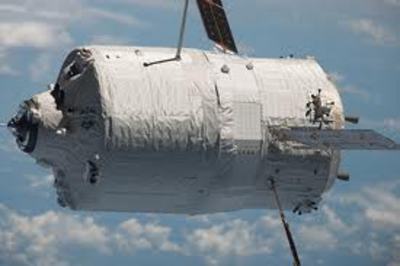
ATV
Once the structural design is accomplished all efforts are focussed on the hardware verification.
The structural verification of ISS payloads and system hardware is performed by a combination of analyses and tests to demonstrate positive margins of safety of all safety critical structural elements. In most cases, the tests are performed to validate the initial mathematical models used in the analytical verification. This means that, for most cases, the structural verification is accomplished only by the results of the analyses performed using validated models. This is particularly true for metallic structures, whilst for other materials, such as composite structures or glass structures, additional tests, besides the ones required to validate the payload models, are needed.
One or more detailed mathematical finite element models of the payload are built and used to support the hardware design and the analytical verification. Normally, only one model is built, although if the hardware has different configurations for different mission phases (e.g., launch, landing, on-orbit operations), more than one model must be built and validated. The models must be checked for mathematical correctness and, at the final phase of the verification process, they are validated by dynamic (either resonance search of modal survey) and/or static tests of either flight or flight representative hardware. Typical analyses run using the finite element models are the following:
- Modal (to check modes and frequencies)
- Static, thermo-elastic (to derive forces, stresses, displacements), stability
- Dynamic (either transient or frequency response, whenever time or frequency consistent results are needed to decrease conservatism)
- Multi-body dynamics for special cases
- Hand or spreadsheet calculations for post-processing and derivation of margins of safety.
|  | ESA Atronaut A. Kuipers and Cupola window | |
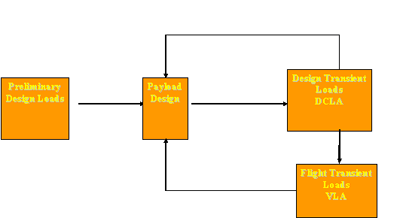
As mentioned above, the transient loads used in the structural verification of ISS payloads and system hardware are evolving during the whole process. We have already described the design limit loads used for the structural design. Further in the development process of the hardware, the mathematical models (not necessarily validated yet) of hard-mounted cargoes are submitted to the launcher authority to perform system level analyses. New transient loads are calculated from the system level analysis performed by the launcher authority and called Design Coupled Loads Analysis (DCLA). A comparison between the initial design limit loads and the DCLA loads must be performed and, if the DCLA values exceed the limit loads, the design must be checked against the new loads. This check will decide on possible changes of the structural design. Usually, only mass properties of the hardware have to be delivered to launcher authorities for cargoes launched inside transport bags (soft-mounted configuration).
Once the hardware models are validated by test and the launcher configuration (including the cargo carrier) is known and frozen, the last system level analysis is performed by the launcher authority. This time is named Verification Coupled Loads Analysis (VCLA or VLA). It provides the final transient flight loads that, again, must be compared with the used design limit loads. This is the last step of the structural verification process and is normally followed, once other mechanical disciplines like fracture control are cleared, by the formal certification of the payload to fly on board the launch vehicle and being operated on board the ISS.
The whole structural verification process is summarized in the figure below.
Payload verification process
Last update: 7 January 2013 | |