ESA    Life in Space    Expanding Frontiers    Improving Daily Life    Protecting the Environment    Benefits for Europe  
   
Media Centre
Press ReleasesESA TelevisionLaunch Media CornerExhibitions
Services
CalendarPublicationsFrequently asked questionsESA-sponsored ConferencesHelpSite CreditsPortal terms of useCommentsSubscribe


Bookmark and Share


Mars Express reveals wind-blown deposits on Mars
 
3 February 2012

Download:
 HI-RES JPEG (Size: 820 kb)  HI-RES TIFF (Size: 62 224 kb)
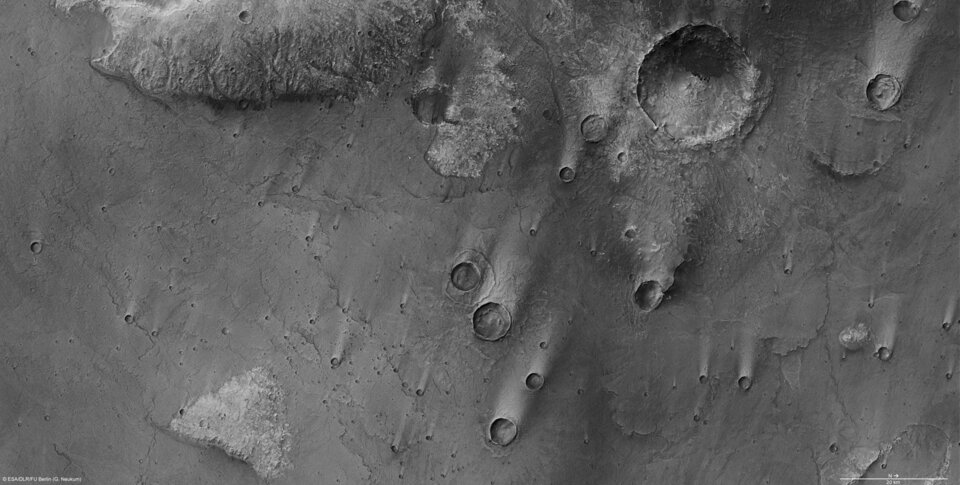
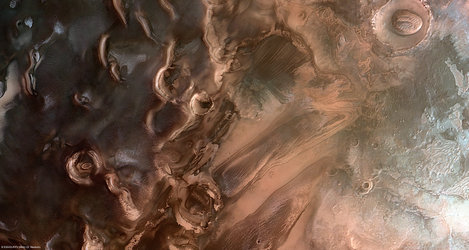
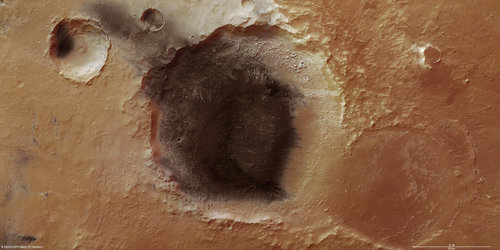
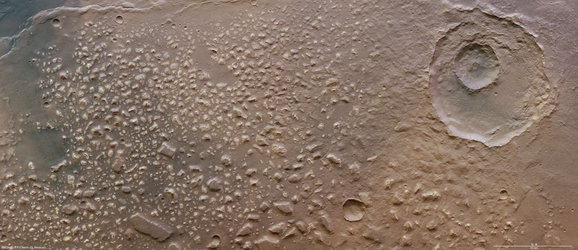
Syrtis Major, discovered in 1659 by Christaan Huygens, is a volcanic province on Mars. The image is centred on approximately 16°N/73°E. The High-Resolution Stereo Camera (HRSC) on ESA’s Mars Express collected the data for this image on 8 June 2011 during orbit 9487. The image has a ground resolution of approximately 19 m per pixel. The image size is approximately 90x180 km.
Credits: ESA/DLR/FU Berlin (G. Neukum)
 
 
Download:
 HI-RES JPEG (Size: 304 kb)  HI-RES TIFF (Size: 3582 kb)
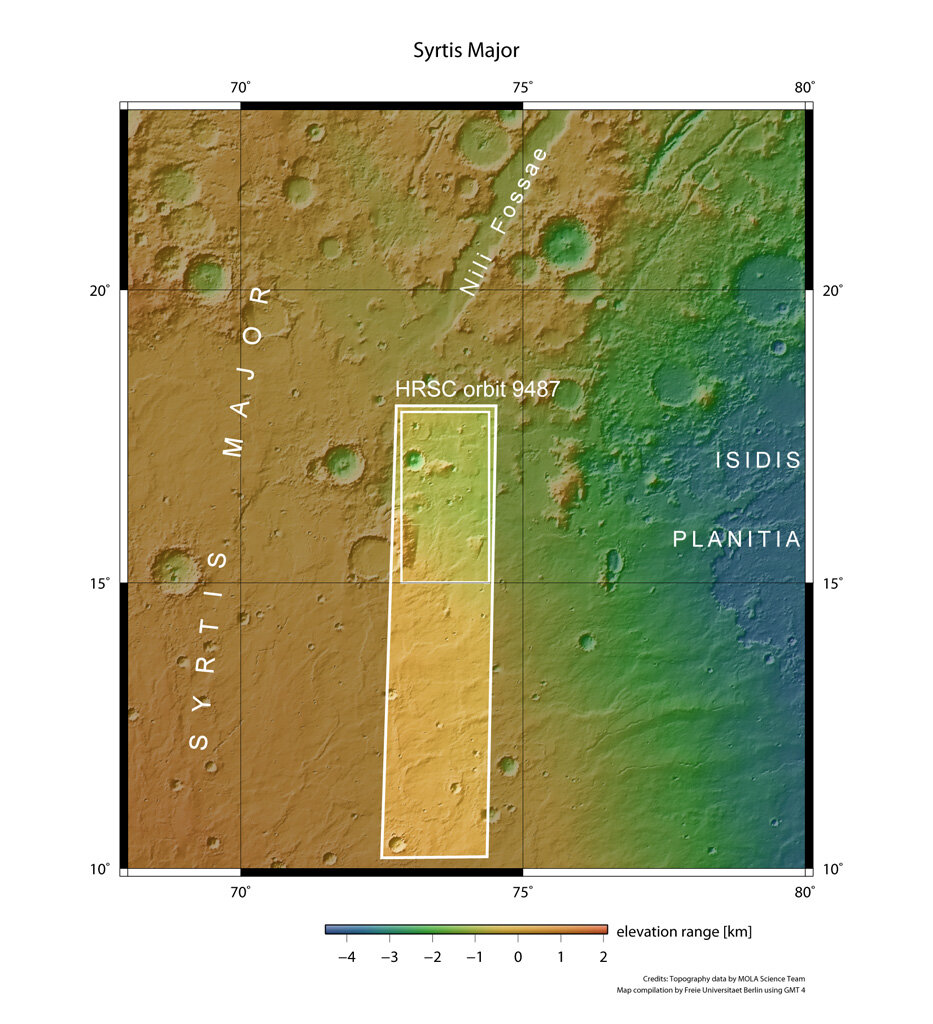
A wider contextual image of Syrtis Major. The smaller rectangle shows the region covered in this Mars Express HRSC image release.

Credits: NASA MGS MOLA Science Team
 
 
Download:
 HI-RES JPEG (Size: 644 kb)  HI-RES TIFF (Size: 23 848 kb)
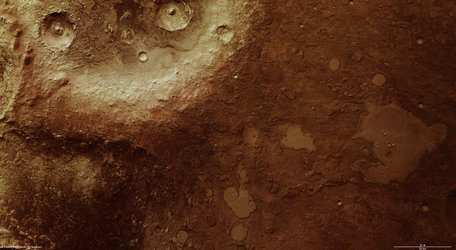
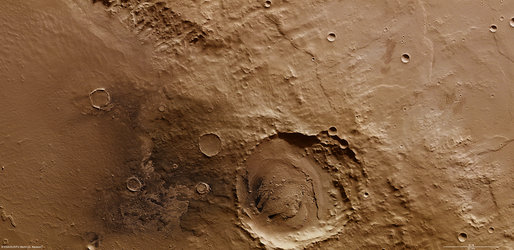
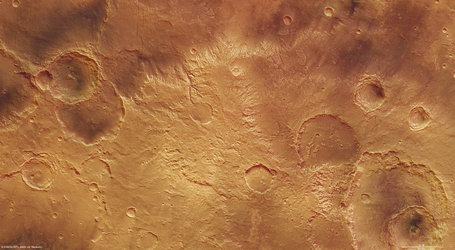
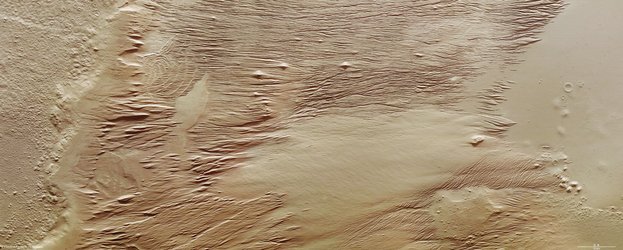
Syrtis Major is a volcanic province on Mars. This image from the High-Resolution Stereo Camera on ESA’s Mars Express orbiter shows lava flows in box 1. Filled craters and partly filled craters can be seen in box 2. The prevailing wind direction can be judged from the dispersal of the lighter-toned material. The smaller craters illustrate this clearly. The largest crater in the picture, highlighted in box 3, has a small central peak and contains a small dune field of darker-toned dunes. ESA’s Mars Express collected the data for this image on 8 June 2011 during orbit 9487. The image has a ground resolution of approximately 19 m per pixel.
Credits: ESA/DLR/FU Berlin (G. Neukum)
 
 
Download:
 HI-RES JPEG (Size: 784 kb)  HI-RES TIFF (Size: 74 260 kb)
Syrtis Major, discovered in 1659 by Christaan Huygens, is a volcanic province on Mars. The image is centred on approximately 16°N/73°E. The image was created using a Digital Terrain Model (DTM) obtained from the High-Resolution Stereo Camera on ESA’s Mars Express spacecraft. Elevation data from the DTM is colour coded: purple indicates the lowest-lying regions and grey the highest. The scale is in metres. The data for these images were collected on 8 June 2011 during orbit 9487. The images have a ground resolution of approximately 19 m per pixel.

Credits: ESA/DLR/FU Berlin (G. Neukum)
 
 
Download:
 HI-RES JPEG (Size: 642 kb)  HI-RES TIFF (Size: 24 002 kb)
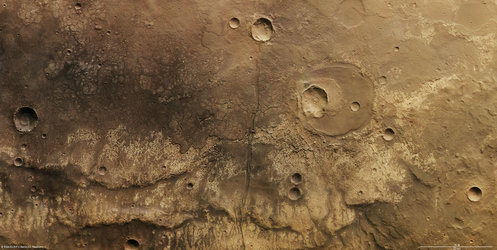
Syrtis Major, discovered in 1659 by Christaan Huygens, is a volcanic province on Mars. The image is centred on approximately 16°N/73°E. The High-Resolution Stereo Camera on ESA’s Mars Express collected the data for these images on 8 June 2011 during orbit 9487. The images have a ground resolution of approximately 19 m per pixel. It was derived from the nadir channel, which provides the highest detail of all the channels.

Credits: ESA/DLR/FU Berlin (G. Neukum)
 
 
Download:
 HI-RES JPEG (Size: 729 kb)  HI-RES TIFF (Size: 22 967 kb)
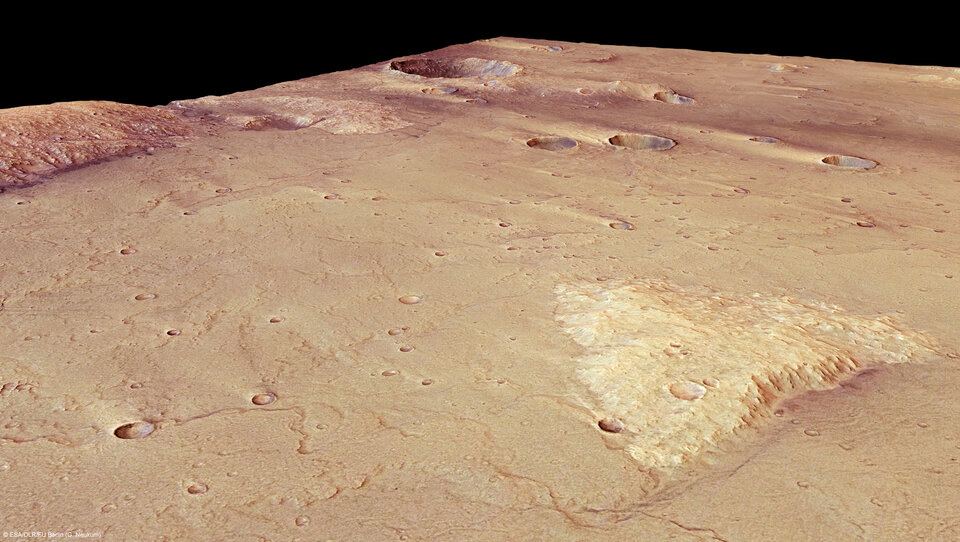
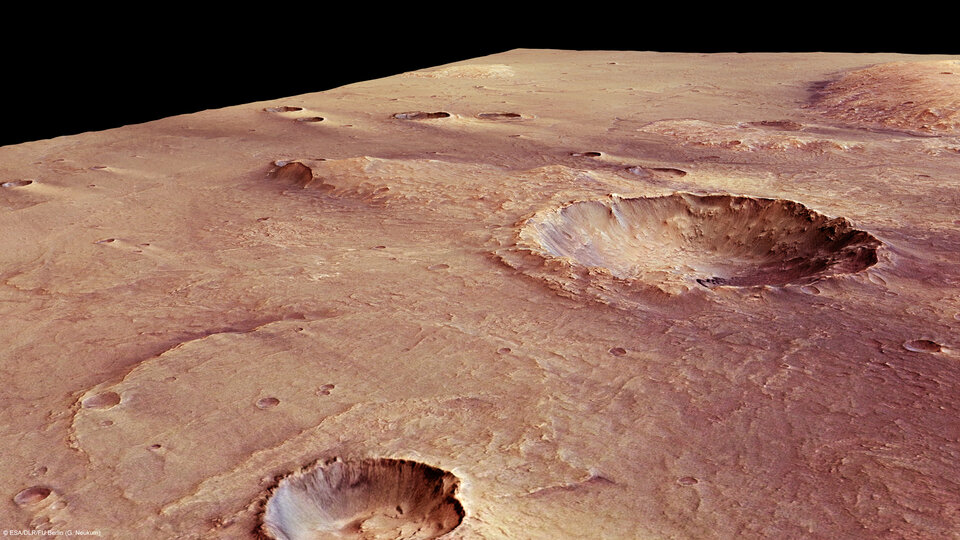
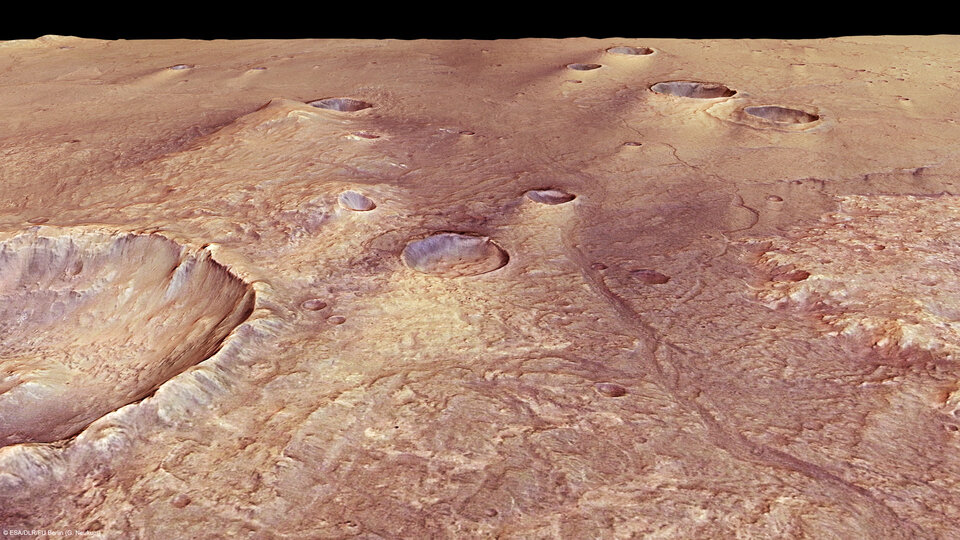
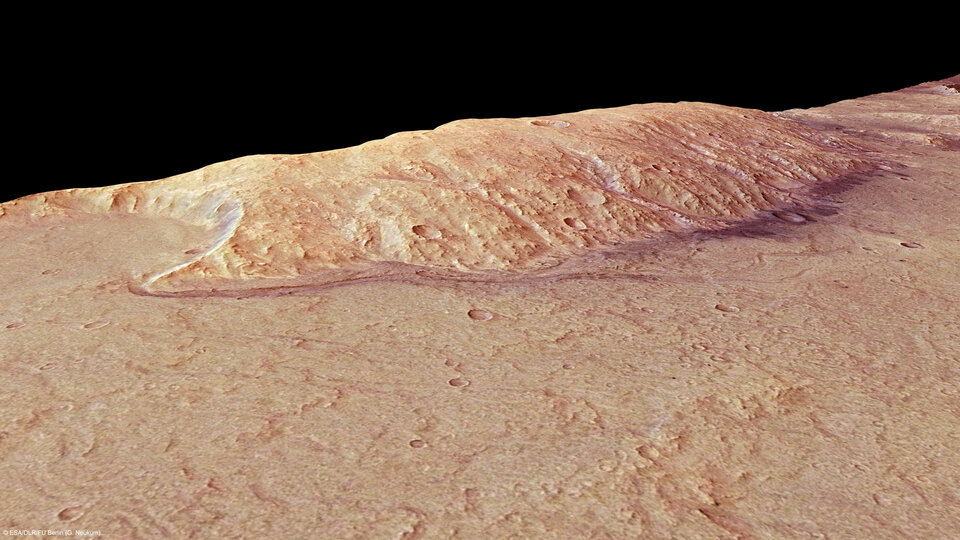
Syrtis Major, discovered in 1659 by Christaan Huygens, is a volcanic province on Mars. The image is centred on approximately 16°N/73°E. The High-Resolution Stereo Camera on ESA’s Mars Express collected the data for these images on 8 June 2011 during orbit 9487. The images have a ground resolution of approximately 19 m per pixel. This perspective view has been calculated from the Digital Terrain Model derived from the stereo channels. Some ancient lava flow fronts are seen in the foreground and a lighter-toned butte is emerging on the right.

Credits: ESA/DLR/FU Berlin (G. Neukum)
 
 
Download:
 HI-RES JPEG (Size: 755 kb)  HI-RES TIFF (Size: 23 194 kb)
Syrtis Major, discovered in 1659 by Christaan Huygens, is a volcanic province on Mars. The image is centred on approximately 16°N/73°E. The High-Resolution Stereo Camera on ESA’s Mars Express collected the data for these images on 8 June 2011 during orbit 9487. The images have a ground resolution of approximately 19 m per pixel. This perspective view has been calculated from the Digital Terrain Model derived from the stereo channels. Some ancient lava flow fronts are seen in the foreground and a lighter-toned butte is emerging on the right.

Credits: ESA/DLR/FU Berlin (G. Neukum)
 
 
Download:
 HI-RES JPEG (Size: 821 kb)  HI-RES TIFF (Size: 23 346 kb)
Syrtis Major, discovered in 1659 by Christaan Huygens, is a volcanic province on Mars. The image is centred on approximately 16°N/73°E. The High-Resolution Stereo Camera on ESA’s Mars Express collected the data for these images on 8 June 2011 during orbit 9487. The images have a ground resolution of approximately 19 m per pixel. This perspective view has been calculated from the Digital Terrain Model derived from the stereo channels. Some ancient lava flow fronts are seen in the foreground and a lighter-toned butte is emerging on the right.

Credits: ESA/DLR/FU Berlin (G. Neukum)
 
 
Download:
 HI-RES JPEG (Size: 609 kb)  HI-RES TIFF (Size: 15 796 kb)
Syrtis Major, discovered in 1659 by Christaan Huygens, is a volcanic province on Mars. The image is centred on approximately 16°N/73°E. The High-Resolution Stereo Camera on ESA’s Mars Express collected the data for these images on 8 June 2011 during orbit 9487. The images have a ground resolution of approximately 19 m per pixel. This perspective view has been calculated from the Digital Terrain Model derived from the stereo channels. Some ancient lava flow fronts are seen in the foreground and a lighter-toned butte is emerging on the right.

Credits: ESA/DLR/FU Berlin (G. Neukum)
 
 
Download:
 HI-RES JPEG (Size: 798 kb)  HI-RES TIFF (Size: 48 149 kb)
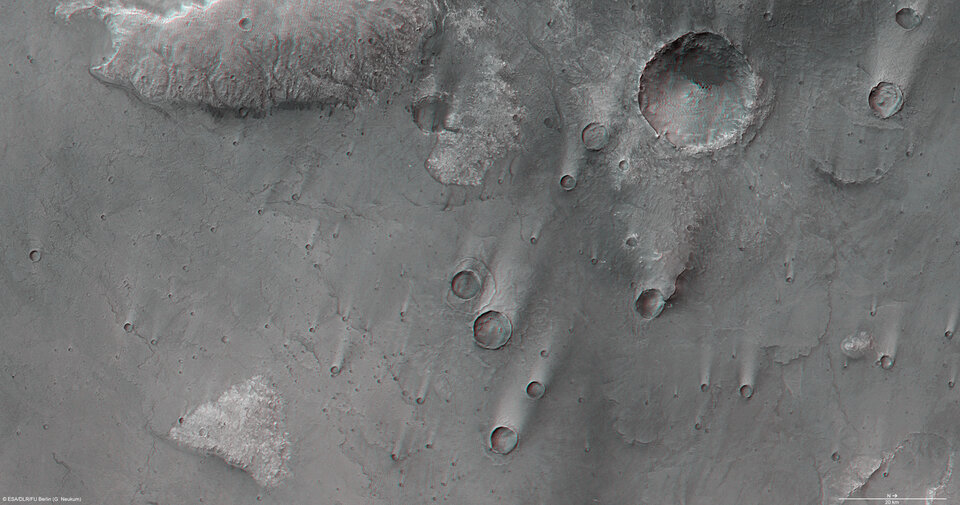
Syrtis Major, discovered in 1659 by Christaan Huygens, is a volcanic province on Mars. The image is centred on approximately 16°N/73°E. The High-Resolution Stereo Camera on ESA’s Mars Express collected the data for these images on 8 June 2011 during orbit 9487. The image combines data from the nadir channel and one stereo channel to produce this 3D image. Stereoscopic glasses are required to see the 3D effect.

Credits: ESA/DLR/FU Berlin (G. Neukum)
 
 
Mars Express on YouTube
Traces of Martian life
Related articles
The pit-chains of Mars – a possible place for life?ESA's Mars Express radar gives strong evidence for former Mars oceanMountains and buried ice on MarsBattered Tharsis Tholus volcano on MarsMars Express observes clusters of recent craters in Ares VallisRare martian lake delta spotted by Mars ExpressMars’ northern polar regions in transitionPhobos slips past JupiterSpringtime at Mars’ south poleMars Express sees deep fractures on MarsNeighbouring volcanoes on MarsThe scars of impacts on MarsMars Express puts craters on a pedestalMars Express close flybys of martian moon PhobosWind and water have shaped Schiaparelli on MarsLight and dark in the Phoenix LakeMars: how low can you go?Mars’s mysterious elongated craterRocky mounds and a plateau on MarsWet era on early Mars was globalVolcanic ash in Meridiani PlanumCraters young and old in Sirenum FossaeCraters, lava flows and tectonic features near Ma'adim VallisCraters and channels in Hephaestus FossaeChaotic terrain in Ariadnes CollesIce-covered martian North PoleThe Euminedes Dorsum mountains on MarsLava deposits in Mangala Fossae
Related links
High Resolution Stereo CameraBehind the lens...Frequently asked questions
For specialists
ESA Planetary Science archive (PSA)NASA Planetary Data SystemHRSC data viewer


   Copyright 2000 - 2012 © European Space Agency. All rights reserved.