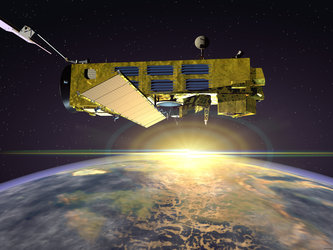
Artemis relays first images for Envisat
ESA PR 16-2003. The first satellite-relayed images from Envisat have been received via the Artemis data-relay spacecraft in geostationary orbit at ESA's data processing centre at ESRIN, near Rome.
The images represent twin triumphs for the European Space Agency. "For the Envisat Earth observation mission, bringing Artemis online to relay Earth imagery and scientific measurements means that more data can be acquired and downloaded and the process of delivering Earth observation data to end users will be much faster. This is very good news," said José Achache, Director of Earth Observation.
For Artemis, the Advanced Relay Technology Mission, the image transmission caps a historic, 18-month recovery operation that brought the spacecraft to its assigned geostationary orbit after a July 2001 launch that left Artemis stranded in an orbit far lower than intended. Despite the lack of sufficient conventional propellant to raise the spacecraft's orbit, ESA engineers used Artemis' groundbreaking ion propulsion system, combined with innovative operations of its chemical thrusters, and succeeded in raising the satellite to its nominal geostationary position at 21.5 degrees East.

"This recovery mission was a real demonstration of experimental technology" said Claudio Mastracci, Director of Applications. "I am pleased Artemis is now able to support the whole space community".
"The purpose of the Artemis mission is to qualify new space communication technologies in orbit and to offer new communication services," said Gotthard Oppenhäuser, ESA's Artemis Mission Manager. "Via the data relay system, users can receive their data in real time while maintaining full security."
Artemis carries payloads supporting land mobile communications, navigation systems and data relay systems. The spacecraft operates at S-band (2 GHz), Ka-band (26 GHz) and optical frequencies. Artemis and Envisat communicate at Ka-band frequencies.
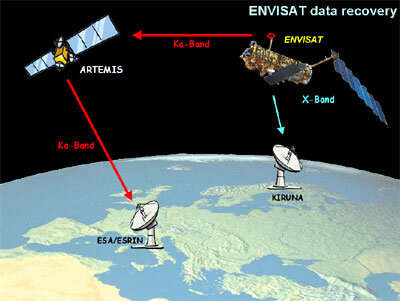
Setting up the operational data relay system in the Ka-band between Artemis and Envisat is a first for Europe. The system proves the space qualifications of new technologies and operational procedures, along with demonstrating the complex software used in both the ground and space segments. It also shows the usefulness of data relay payloads.
Once testing of the inter-satellite link is completed, Envisat will transmit about half of its sensor data through Artemis straight to the Envisat data processing centre at ESRIN, starting in May. Data from various instruments will continue to be downloaded to the Envisat ground station and data processing centre in Kiruna, Sweden, but the addition of the data relay satellite offers several important new capabilities to the Envisat data network.
The Kiruna ground station can 'see' the satellite for about 10 minutes of Envisat's 100-minute orbit, and for 10 daily orbits. Because of its orbital position above Envisat, Artemis can remain in contact with Envisat on almost all its 14 daily orbits, and for longer periods.

Shifting a large portion of Envisat's downloads to Artemis for relay to ESRIN will ease the workload at Kiruna and thus reduce the time taken in processing information from Envisat's sensors to within three hours of the initial data acquisition.
The use of Artemis will also enable ESA to increase the amount of data acquired by Envisat anywhere in the world, particularly in the case of the Advanced Synthetic Aperture Radar (ASAR) instrument, increase the flexibility of the mission's ground segment, and provide a back-up in the event of a problem with the onboard recorders, which will improve mission reliability.
"Artemis will be a great help to us in improving our services to Envisat users," said Henri Laur, ESA's Mission Manager for Envisat. "It will reduce the delivery time for Envisat data and remove some processing delays."

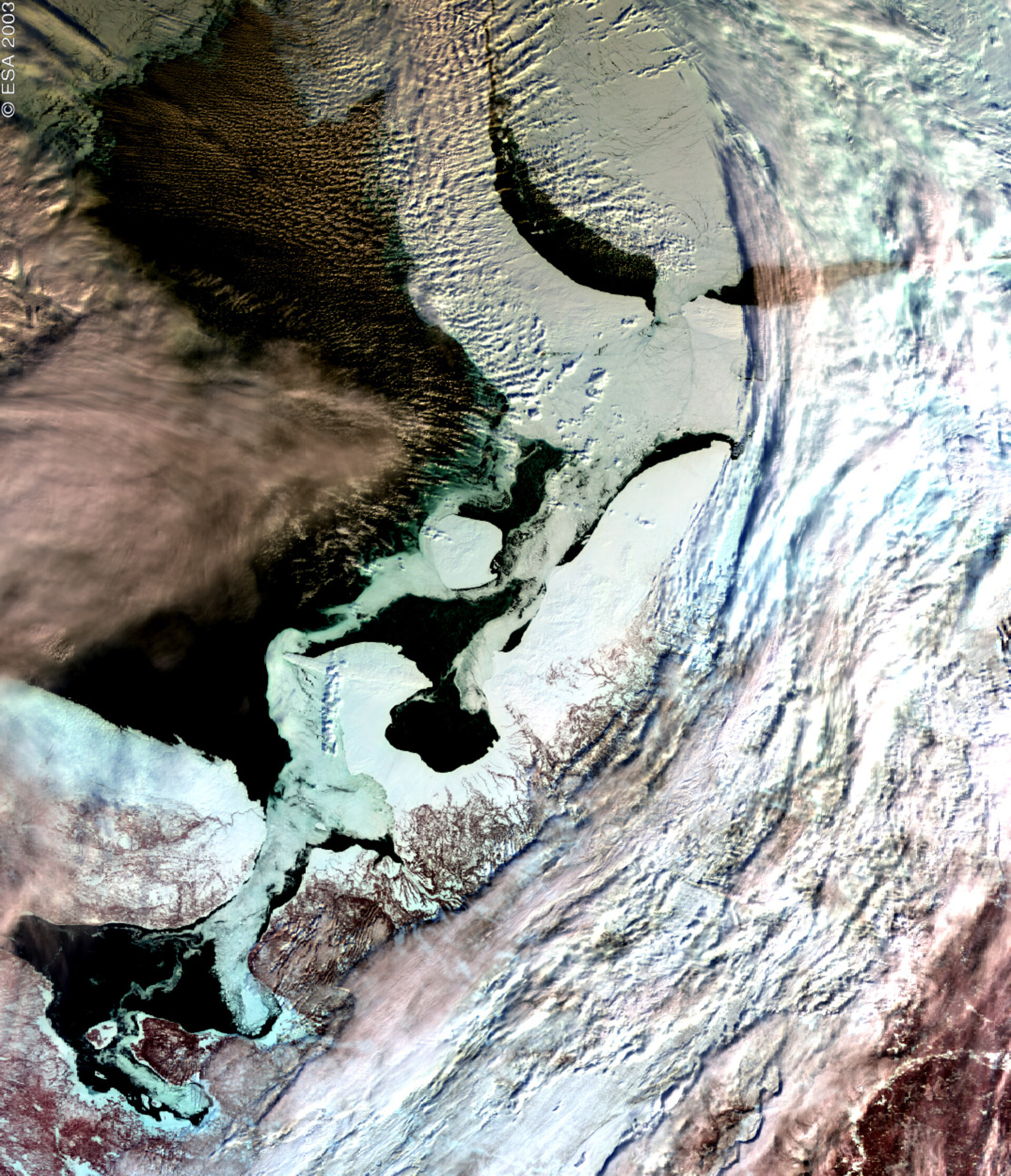
The ASAR shows a swath over southwestern Tanzania measuring 414 km by 393 km. The first Artemis-relayed image from the Medium Resolution Imaging Spectrometer (MERIS) displays the coastline around the White Sea in northern Russia, with the city of Archangel to the southwest.
Envisat recently marked its first year in orbit. Launched on 28 February 2002 from Europe's spaceport in French Guiana, it is the largest and most capable Earth observation satellite ever built. Its suite of 10 sensors is designed to provide a comprehensive view of the Earth's oceans, land, atmosphere and ice caps.
The optical data relay system will be used between Artemis and the French Earth observation satellite, SPOT 4, starting in April. In 2005 the Automatic Transfer Vehicle will start using a regular data relay service and in 2006 (to be confirmed) Columbus, the European element of the International Space Station, will establish data relay links to Artemis for nearly five hours a day.
For further information, please contact:
Gotthard Oppenhaüser
ESA's Artemis Mission Manager
Tel: +31.71.565.3168
Henri Laur
ESA's Envisat Mission Manager
+39.06.9418.0557
ESA Media Relations Service
Tel: +33(0)1.53.69.7155
Fax: +33(0)1.53.69.7690