Mars Express radar data analysis is on the move
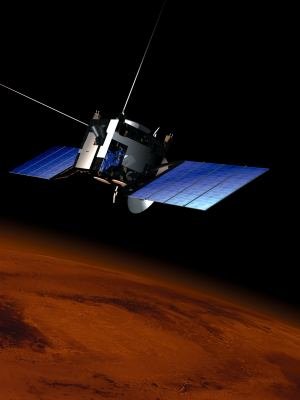
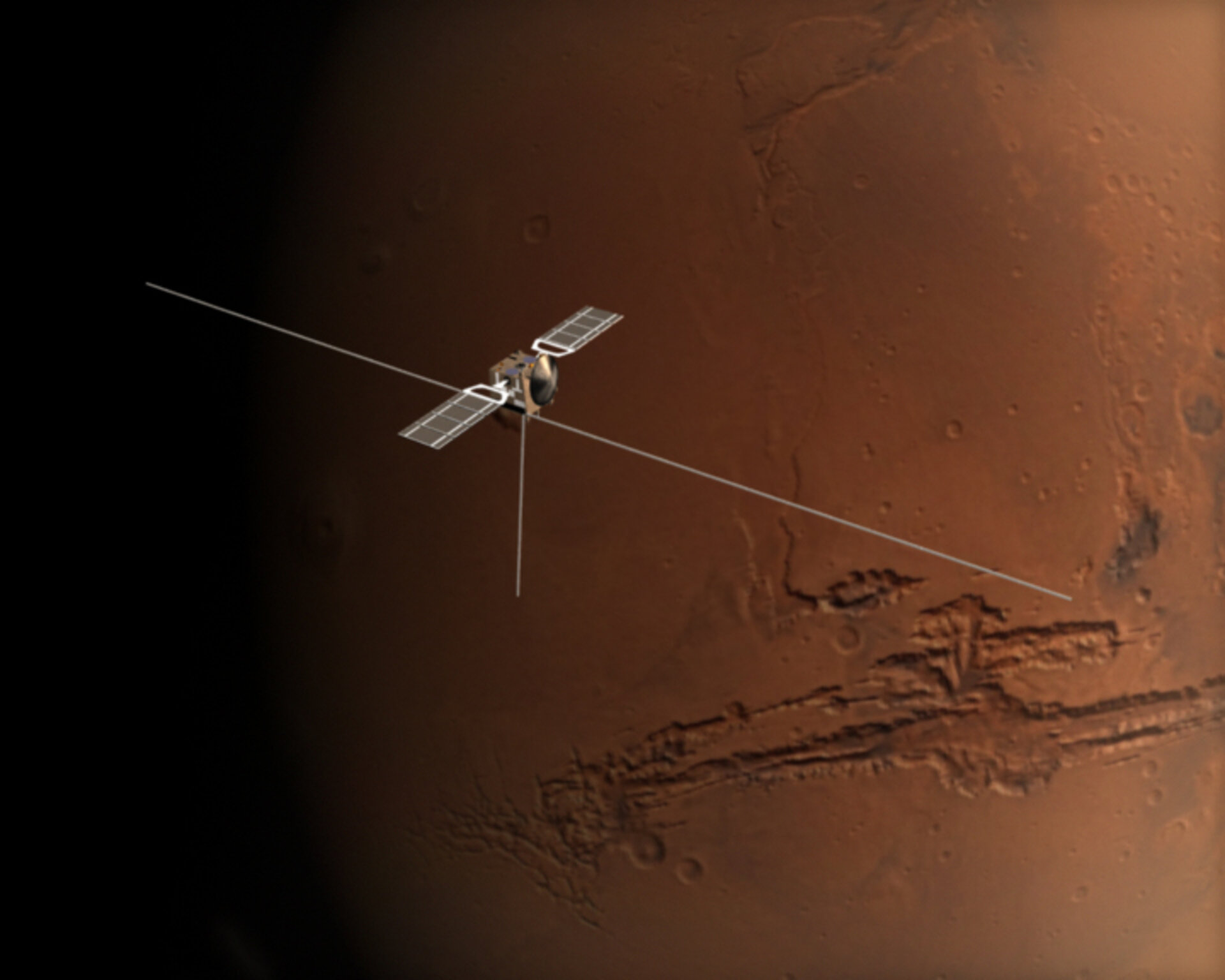
The Mars Express radar, MARSIS, has now been deployed for more than four months. Here we report on the activities so far.
For the operational period up to now, Mars Express has been making its closest approaches to Mars predominantly in the daytime portion of its orbit. The MARSIS radar’s scientists are mainly collecting data about the upper layers of the Martian atmosphere, or ‘ionosphere’, which is the highly electrically conducting layer that is maintained by sunlight.
When a radio wave crosses different layers of materials, the echo generated carries a sort of ‘fingerprint’.
They are also continuing the laborious analysis of all data gathered during the first night-time observations last summer, especially in the search for and interpretation of possible signals from subsurface layers. This includes the search for a possible signature of underground water, in frozen or liquid state.
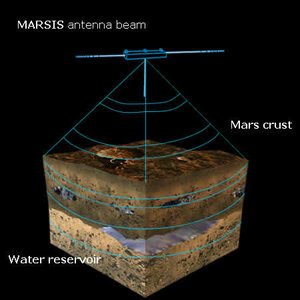
Radar science is a complex business - it is based on the detection of radio waves reflected by boundaries between different materials. By analysis of these ‘echoes’, it is possible to deduce information about the kind of material causing the reflection, such as estimates of its composition and physical state.
Different materials are characterised by their ‘dielectric constant’, that is the specific way they interact with electromagnetic radiation, such as radio waves. When a radio wave crosses the boundary of different layers of ‘material’, an echo is generated and carries a sort of ‘fingerprint’ from the specific materials.
From the time delay for an echo to be received by the radar instrument, the distance or the depth of the layers of material producing the echo can be deduced.
While the Mars Express point closest approach is in daylight, MARSIS is only operating at higher frequencies within its capability because the lower-frequency radio signals get disturbed. With these higher frequencies, MARSIS can study the ionosphere and the surface, while some shallow subsurface sounding can still be attempted.
During night-time observations, like those performed briefly last summer immediately after deployment, it is possible for MARSIS to use all frequencies for scientific measurements, including the lowest ones, suitable for penetrating under the soil of Mars.
Tuning to different frequencies for different targets in different conditions is not the only secret of MARSIS. The instrument, responding to signals reflected from any direction, requires scientists also do a huge amount of analysis work to remove these interfering signals from the echoes.
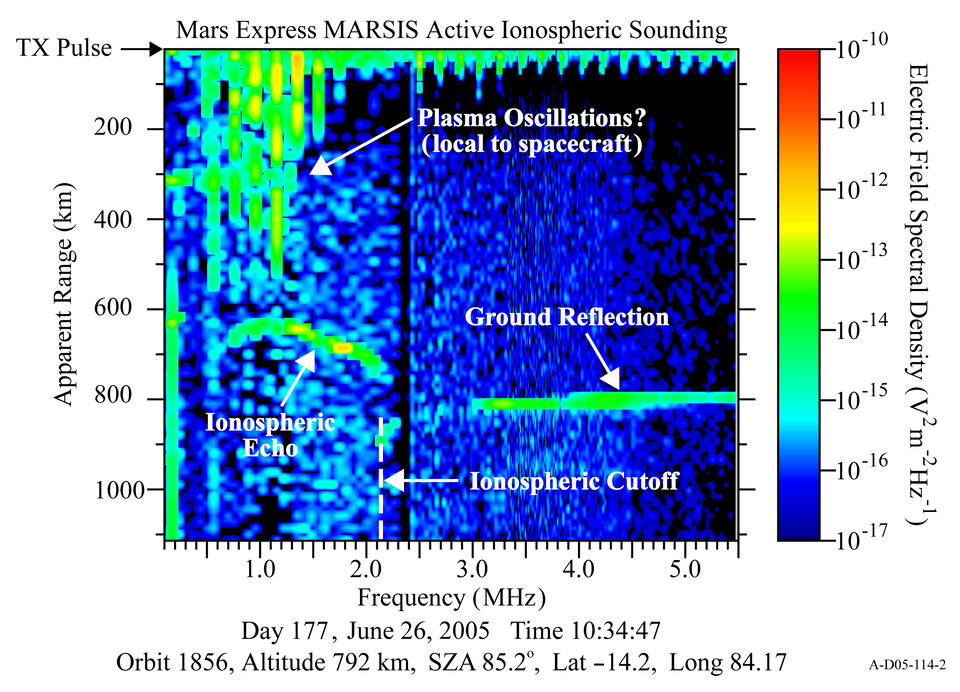
In the first months of operation, MARSIS performed its first ionospheric sounding.
A typical example of what they look for is ‘clutter backscattering’, which are reflections apparently coming from the subsurface, but actually produced by irregularities in the surface terrain that delay the return of the echo. For this ‘cleaning’ work, the team also makes use of ‘surface echo simulator’ computer programs.
In the first months of operations, MARSIS performed its first ionospheric sounding. The data are converted into typical plots, called ‘ionograms’, where the altitude at which the echo was generated, deduced by the echo time delay, is given for each transmitted frequency. The intensity of the various echo signals detected is indicated in different colours.
In parallel to the analysis of surface and subsurface signals, the scientists are studying all ionograms to draw the first conclusions on the nature and behaviour of the ionosphere of Mars, and of its interaction with the planet and the surrounding environment.
Note to editors:
On 19 September 2005, ESA took the decision to extend the Mars Express mission by one additional Martian year (23 months). The rationale for the decision was also based on giving MARSIS the possibility to continue subsurface observations as of December this year. By then, the pericentre (point of closest approach to the planet) of the Mars Express orbit will be in the Martian night-time.
For more information:
Prof. Giovanni Picardi, MARSIS Principal Investigator
Universita’ di Roma 'La Sapienza'
E-mail: picar @ infocom.uniroma1.it
Jeff Plaut, MARSIS Co-Principal Investigator, NASA/JPL
E-mail: plaut @ jpl.nasa.gov
Agustin Chicarro, ESA Mars Express Project Scientist
E-mail: agustin.chicarro @ esa.int
Fred Jansen, ESA Mars Express Mission Manager
E-mail: fjansen @ rssd.esa.int
Enrico Flamini, ASI Mars Express Mission Manager
E-mail: Enrico.Flamini @ asi.it