Solar-B – a new solar mission to study the dynamic Sun
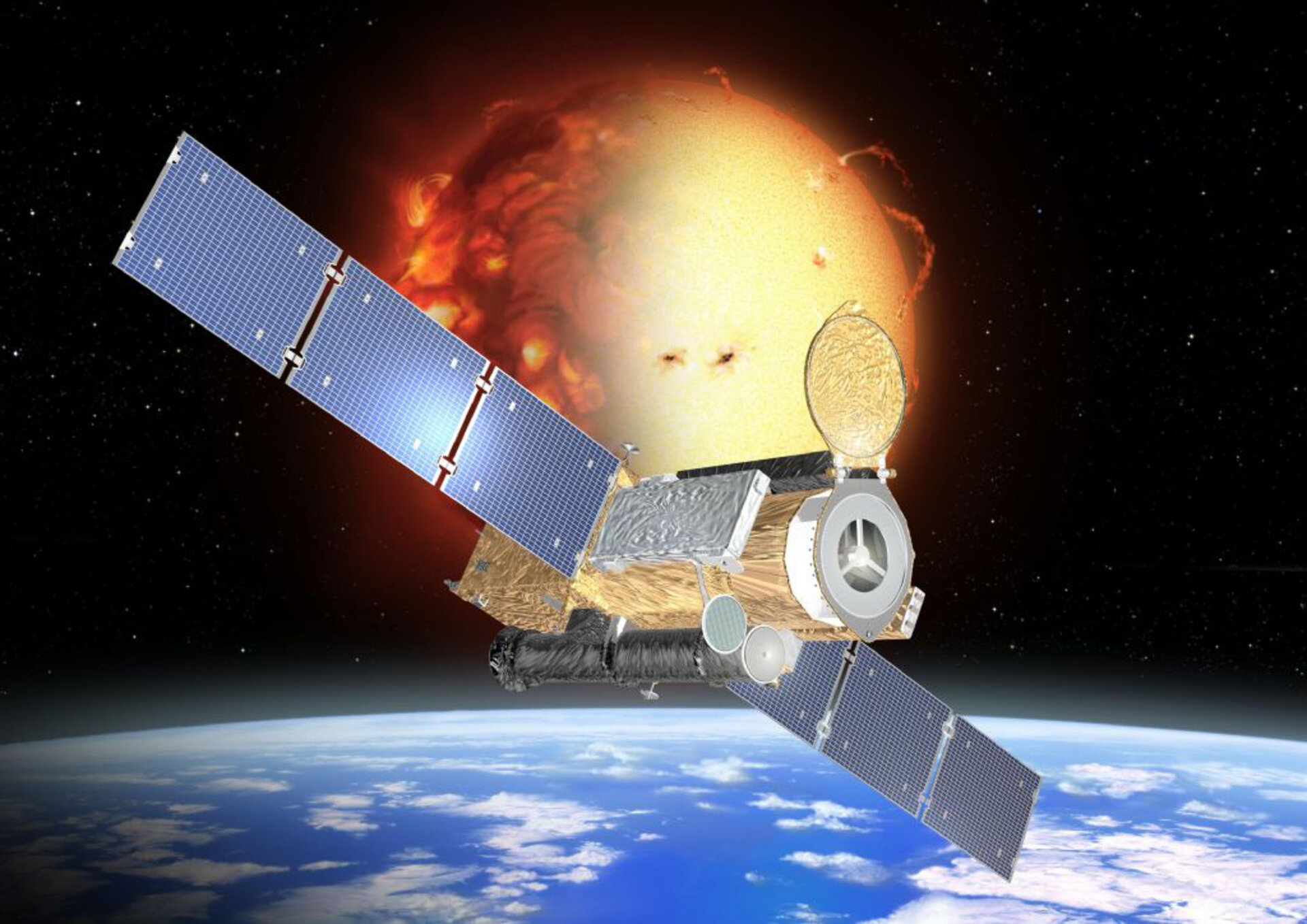
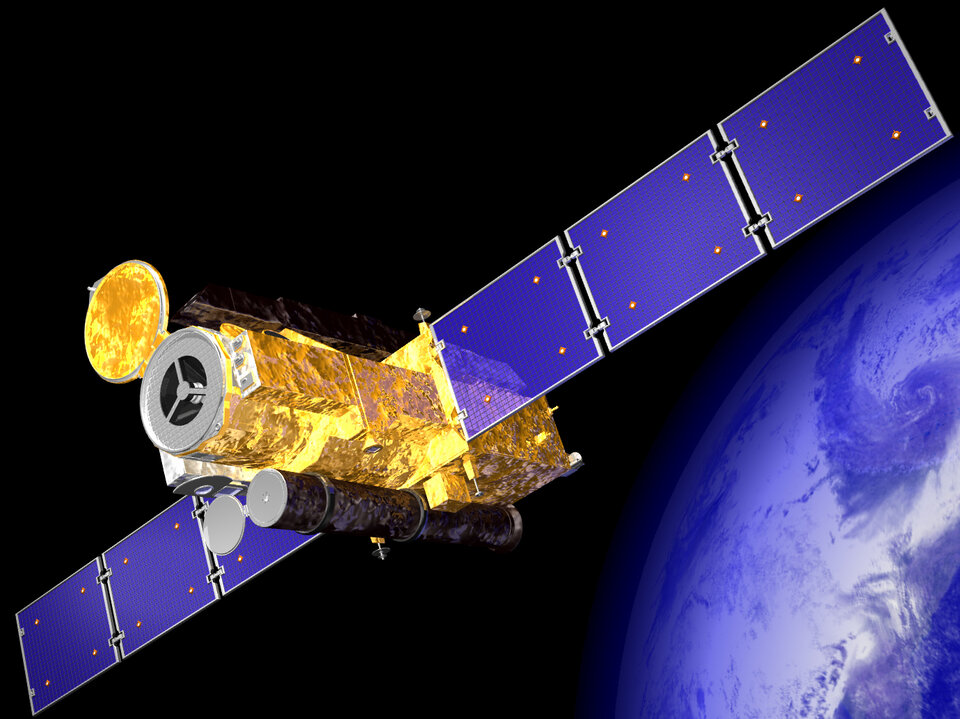
A new Japanese-led solar mission with ESA participation is preparing for launch on 22 September 2006. Solar-B will study the mechanisms which power the solar atmosphere and look for the causes of violent solar eruptions.
This will lead to a better understanding of the complex connection between the Sun and Earth.
Solar-B will be launched on 22 September 2006 at 23:36 CEST from the Japan Aerospace Exploration Agency's (JAXA) Uchinoura Space Centre in Japan. The satellite will be placed into a 96-minute polar orbit around Earth.

The orbit will be synchronised with respect to the Earth's revolution around the Sun. This particular geometry will allow the spacecraft to be in continuous sunlight for at least nine months a year during the planned mission duration of three years.
The mission is designed to provide precise quantitative measurements of the Sun’s magnetic field – the major engine at work to trigger violent solar activity – which will lead to a better understanding of the Sun-Earth environment.

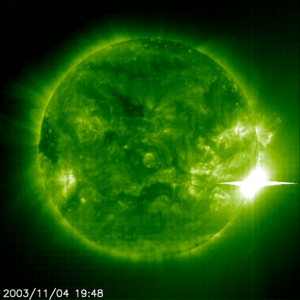
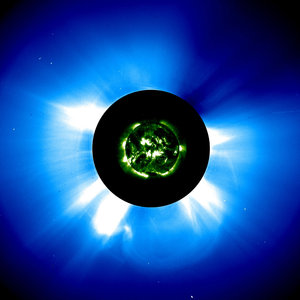
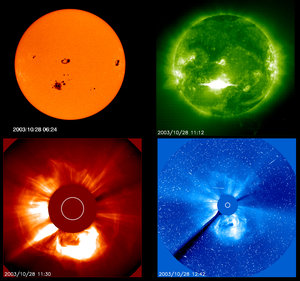
When the Sun's magnetic field lines interact with each other, huge amounts of energy are suddenly released in the form of so-called solar flares. Connected to this is the phenomenon of coronal mass ejections which hurl huge clouds of plasma into space. These eruptions have the power to heavily perturb the solar wind and – as a consequence – also cause major magnetic disturbances on Earth.
"Solar-B represents a very important step for solar physics," says Bernhard Fleck, ESA's SOHO Project Scientist. "With SOHO we have been studying the Sun for more than 10 years – we have probed its hot interior, through its visible surface, and studied its outer atmosphere out to distant regions where the wind from the Sun battles with a breeze of atoms coming from among the stars," he continues.
"Thanks to ESA's and Norway’s participation in Solar-B, the European scientific community will now have access to a completely new set of data, complementary to that of SOHO," Fleck added.
"With its three advanced and highly sensitive telescopes (visible, X-ray and ultraviolet), Solar-B will be able to study the solar magnetic field at scales smaller than ever before, and connect its behaviour to the energetic and powerful processes at work on the Sun," he concludes.
International endeavour
Following the successful Japanese YOHKOH (Solar-A) mission, Solar-B is also the result of a truly international effort. This includes the leading Japan Aerospace Exploration Agency (JAXA), the United States (NASA), and the United Kingdom (PPARC). As the senior partner, JAXA's Institute of Space and Astronautical Science (ISAS) is responsible for the spacecraft and the optical telescope, while the other two science instruments were assembled under Japanese supervision by the international partners in the United States and the United Kingdom.
The European Space Agency (ESA) has recently joined the team in the form of a coordinated endeavour with Norway, whose participation is led by the Norwegian Space Centre in Oslo, Norway.
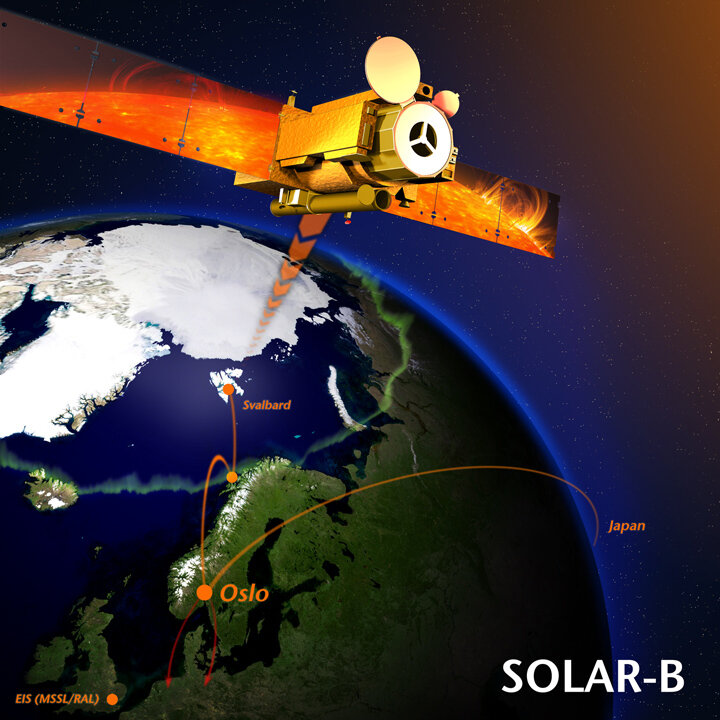
ESA and Norway will provide ground station coverage through the Svalbard Satellite Station (SvalSat), situated on the Norwegian Svalbard islands. SvalSat is the only ground station in the world that can be used for every single orbit of Solar-B and will receive the satellite data for each of its 15 daily orbits.
"The joint venture between ESA and Norway to support Solar-B will basically double the scientific return from the mission," says Marcello Coradini, ESA's Coordinator for Solar System Missions. "The full ground coverage provided by the high-latitude SvalSat station will allow the full downlink per orbit of all the precious data collected by Solar-B. This will create benefits for the whole mission in general and for the European scientific community in particular. The latter – according to the agreement with JAXA - will now be able to access to the Solar-B data sets."
In addition, the cooperative endeavour between ESA and Norway will result in the creation of a Solar-B data centre, to be situated at the Institute of Theoretical Astrophysics at the University of Oslo, Norway. A private company was subcontracted by the Norwegian Space Centre to provide all connections to the ground communications network infrastructures required to transport data from SvalSat to JAXA.

Joining Solar-B represents for ESA a programmatic choice, too. "Our participation in this new promising solar mission also strongly consolidates ESA's long-standing cooperation with Japan, already ongoing both in the fields of astronomy and solar system research," continues Coradini.
"From the ASTRO missions to study the high-energy universe to the future BepiColombo mission to Mercury, the European scientific community at large is collecting and will collect the fruit of such solid collaboration."
Note to editors
The ESA-Norway contribution to Solar-B consists of an overall investment of more than 11 million Euros (almost 8 million from ESA, and almost 4 million from Norway).
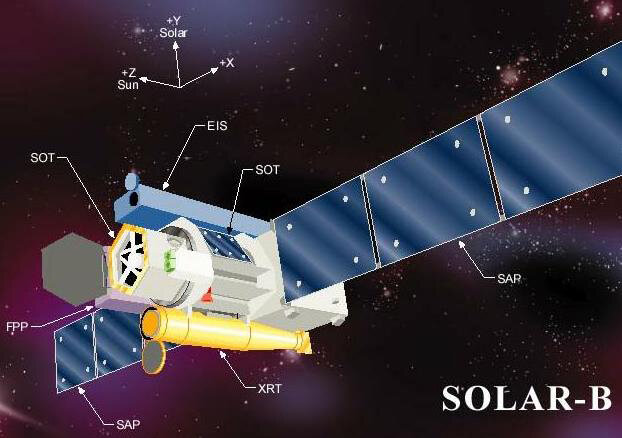
Solar-B is a sun-pointing spacecraft that weighs 900 kilos. It carries three scientific instruments:
A Solar Optical Telescope (SOT), the first large optical telescope flown in space dedicated to observing the Sun. Its aperture is 50-centimetre and its angular resolution up to 0.25" (corresponding to 175 kilometres on the Sun's surface). It covers a wavelength range of 480-650 nanometres.
An X-ray Telescope (XRT), to provide coronal images at different temperatures. It is able to provide both full disk and partial fields of view. The temperature range it can observe will be from 1 to 30 million degrees Kelvin.
- A EUV Imaging Spectrometer (EIS), an optical telescope designed as an off-axis paraboloid with focal length of 1.9 metres and a mirror diameter of 150 millimetres. It will be measuring the flows of hot gas down to a level of 1 kilometre per second.
For more information
Marcello Coradini, ESA Solar System Missions Coordinator
Email: marcello.coradini @ esa.int
Bernhard Fleck, ESA SOHO Project Scientist
Email: bfleck @ esa.nascom.nasa.gov
Pål Brekke, Senior Advisor, Norwegian Space Centre
Email: paal.brekke @ spacecentre.no