La intrépida prueba de Herschel: un atisbo de lo que vendrá
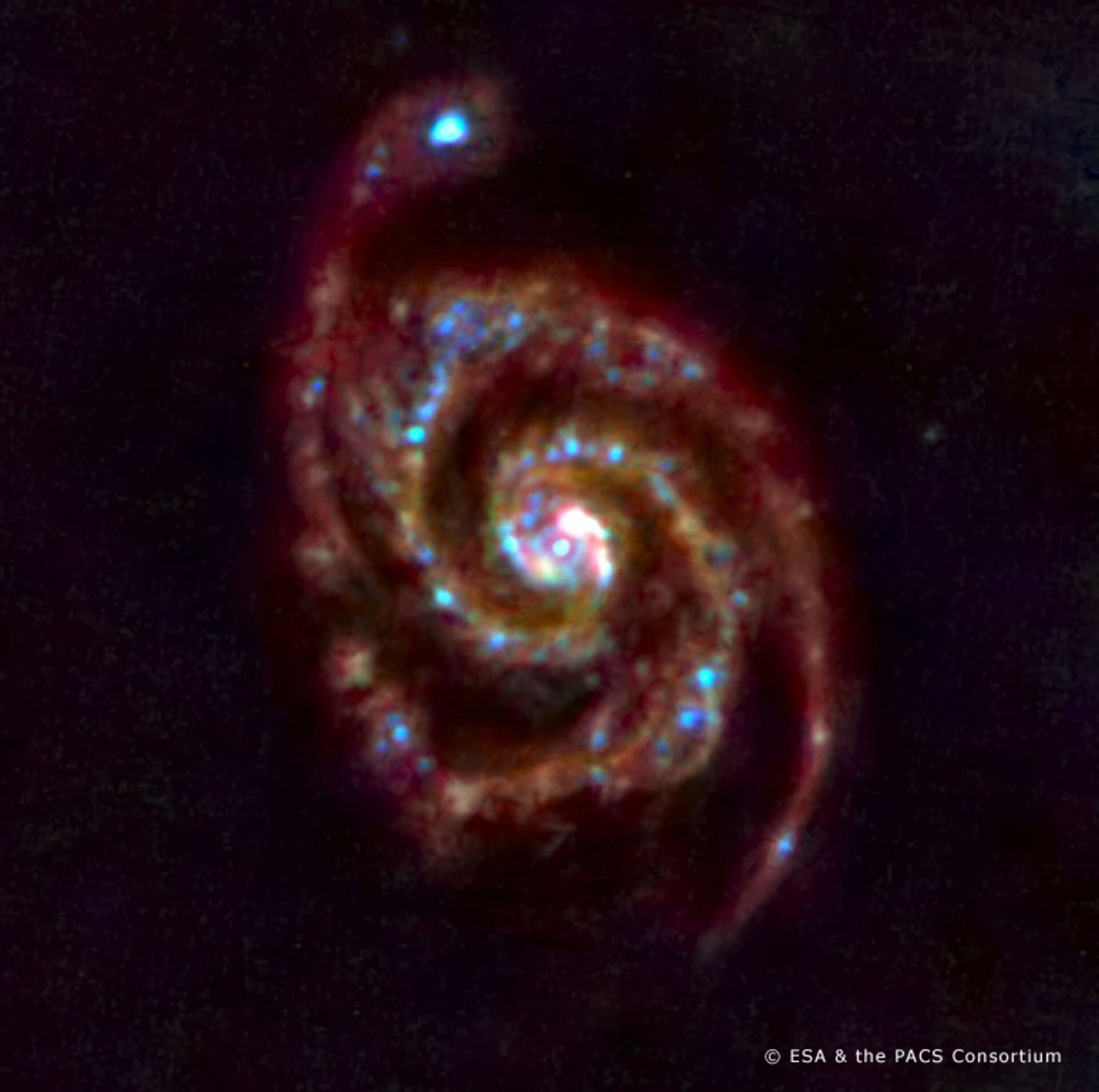
Tras abrir sus ‘ojos’ el pasado 14 de Junio, Herschel obtuvo con su instrumento PACS imágenes de M51, la ‘galaxia remolino’, para una primera observación de prueba. Los científicos obtuvieron imágenes que demuestran claramente la superioridad de Herschel, el mayor telescopio espacial infrarrojo jamás lanzado.
Esta imagen muestra la famosa ‘galaxia remolino’, observada por primera vez por Charles Messier en 1773. Messier la catalogó como ‘Messier 51’ (M51). Esta galaxia espiral está relativamente cerca, a unos 35 millones de años luz, en la constelación de Canes Venatici. Fue la primera galaxia en que se observó una estructura espiral.
La imagen es una composición de tres observaciones tomadas por el instrumento PACS (Photoconductor Array Camera and Spectrometer) a 70, 100 y 160 micras, los días 14 y 15 de Junio, inmediatamente después de que fuera abierta la crío-cubierta del satélite el 14 de Junio.
Herschel fue lanzado hace sólo un mes y aún está en periodo de prueba. Estaba previsto que las primeras observaciones de sus instrumentos llegaran dentro de unas semanas. Pero los ingenieros y científicos se atrevieron a planificar y llevar a cabo observaciones como si ‘echaran un vistazo rápido’ inmediatamente después de la apertura de la cubierta. El objetivo era producir una imagen que permitiera vislumbrar lo que está por venir.
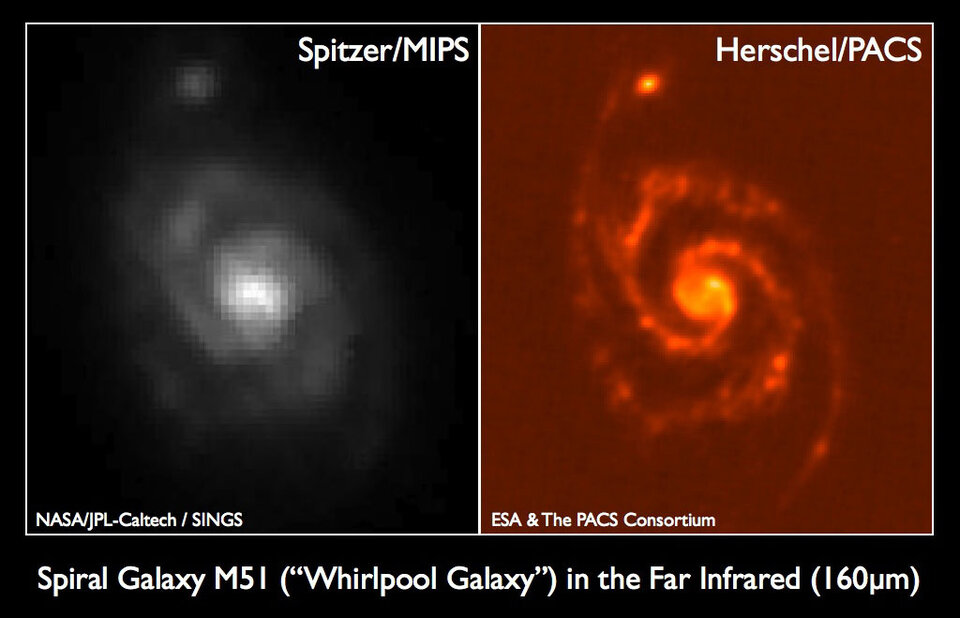
La imagen de la izquierda es la mejor de las obtenidas de M51 con el Telescopio Espacial Spitzer de la NASA, con su instrumento MIPS (Multiband Imaging Photometer for Spitzer). La de la derecha es la lograda por Herschel los días 14 y 15 de Junio. La ventaja obvia del tamaño mayor del telescopio se traduce claramente en una resolución muy superior: Herschel revela estructuras que no pueden distinguirse en la imagen de Spitzer.
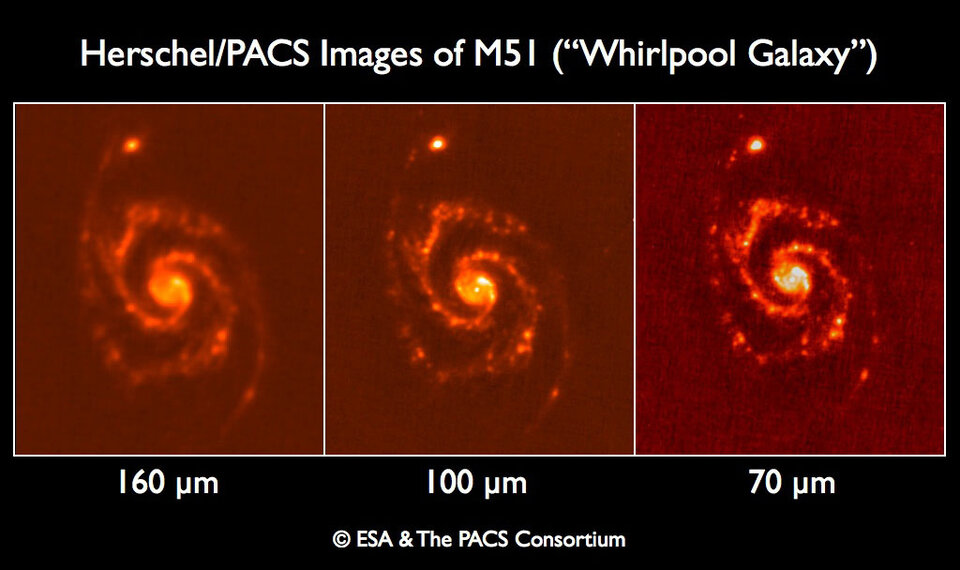
Herschel ‘atisba’ M51 a 70, 100 y 160 micras.
Estas imágenes demuestran claramente que cuanto más cortas sean las longitudes de onda, más nítida es la imagen. Este es un mensaje muy importante en lo que se refiere a la calidad de la óptica de Herschel, dado que PACS es, de los tres instrumentos de Herschel, el que opera a longitudes de onda más cortas.
Estas imágenes producidas en las primeras observaciones de prueba permiten concluir a los científicos que el funcionamiento de la óptica de Herschel y de su gran telescopio cumple por ahora todas las expectativas.