Rosetta – a new target to solve planetary mysteries
ESA INFO 01-2004. Rosetta is scheduled to be launched on board an Ariane-5 rocket on 26 February from Kourou, French Guiana.
Originally timed to begin about a year ago, Rosetta's journey had to be postponed, as a precaution, following the failure of a different version of Ariane-5 in December 2002. This will be the first mission to orbit and land on a comet, one of the icy bodies that travel throughout the Solar System and develop a characteristic tail when they approach the Sun.
This delay meant that the original mission's target, Comet Wirtanen, could no longer be reached. Instead, a new target has been selected, Comet 67P/Churyumov-Gerasimenko, which Rosetta will encounter in 2014 after a ‘billiard ball’ journey through the Solar System lasting more than ten years. Rosetta’s name comes from the famous ‘Rosetta Stone’, from which Egyptian hieroglyphics were deciphered almost 200 years ago. In a similar way, scientists hope that the Rosetta spacecraft will unlock the mysteries of the Solar System.
Comets are very interesting objects for scientists, since their composition reflects how the Solar System was when it was very young and still 'unfinished', more than 4600 million years ago. Comets have not changed much since then. In orbiting Comet Churyumov-Gerasimenko and landing on it, Rosetta will collect information essential to an understanding of the origin and evolution of our Solar System. It will also help discover whether comets contributed to the beginnings of life on Earth. In fact comets are carriers of complex organic molecules that, delivered to Earth through impacts, perhaps played a role in the origin of living forms. Furthermore, ‘volatile’ light elements carried by comets might also have played an important role in forming the Earth’s oceans and atmosphere.
“Rosetta is one of the most challenging missions undertaken so far,” says Professor David Southwood, ESA Director of Science. “No one has ever attempted such a mission, unique for its scientific implications as well as for its complex and spectacular interplanetary space manoeuvres.” Before reaching its target in 2014, Rosetta will circle the Sun four times on wide loops in the inner Solar System. During its long trek, the spacecraft will have to endure some extreme thermal conditions. Once it is close to Comet Churyumov-Gerasimenko, scientists will take it through a delicate braking manoeuvre; the spacecraft will then closely orbit the comet, and gently drop a lander on it. It will be landing on a small, fast-moving ‘cosmic bullet’ about whose 'geography' very little is known yet.
An amazing 10-year interplanetary trek

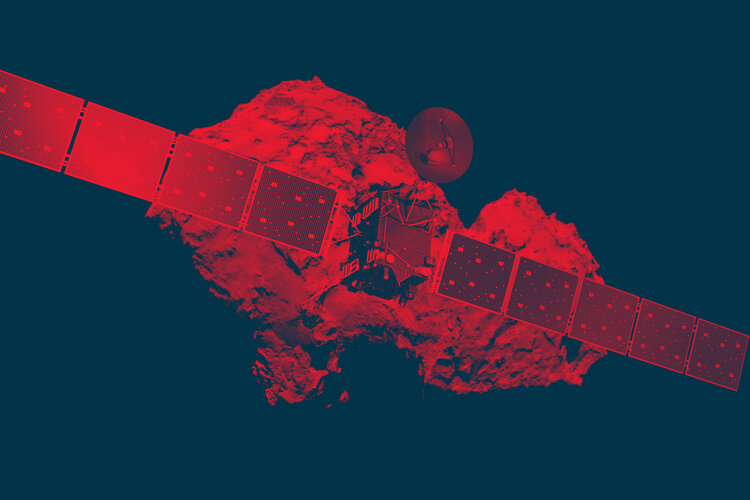
Rosetta is a three-tonne box-type spacecraft about three metres high, with two 14-metre solar panels. It consists of an orbiter and a lander. The lander is approximately one metre across and 80 centimetres high. It will be attached to the side of the orbiter during the journey to Comet Churyumov-Gerasimenko. Rosetta carries 21 experiments in total, 10 of them on the lander. They will be kept in hibernation during most of its 10-year trek towards the comet.
Why does Rosetta's cruise need to take so long? To reach Comet Churyumov-Gerasimenko, the spacecraft needs to go out into deep space as far out from the Sun as Jupiter. No launcher could possibly get Rosetta there directly. ESA's spacecraft will gather speed from gravitational ‘kicks’ provided by four planetary fly-bys: one of Mars in 2007 and three of Earth in 2005, 2007 and 2009. During the trip, Rosetta will also twice pass through the asteroid belt, where a fly-by with one or more of these primitive objects is possible. A number of candidate targets have already been identified, but the final selection will be made after launch, once the amount of surplus fuel has been verified by mission engineers. During these encounters, scientists plan to switch on Rosetta's instruments for scientific studies of these largely unexplored Solar System bodies.
Long trips in deep space include many hazards, such as extreme changes in temperature. Rosetta will leave the benign environment of near-Earth space to the dark, frigid regions beyond the asteroid belt. To manage these thermal loads, experts have done very tough pre-launch tests to study Rosetta's endurance. For example, they have heated its external surfaces to more than 150°C, then cooled it to -150°C in the next test.

The spacecraft will be fully reactivated prior to the comet rendezvous manoeuvre in 2014. Then, Rosetta will orbit the comet – an object only about 4 kilometres in diameter - while it cruises through the inner Solar System at 135 000 kilometres per hour. At the time of the rendezvous – around 675 million kilometres from the Sun – Comet Churyumov-Gerasimenko will hardly show any surface activity. This means that the characteristic ‘coma’ (the comet’s ‘atmosphere’) and the tail will not be formed yet, because of the distance from the Sun. The comet's tail is in fact made of dust grains and frozen gases from the comet's surface that vaporise because of the Sun's heat.
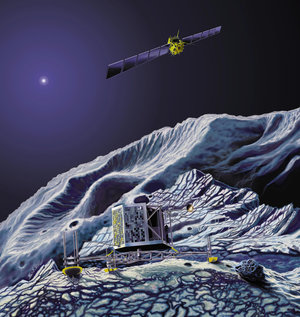
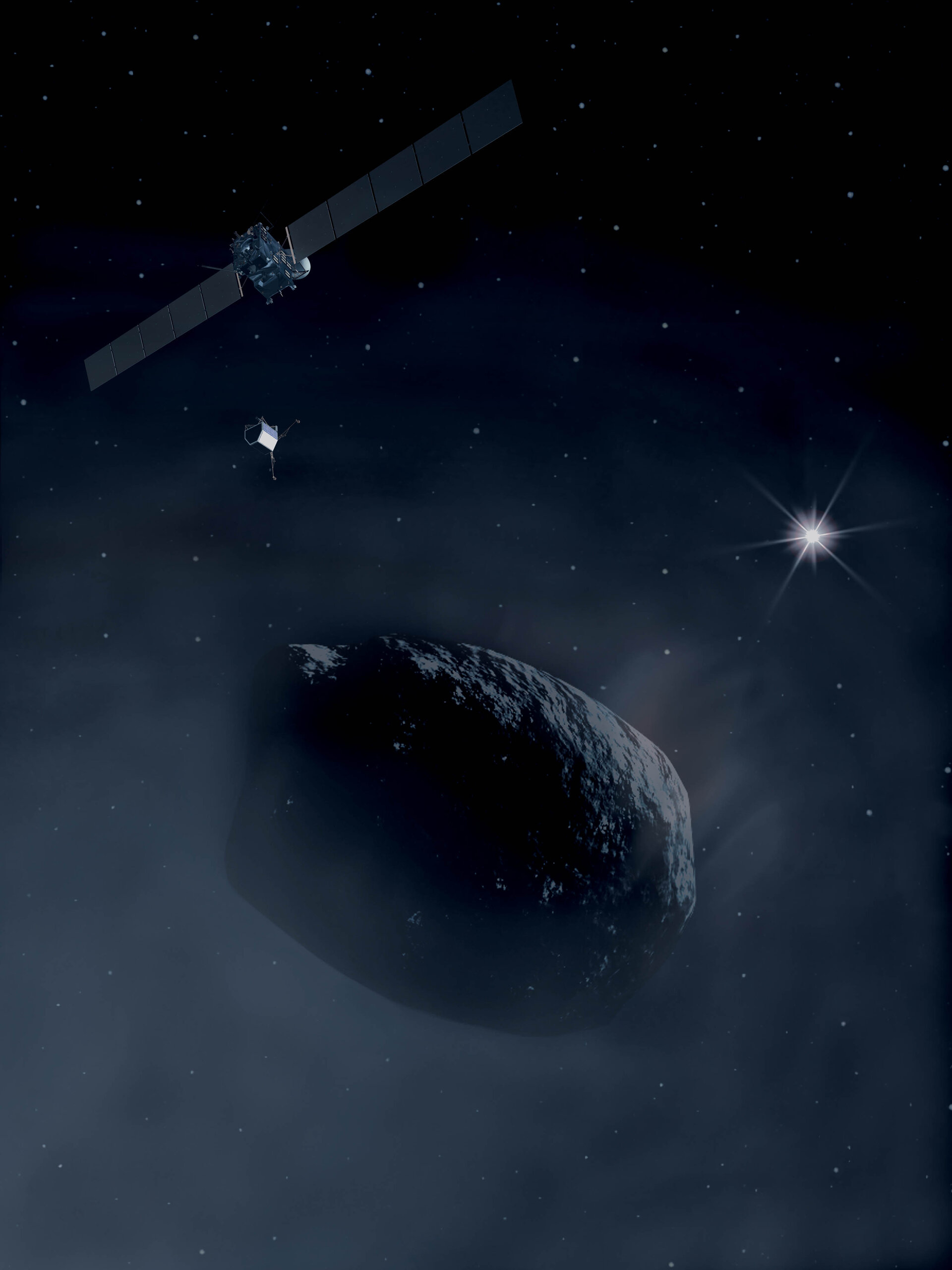
Over a period of six months, Rosetta will extensively map the comet's surface, prior to selecting a landing site. In November 2014, the lander will be ejected from the spacecraft from a height which could be as low as one kilometre. Touchdown will be at walking speed, about one metre per second. Immediately after touchdown, the lander will fire a harpoon into the ground to avoid bouncing off the surface back into space, since the comet’s extremely weak gravity alone would not hold onto the lander. Operations and scientific observations on the surface will last at least a week, but may continue for many months. Besides taking close-up pictures, the lander will drill into the dark organic crust and sample the primordial ices and gases.
During and after the lander operations, Rosetta will continue orbiting and studying the comet: it will be the first spacecraft to witness at close quarters the changes taking place in a comet when the comet approaches the Sun and grows its coma and tail and then travels away from it. The trip will end in December 2015, after 12 years of adventure, when the comet has made its closest approach to the Sun and is on its way towards the outer Solar System.
Studying a comet on the spot

Rosetta's goal is to examine the comet in great detail. The instruments on the orbiter include several cameras and spectrometers that work at different wavelengths: infrared, ultraviolet, visible and microwave. In addition, there are various other instruments to make in situ analysis. Together, they will provide, amongst other things, very high-resolution images and information about the shape, density, temperature and chemical composition of the comet. Rosetta’s instruments will analyse the gases and dust grains in the coma that forms when the comet becomes active, as well as the interaction with the solar wind.
The ten experiments on the lander will make an on-the-spot analysis of the composition and structure of the comet’s surface and subsurface material. A drilling system will take samples down to 30 centimetres below the surface and feed these to the ‘composition analysers’. Other instruments will measure properties such as near-surface strength, density, texture, porosity, ice phases and thermal properties. Microscopic studies of individual grains will tell us about the texture.
Ground operations
All scientific data including those relayed from the lander will be stored on the orbiter for downlink to Earth at the next ground station contact. ESA has installed a new deep-space antenna at New Norcia, near Perth in Western Australia, as the main communications link between the spacecraft and ESOC Mission Control in Darmstadt, Germany. This 35-metre diameter parabolic antenna allows the radio signal to reach distances of more than a million kilometres from Earth. The radio signals, travelling at the speed of light, will take up to 50 minutes to cover the distance between the spacecraft and Earth.
Building Rosetta
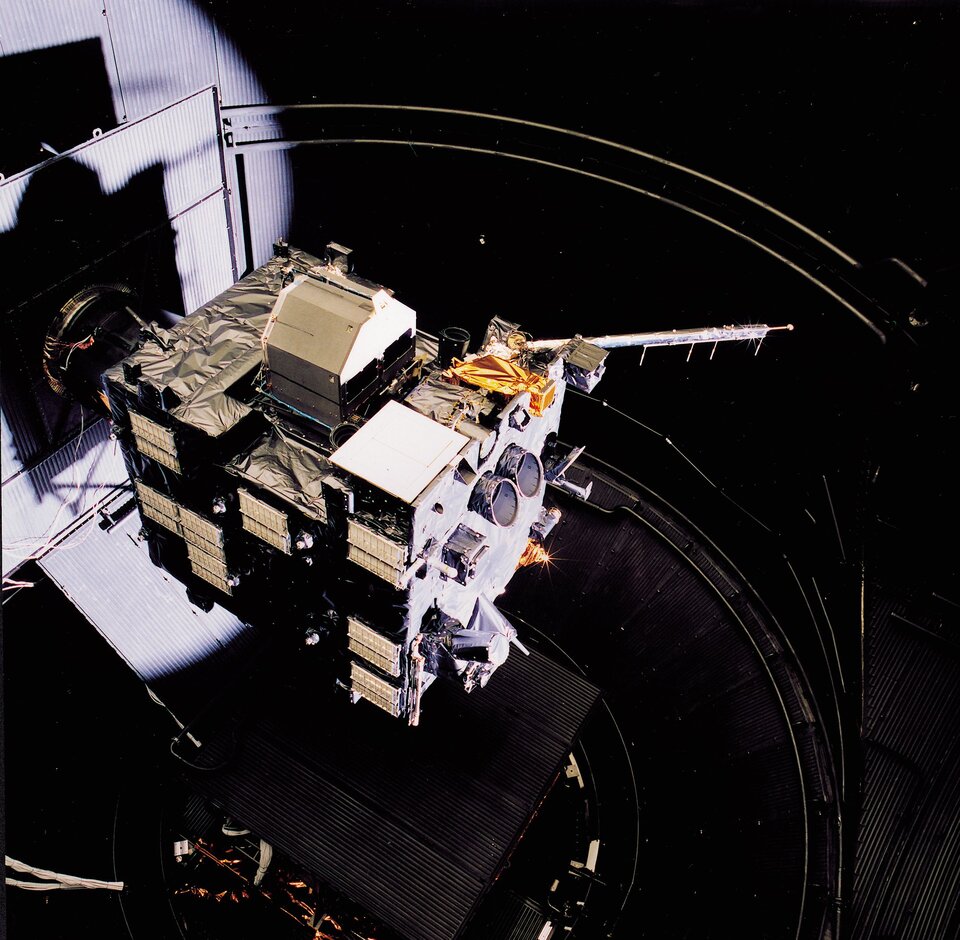
Rosetta was selected as a mission in 1993. The spacecraft has been built by Astrium Germany as prime contractor. Major subcontractors are Astrium UK (spacecraft platform), Astrium France (spacecraft avionics), and Alenia Spazio (assembly, integration, and verification). Rosetta’s industrial team involves more than 50 contractors from 14 European countries, Canada and the United States.
Scientific consortia from institutes across Europe and the United States have provided the instruments on the orbiter. A European consortium under the leadership of the German Aerospace Research Institute (DLR) has provided the lander. Rosetta has cost ESA EUR 770 million at 2000 economic conditions. This includes the launch and the entire period of development and mission operations from 1996 to 2015. The lander and the experiments, the so-called 'payload', are not included since they are funded by the member states through scientific institutes.
Note to editors
Europe is a leading pioneer in comet exploration. In 1986, ESA’s Giotto spacecraft performed the closest comet fly-by ever achieved by any spacecraft (at a distance of 600 kilometres from Halley). It sent back wonderful pictures and data that showed that comets contain complex organic molecules. These kinds of compounds are rich in carbon, hydrogen, oxygen, and nitrogen. Intriguingly, these are the elements which make up nucleic acids and amino acids, which are essential ingredients for life as we know it. Giotto continued its successful journey and flew within about 200 km of Comet Grigg-Skjellerup in 1992. Now scientists will be eagerly waiting to be able to answer some of the fascinating new questions that arose from analysing the exciting results from Giotto.
Other past missions that have flown by a comet are: NASA’s ICE mission in 1985, the two Russian Vega spacecraft and the two Japanese spacecraft Suisei and Sakigake that were part of the armada that visited Comet Halley in 1986; NASA’s Deep Space 1 flew by Comet Borelly in 2001 and NASA’s Stardust, which flew by Comet Wild 2 earlier this month and has captured samples of the comet’s coma to be returned in 2006. Unfortunately NASA’s Contour launched in summer 2002 failed when it was inserted into its interplanetary trajectory. Later this year we shall also see the launch of Deep Impact, a spacecraft that will shoot a massive block of copper into a comet's nucleus.
For more information please contact:
ESA - Communication Department
Media Relations Service
Tel: +33(0)1 53 69 7155
Fax: +33(0)1 53 69 7690