EuTEF's scientific instruments
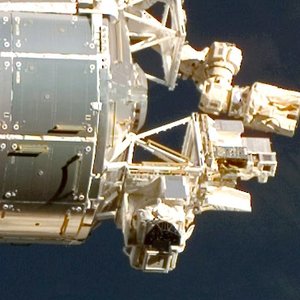
EuTEF has seven scientific instruments and two technical instruments.
DEBIE-2: Has three detectors which register encountered debris, e.g. micrometeorites and particles or dust of man-made origin. Each sensor contains three plasma detectors and two piezoelctric detectors. The impact on a thin aluminium foil over the sensors generates signals that the detector can process. The piezoelectric detectors are impact and pressure sensitive and they are coupled to the foil to measure the energy released upon impact. Impacts are registered via wire grid (25 microns thick) and these signals are stored electronically. Even though data has been registered electronincally throughout the stay outside the ISS, the sensors will be carefully examined after return.
DOSTEL: (Dosimetric Telescope) is a charged-particle telescope for registration of harmful radiation in space. It monitors the particle flux, dose rate and linear energy transfer, spectra of radiation from the Van Allen belts, deep space and the Sun. The dosimeter technique used has been applied on numerous earlier space missions. DOSTEL was recently a part of the Matroshka facility in the external location on the Station, where it was placed on top of the Matroshka mannequin that was attached to the exterior surface of the Russian Zvezda module for 539 days between 2004 and 2005.
EXPOSE-E: The exposure of a multitude of samples to hostile space conditions has brought highly important knowledge about the long-term survival of diverse living organisms. The last such experiment package was flown in Biopan on Foton M-3 in September 2007. During EXPOSE-E’s 18 months on orbit, not all samples have been exposed for the same length of time. The facility has a number of controllable mechanisms that allow manipulation of the machinery when necessary. In addition, in the case that over-heating threatens, the lids over the sample trays could be closed.
EXPOSE-E’s experiment packages:
Proces: Studies the effect of solar UV on amino acids and other organic compounds placed in terrestrial orbit. This experiment is about discovering how life could have arisen on the basis of very primitive chemical compounds.
Adapt: Exo-biologists are, among other things, concerned with the ability of micro organisms to travel in space, embedded in micrometeorites for example, and to continue life on another planet than the one they originated from. The Adapt experiment is looking at whether these micro-organisms respond to the long-lasting harsh UV radiation that is lethal for most living matter, by increasing their resistance in one way or another.
Protect: Investigates the resistance of spores to the space environment, also in terms of the degree of damage they experience and how and if they are able to repair this damage.
Life: EXPOSE-E accommodates lichens, fungi and symbionts (organisms that live in close, prolonged association). Similar experiments with organisms particularly resistant to extreme environment were flown in Biopan, attached to the outside of the Foton capsules.
- Seeds: Uses Arabidopsis thaliana seeds, which come from a plant for which the entire genome is documented and is used widely in such studies. Seeds are exposed to space and will be genetically examined post-flight, for examination of essential functional qualities, and an assessment of damage to the genetic material will be performed.
FIPEX: Flux (Phi) Probe Experiment. The space environment, in this context in particular the aggressive atomic oxygen and the temperature variations are in focus in for the FIPEX facility. FIPEX type sensors have been flown on several earlier missions for measurement of low concentration oxygen. With those early commercial ceramic oxygen sensors the distinction between O2 and the atomic version O was not possible. FIPEX has that ability. Mainly the atomic oxygen and in particular the ionized O+ is of special interest due to its highly aggressive corrosive character, where e.g. spacecraft surface materials such as Mylar and Capton react very vividly with O+, whilst metals apart from silver and osmium do no react significantly. The high-energy ionizing UV radiation is splitting O2 into two oxygen atoms, this formation mainly taking place between 80 and 160 km altitude in the atmosphere.
MEDET: (Material Exposure and Degradation Experiment) Past experiments, with degradation measurements only, have not always exhibited real in-space degradation effects as samples are often cured by oxygen in the air after their return. Moreover, the degradation dynamics, combined effects and saturation processes are not fully understood. Ground based simulation experiments have been performed, which are often very complex arrangements. It is however known, that the simultaneous existence of atomic oxygen, thermal cycles and micro-meteorites are much more serious than each environment alone.
The effect of a combination of space environmental temperatures and radiation on the material in question are investigated - an environment overall, that can not very well be imitated on Earth
PLEGPAY: (Plasma Electron Gun Payload) The PLEGPAY facility has a few basic components in order to generate the data expected from it. The main question is focused around electrostatic charging and discharging of gases in low Earth orbit on large space structures, identifying a potentially fatal problem for spacecraft electronics. The most effective technology for avoiding unwanted and uncontrolled events is based on hollow cathode technology which consists of a cavity closed at one end. This is essentially the system that PLEGPAY provides for controlled experiments with variations in gas flows.
TRIBOLAB: The Tribology Laboratory instrument aims to test solid and lubricant systems in space, which have proven to be ideal candidates on ground, in particular the effects of microgravity, vacuum and launch, as well as ISS environment and collateral radiation effects. The instrument hosts three different experiments:
- Fluid lubricant experiment on test and verification of labyrinth seal and vent design;
- Tribological evaluation of coatings and surface treatment
- Evaluation of thermal sprayed solid lubricant coatings
The two technical instruments are:
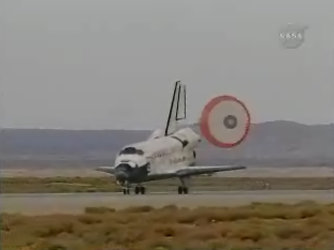
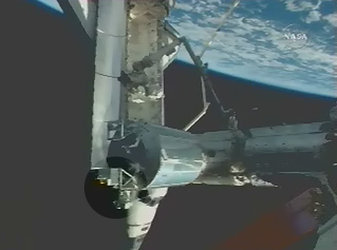
EuTEMP: Records the environmental temperature at all times. It has measured the temperature profile during the ascent to orbit on the STS-122 flight, during the transfer to Space Shuttle Discovery's cargo bay during STS-128 and for one day inside the cargo bay.
EVC: The Earth Viewing Camera is a technology demonstrator, testing the usability of commercial digital cameras for usage in space. It has been taking photos of Earth during the stay.