Jules Verne - an extraordinary space traveller
Over thirty international media representatives witnessed yesterday the christening of the first Automated Transfer Vehicle at ESTEC. Due for launch in 2007, the first spaceship has been named "Jules Verne" in honour of the 19th century French author who fascinated the minds of million of young people and inspired space scientists and explorers with his extraordinary voyages: From the Earth to the Moon, 20 000 leagues under the sea, Journey to the Centre of the Earth, to name just a few.
"Verne's fantastic stories gave us something to dream about: the future", said Robert Laine, ESA's ATV Project Manager, at the ceremony. "We at ESA are making the future become today's reality with our space freighter for the International Space Station", he added.
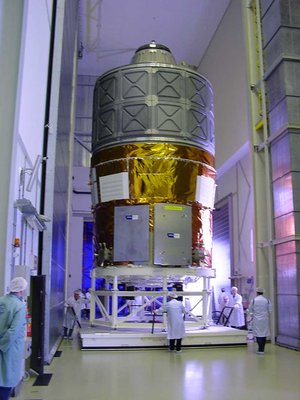
The Jules Verne, Europe's new multifunctional spacecraft designed to supply the International Space Station, was on view in fully stacked pre-launch configuration, at ESA's Research and Technology Centre, ESTEC (NL) on 9 April.
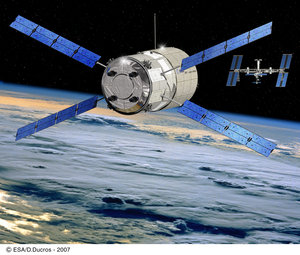
The International Space Station requires regular deliveries of equipment for scientific and commercial utilisation, fuel to raise its altitude, spare parts, and food, air and water for its permanent crew. From the first operational flight of the ATV in 2007, Europe's most challenging spacecraft will play a vital role in station servicing.
Depending on the operational lifetime of the Space Station, ESA will build at least 7 ATVs. The project involves 30 companies from ten European countries under the prime contractorship of EADS Launch Vehicles (France), which is also overseeing 8 companies from Russia and the United States participating in the development of the spacecraft.