Cutting-edge spacecraft
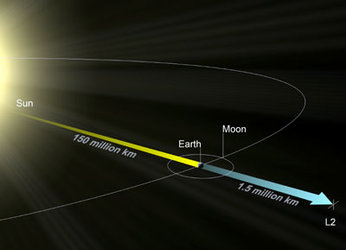
Herschel was stationed at the second Sun-Earth Lagrange point (L2), 1.5 million km from Earth. This point is theoretically stationary in space with respect to the Earth and Sun, which meant that for Herschel, Earth and the Sun were always in the same general direction.
This provided a stable thermal environment and a good view of the sky. Since the Earth was far away, Herschel was also not disturbed by its radiation belts.
At the same time, the spacecraft's position in space and the resulting temperature extremes made the task of optimising the work environment for the instruments a challenge.
The Herschel spacecraft has heritage from the successful ESA Infrared Space Observatory (ISO). It was been improved and optimized for a more distant and more favourable orbit and its complement of instruments.
Modular design
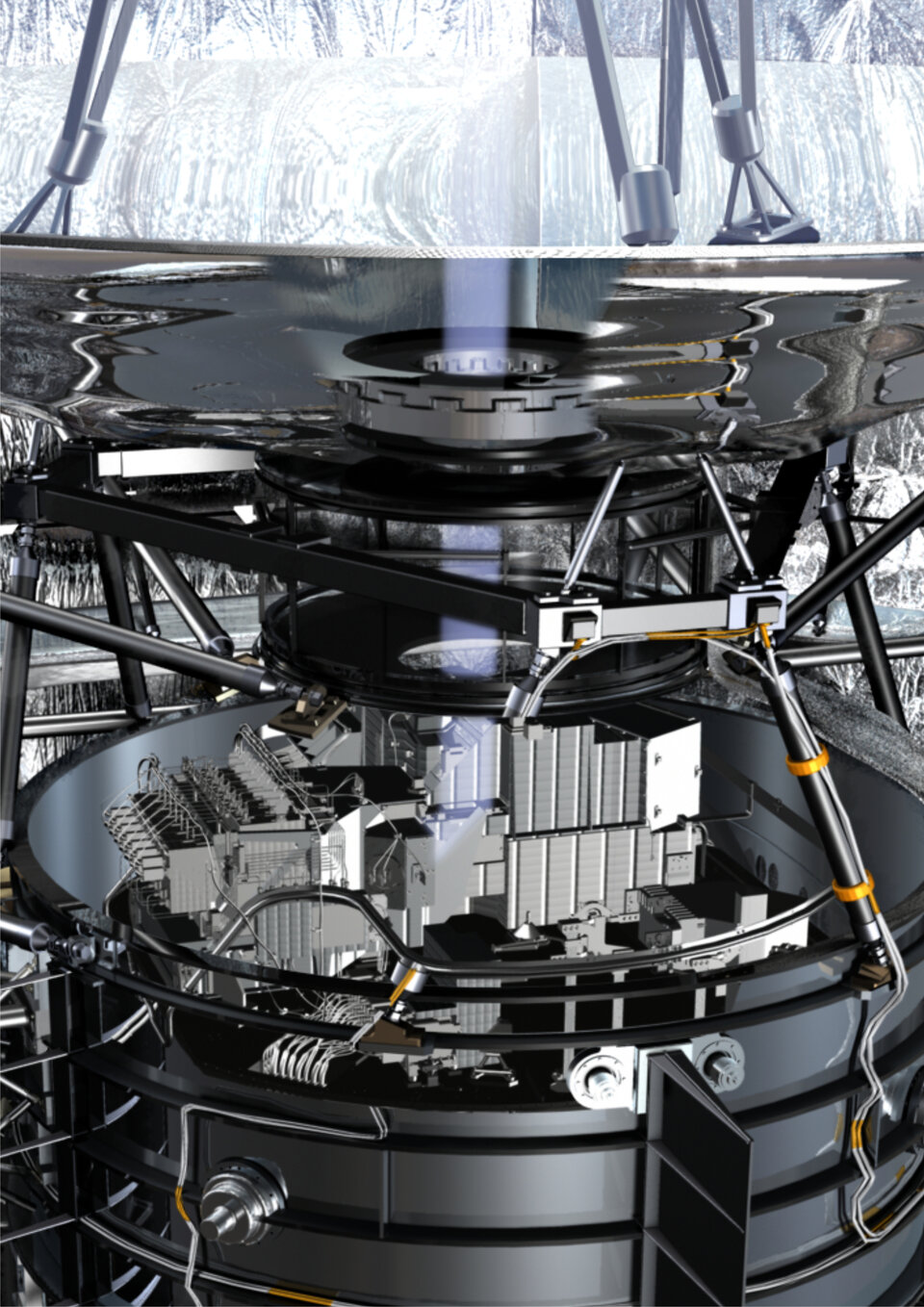
The Herschel satellite was composed of three sections.
First the telescope, which had a 3.5 m-diameter primary mirror protected by a sunshade. The telescope focused light onto three scientific instruments; their detectors were housed in a giant thermos flask, known as a cryostat.
The cryostat provided the interface and cryogenic environment for the instrument focal plane units, and supported the telescope, the solar array and telescope sunshade, and a unit of the Heterodyne Instrument for the Far Infrared.

Inside the cryostat, Herschel's detectors were kept at very low and stable temperatures, necessary for the instruments to operate. The cryostat contained liquid superfluid helium at temperatures lower than –271°C, which made the instruments as sensitive as possible. The instruments detectors and the cryostat made up the second section, the payload module.
The infrared detectors were cooled to extremely low temperatures in order to work, in fact close to absolute zero (–273.15°C or 0 K).

All three Herschel instruments were housed inside and cooled by the cryostat which was filled at launch with more than 2300 litres of superfluid helium kept at 1.65 K, i.e. –271.5°C. Further cooling – down to 0.3 K – was required for the SPIRE and PACS bolometeric detectors. The role of the cryostat was fundamental because it determined the lifetime of the observatory.
Superfluid helium evaporates at a constant rate, gradually emptying the tank. In the case of Herschel, it exhausted its supply after about four years after launch.

At that moment, the temperature of the instruments started to rise and Herschel could no longer perform observations. However, the data that Herschel has supplied will keep astronomers busy for decades.
The third element of the satellite was the service module located below the payload module. It housed the instrument electronics and the components responsible for satellite function, such as the communication hardware. The service module housed the payload electronics that do not need cooling, and provided the necessary subsystems: power, attitude and orbit control, on-board data handling, thermal control and command execution, communication, and safety.