Images of Saturn’s small moons tell the story of their origins
Imaging scientists on the Cassini mission are telling a tale of how the small moons orbiting near the outer rings of Saturn came to be. The moons began as leftover shards from larger bodies that broke apart and filled out their figures with the debris that made the rings.
It has long been suspected that Saturn’s rings formed by the disintegration of one or several large icy bodies, perhaps pre-existing moons, by giant impacts. The resulting debris quickly spread and settled into the equatorial plane to form a thin disc surrounding the planet. And the small, irregularly shaped, ring-region moons were believed to be the pieces left over from this breakup.
Now, several years’ worth of cosmic images of Saturn’s 14 known small moons have been used to derive the sizes and shapes of most of them, and in about half the cases, even masses and densities. This information, published in the today’s issue of the journal Science, has led to new insights into how some of these moons may have formed.
The tip-off was the very low density of the inner moons, about half that of pure water ice, and sizes and shapes that suggested they have grown by the accumulation of ring material. The trouble was, these moons are within and near the rings, where it is not possible for small particles to fuse together gravitationally. So how did they do it? They got a jump start.
“We think the only way these moons could have reached the sizes they are now, in the ring environment as we now know it to be, was to start off with a massive core to which the smaller, more porous ring particles could easily become bound,” said Carolyn Porco, Cassini imaging team leader from the Space Science Institute in Colorado, USA. Porco is the lead author of the first of two related articles published week, in Science.
Simple calculations and more complicated computer simulations have shown that ring particles will readily become bound to a larger seed having the density of water ice. By this process, a moon will grow even if it is relatively close to Saturn. The result is a ring-region moon about two to three times the size of its dense ice core, covered with a thick shell of porous, icy ring material. To make a 30-km moon requires a seed of about 10 km.
Where did such large cores come from? And when did this all take place?
“The core may in fact be one of the remnants from the original ring-forming event,” said co-author Derek Richardson, professor of astronomy at the University of Maryland, College Park, USA “which might have been left intact all this time and protected from additional collisional breakup by the mantle of ring particles around it.”
Just exactly when the rings formed is not known. “But it is not out of the question that the moons date back to the time of ring formation,” said Porco.
The researchers show that the cores of Pan and Daphnis, which orbit within gaps in the outer A ring, were large enough to open narrow gaps. Accretion, or accumulation of material, they say, probably occurred quickly. The moons grew and their gaps widened, achieving their present sizes before the gaps were completely emptied of material, and probably before the local rings reached their present thickness.
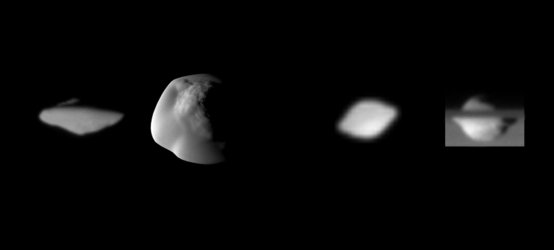
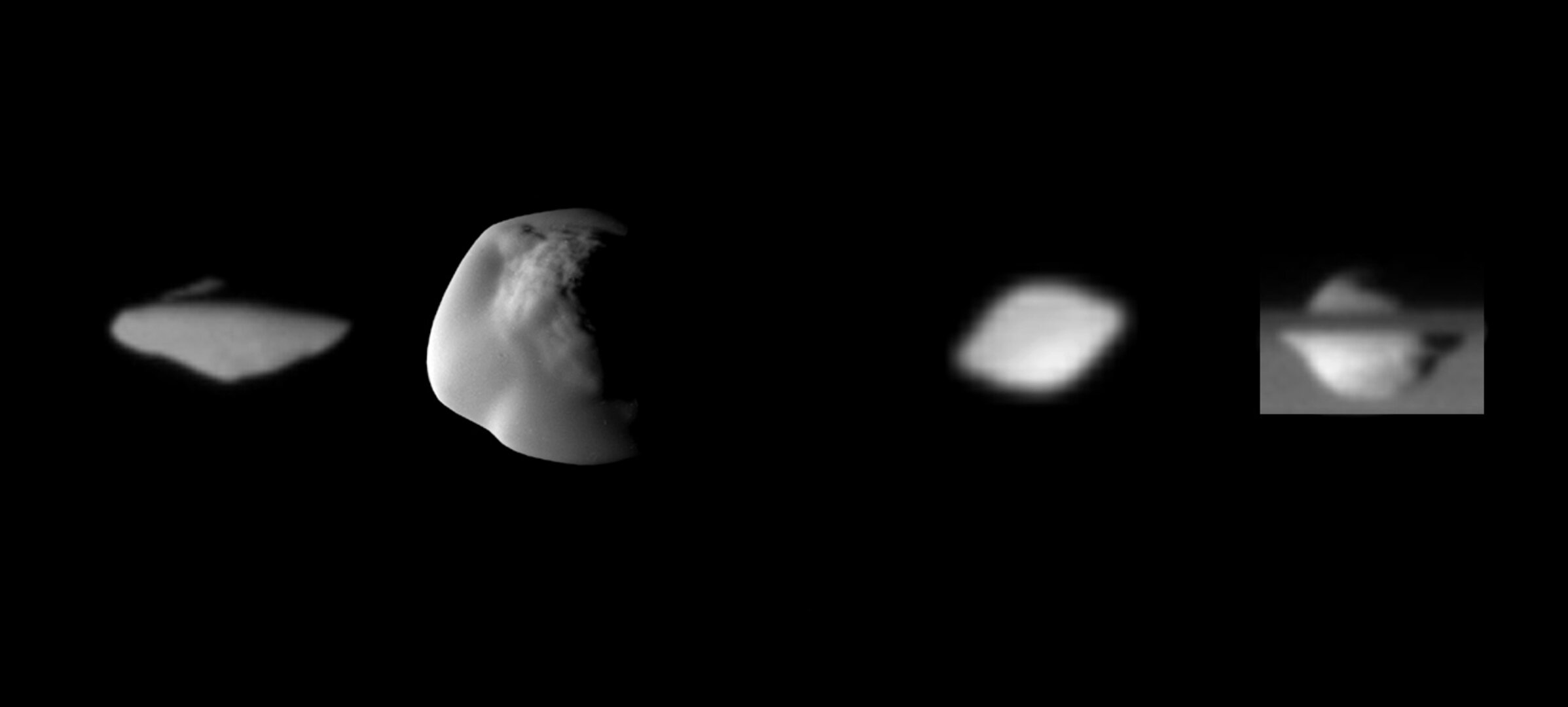
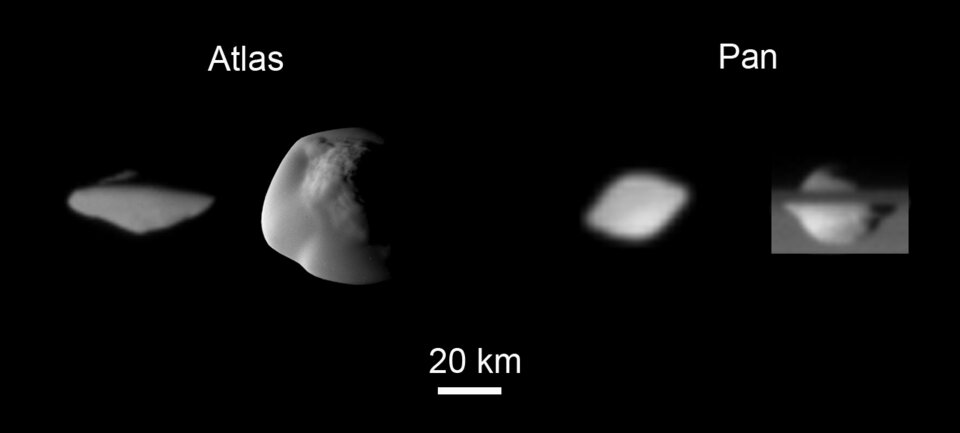
So how did Pan in the main rings, and Atlas, which orbits just beyond the outer edge of the main rings, get the prominent equatorial ridges that make them look like flying saucers? The second paper reports evidence for a secondary stage of accretion that occurred after the moons’ growth was completed and after the rings flattened to their present 20-m thickness.
“Our computer simulations show that the ridges must have accreted rapidly when Saturn's rings were thin, forming small accretion disks around the equators of Pan and Atlas,” said Sebastien Charnoz, lead author and an associate of imaging team member Andre Brahic at the University Paris-Diderot and CEA Saclay, in France. “The ridges might be the remains of ‘fossilised’ accretion disks, fundamental structures seen at all scales in the universe, from planetary rings to galaxies.”
Notes for editors:
The Cassini-Huygens mission is a cooperative project between NASA, ESA and the Italian Space Agency.
The Jet Propulsion Laboratory (JPL), a division of the California Institute of Technology, manages the Cassini-Huygens mission for NASA's Science Mission Directorate. JPL designed and assembled the Cassini orbiter. ESA developed the Huygens Titan probe, while ASI managed the development of the high-gain antenna and the other instruments of its participation. The imaging team is based at the Space Science Institute, USA.